| | In this edition: Candidates contend with their past selves, immigration gets an affordability remix,͏ ͏ ͏ ͏ ͏ ͏ |
| |  DALLAS, TX DALLAS, TX |  JEFFERSON CITY, MO JEFFERSON CITY, MO |  DERRY, NH DERRY, NH |
 | Americana |  |
| |
|
 - N.H. postmortem
- R.I. outlook
- Dallas convention opens
- Affordability, immigration-style
- Abortion-rights ads
|
|
 Candidates who think they’ve escaped or explained their pasts keep having to explain comments that “resurface” online, again and again. Video of Texas Democratic Senate nominee James Talarico rejecting “tough on crime” policies in 2020 recently “resurfaced,” according to Fox News. More video of Talarico later “resurfaced,” this time of him thanking activists who drew the “link between climate change and white supremacy and capitalism.” He had company when tweets about 9/11, written and then deleted by Michigan Democratic Senate nominee Abdul El-Sayed, “resurfaced” in the New York Post. Republicans are not immune to this phenomenon. Peter Oberacker, a New York state senator running for Congress, watched his party cancel ad reservations after a “resurfaced 2015 Veterans Day Facebook post” appeared in Politico, honoring a grandfather who fought on the wrong side of World War II. Colorado gubernatorial nominee Victor Marx’s tale of a meeting with Satan happened many years ago; it “resurfaced” this week, via a podcast he recorded in 2020. “Resurfacing” is more than a shortcut for political reporters to explain why they’re serving up something old to their audience. It reflects the way so much of our modern discourse is made — by journalists and operatives skimming the waters of social media, noodling out content that long ago stopped getting delivered in a linear form. The overall progression here is familiar to anyone who read Douglas Rushkoff identifying and diagnosing the “narrative collapse” when Vine was young, TikTok hadn’t been founded, and most YouTube creators weren’t getting paid. Interesting information no longer needs to be part of a larger story; it now lives untethered to news or the news cycle. |
|
New Hampshire primaries set up Sununu-Pappas |
 Brian Snyder/Reuters Brian Snyder/ReutersThe New Hampshire primaries this week gave the Senate GOP nomination to former Sen. John Sununu, seeking the seat he vacated in 2009, while Democrats tapped Rep. Chris Pappas. Both men had to push past primary challengers — former Massachusetts Sen. Scott Brown and progressive scientist Karishma Manzur, respectively. “Israel can take care of itself,” Manzur said at her final televised debate with Pappas, who said that he continued to support a “two-state solution” in the region. He also said he would have voted, like retiring Sen. Jeanne Shaheen, to limit some arms sales to the country. Both candidates won around two-thirds of the vote, with Sununu carrying every one of New Hampshire’s towns and Pappas losing just two. Democratic turnout was higher, driven by the race for Pappas’ seat — won by Stefany Shaheen, the senator’s daughter, who had never sought office outside of Portsmouth before running. Israel politics flared up in that race, too, as Shaheen attacked the “AIPAC donors” supporting her rival, consolidating enough of the progressive vote to pull ahead. Republicans see the races for both open seats as competitive, despite the national environment. Democrats have not invested much in the race for governor, where Cinde Warmington, the runner-up in their 2024 primary, won the nomination to challenge Gov. Kelly Ayotte. Read Burgess Everett’s reporting on the Senate race. → |
|
|
Rhode Island’s primaries could bring real upheaval |
 McKee Campaign Team/X McKee Campaign Team/XRhode Island Democrats could oust their governor today and replace the mayor of Providence with an outspoken democratic socialist. Gov. Dan McKee, who won just 33% of the vote in a three-way primary for his current term, has badly trailed former CVS executive Helena Foulkes in their rematch — a race that McKee’s tried to turn into a battle between “working-class” values and “a corporate CEO.” The two Democrats haven’t concealed their mutual contempt. McKee refused to take Foulkes’ concession call, on camera, when he beat her four years ago. In their final debate last month, when McKee accused his rival of attacking the state when she highlighted its lagging growth and education numbers, she corrected him: “I am certainly not disparaging the state of Rhode Island. I am disparaging its governor.” In Providence, the campaign’s been less personal. Mayor Brett Smiley vetoed a rent cap; state Rep. David Morales is promising to enact rent control if he wins. The challenger has led in some polling, as the mayor took credit for the city’s declining rating and warned that his housing plans would backfire. Smiley has solidly outspent Morales, while McKee entered the race’s final days being outspent by Foulkes. Lt. Gov. Sabina Matos and Sen. Jack Reed also face progressive primary challengers. |
|
The Democratic cash problems underlying optimism in Dallas |
 Jessica Koscielniak/Reuters Jessica Koscielniak/ReutersDALLAS — Republicans are gathering here for their two-day midterm convention, a Trump-led project that’s gotten attention for which battleground-seat candidates won’t show up. Few swing-state Republicans are making the trek to the American Airlines Center, where there’ll be hours of programming across two nights to sell the Trump record and push the party’s preferred “communism versus common sense” messaging. (It’s sometimes packaged as “common sense versus crazy.“) Democrats are gearing up to mock and clip whatever happens onstage. But they exited Labor Day with their own problem: Republicans, for the first time in more than a decade, are set to outspend them in a midterm election. And Democratic candidates in the sort of seats that the party wants to flip in a larger wave, like Brian Poindexter in northeast Ohio, have serious cash disadvantages against even underperforming GOP incumbents. “I’ve been telling everybody that whatever the polls say, you should assume you’re sailing to a five-point headwind, because they’re going to throw a bunch of money in races. They’re going to play a bunch of dirty tricks at the end of the cycle,” said Rep. Sean Casten, D-Ill., who won his seat in 2018, when Democrats were able to outspend the GOP almost everywhere. |
|
Cost-of-living message helps with deportation arguments, per new poll |
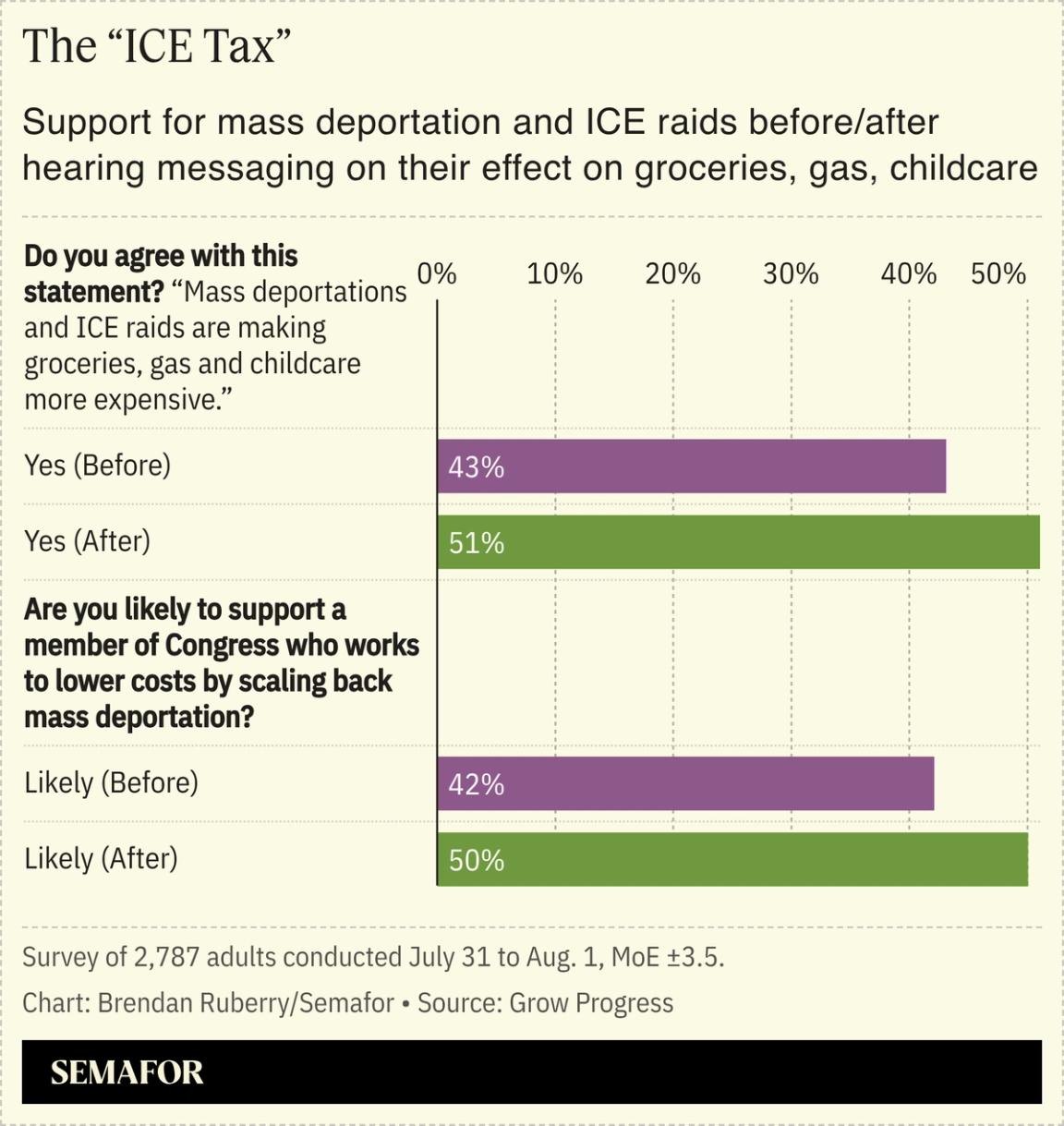 The pro-immigration group America’s Voice, founded in 2008 at a moment when both parties were driving towards big change, has lately struggled with Democrats’ loss of credibility on “border security.” In 2024, its co-founder Frank Sharry regretted that voter sentiment on the topic had raced so far to the right. One answer to that problem lies in this polling by the group. Respondents were asked first about “mass deportation,” then about its effect on prices, echoing research from liberal think tanks about the effects of deporting skilled labor. When respondents were told that deportations were increasing costs, their views turned negative, with higher-income voters moving the furthest. Voters earning more than $100,000 per year shifted 26 points against candidates who supported mass deportation after learning about the costs. This is helpful information for Democrats, but it doesn’t alter the Trump administration’s strategy. The vice president and treasury secretary have argued that mass deportation is driving up wages by shrinking the labor force. |
|
Abortion-rights ad battles resume in Virginia and Missouri |
 Virginians for Safe Repro Policy/YouTube Virginians for Safe Repro Policy/YouTubeFour years ago, with the ink still wet on Dobbs v. Jackson, Democrats ran on abortion rights against Republicans who were shockingly unready to defend their positions. One year later, Virginia Republicans tried to prove that some limits on abortion — a ban after 16 weeks of pregnancy — could win a majority, by running candidates who supported those limits. That didn’t work, either. Conservatives are having the argument again, betting that Democrats’ support for no state-approved abortion limits proves alienating when voters understand it. “Vote No on One,” the first ad from Virginians for Safe Reproductive Policy, uses five women (and one baby) to warn that voters shouldn’t add abortion rights to the state constitution because it would let “non-qualified physicians perform riskier abortions.” In Missouri, Republicans are trying to pass a ballot measure that would negate the abortion legalization amendment voters approved in 2024. One of the first ads about it is a taxpayer-funded message from the attorney general’s office, warning that under current law some abortion clinics are “not required to meet the same medical standards” as hospitals. |
|
 Leah Millis/Reuters Leah Millis/ReutersWhat do Democrats think when the president orders private companies to give the government a share of the profits? Sometimes, they’re quiet about it. Sometimes, they grouse that ideas that the Tea Party-era GOP denounced as “socialism” have been adopted by MAGA with no internal debate. And sometimes, they think ahead. Politico’s Joseph J. Schatz beat me to the story of how Democrats are thinking about the expansion of the TARP-era idea of the government taking stakes in major companies, a real sleeper issue once people start declaring for the presidency and debating their ideas. (Which will be in two months.) |
|
 It’s been a month since the death of John Crowley, one of the great fantasy writers of his generation. If you haven’t heard of him, it’s understandable. The genre authors who build real fame tend to do so after one of their books is adapted into a movie. and the sort of science fiction, fantasy, and horror novels that get adapted tend to tell heroic stories that work better onscreen. “If you want to keep on writing those kinds of books,” Crowley said in 2009, “you have to supply to those readers the kind of stuff that they want and need in a book.” It would make sense to start with one of Crowley’s short story collections, or the novella collection that includes Engine Summer, the kind of twisty, un-adaptable story of civilization after collapse that never gets adapted for TV. Go for Little, Big next, and don’t be worried that reading his “best” book will make the rest feel pale. |
|
|


