





 |
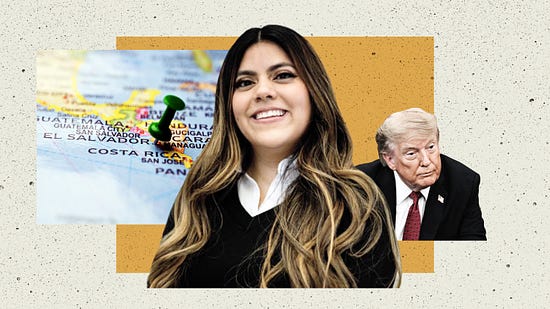
DAYSI GONZÁLEZ HAS WORKED WITH some of the biggest names in Democratic politics—Senate candidate James Talarico, Sen. Ruben Gallego, Rep. Alexandria Ocasio-Cortez, and more. She’s done so as a partner at the consulting firm Solidarity Strategies and as a constituency mail vendor for the Democratic Congressional Campaign Committee, where she’s working on every competitive race with a Latino engagement program ahead of the November midterms. These include top Democratic opportunities in Texas, California, Nevada, and New Mexico.
If Democrats take back the House in a blue wave, some of that success will be owed to the work Daysi has done. When the time comes, though, she will be trading whatever comfort she takes in professional success for the cold hard reality of Trump’s deportation zealotry.
That’s because Temporary Protected Status for Salvadorans is in serious limbo. It was set to expire on September 9—this past Wednesday—but is now extended for some undefined period. Daysi, knowing that her time in the United States is running out, is planning to self-deport to a country she barely remembers.
“It’s so sad that she will have done so much with a team of people to elect ten new Democrats . . . and could be fearing for her life,” Daysi’s boss, Democratic strategist Chuck Rocha, told me. “One of the most powerful Latina operatives in this country, because we lost an election, now has to self-deport to protect her and her sister.”
Like many immigrants who “pass” as native-born Americans, Daysi lives a compartmentalized life. On work calls, her peers and colleagues all tell her the same thing: I can’t believe this is happening to you. There’s not much Daysi can say to that, so she just does her job.
“I’m terrified all the time, but I still need to work,” she told me in a video interview. “I have people depending on me.”
Daysi was 5 years old when she came to the United States in 2000. Shortly after she arrived, a 7.7-magnitude earthquake off the coast of El Salvador led the Bush administration to grant Temporary Protected Status to Salvadorans in the United States. The order affected some 150,000 to 200,000 people.
Congress established the category of Temporary Protected Status in the Immigration Act of 1990. It is a tool the government can use to allow people from countries experiencing extraordinary crises to legally remain in the United States; it can be applied in increments of six, twelve, or eighteen months. Importantly, TPS does not provide a pathway to citizenship. Ongoing insecurity and civic instability in El Salvador, including gang violence, made the Central American state the country with the longest-running TPS designation.
For Daysi, TPS was a fairly mundane administrative reality; to keep her status up to date, she had to occasionally take long trips to update her biometrics. In exchange for doing that, she received stability and security for the first part of her life.
That all changed when Donald Trump was elected. Not in 2024 but in 2016. After his first win, Daysi sobbed for an hour in the shower. Her fears proved well founded. The first Trump administration terminated TPS for El Salvador, among others, in 2018. That termination wound its way through court challenges and injunctions. In 2021, Sanchez v. Mayorkas affirmed that TPS could not be the basis for a green card application. The Biden administration rescinded the TPS termination in 2023, but Salvadorans with TPS—who by this point had lived in the United States for over two decades—were on shaky ground.
“One of the last things Biden did was redesignate El Salvador for TPS. That’s what bought me these last eighteen months,” Daysi told me.
The very day Trump took office for a second time, he issued an executive order “Protecting the American People Against Invasion.” It called on TPS programs to be curbed, making it clear where his second administration stood. Eventually, those TPS terminations were sanctioned by the Supreme Court.
I asked Daysi how she has coped with the uncertainty.
“I . . . shut down for all of last year when my TPS was in process,” she replied. “It technically wasn’t expired; I could still keep my job. But I couldn’t renew my license, I couldn’t get a REAL ID. I was landlocked and couldn’t travel.”
THOUGH DAYSI WAS LARGELY RESIGNED to her fate—and her plans for self-deportation—the nearing of the end of her TPS status instilled some fresh new emotions. There was the now-familiar stress and anxiety. But there were also green shoots of hope.
A USCIS posting this week came right at the September 9 deadline for TPS to end. It read that “an announcement on El Salvador’s TPS will be made at the appropriate time. Until such announcement is made, Salvadoran individuals present in the U.S. under TPS retain protection including work authorization.”
Daysi believes that period could potentially buy TPS holders like herself an additional six months in the country. Guidance from the counsel for the National TPS Alliance says it is legally at least sixty days. She still plans to self-deport, she told me. But she now believes she will do so after this November’s election.
“My license is still expired, a bunch of stuff was contingent on TPS. My sister lost her job, I don’t know if I can cover the mortgage by myself for more than six months, so I’m taking this week to figure things out,” she told me. But she made clear that a life in limbo takes a serious toll, which is why she is still considering self-deportation.
“I don’t know if I can continue living like this,” she said after the announcement. “The emotional and physical damage of the last few months, I don’t know how bad it is.”
That her hopes have been lifted at the eleventh hour is another illustration of the mental anguish that the Trump administration has placed on immigrant communities.
For months, Daysi had been trying to dull her optimism and get into a headspace where she could leave the United States on her own terms.
She created a public record on Instagram, keeping a countdown of the days until her TPS expires. In a video exactly a month out, the unfairness of having an American life dangled before her for two and a half decades got to her.
“It just threw my life into this ten-year limbo,” she said in the video. “It’s irreparably damaged my mental health. It’s ruined plans, relationships—any sense of stability. . . . All I’ll say for now is that this really fucking sucks. It’s unfair, and I’ll probably crash out.”
The cleancut Daysi, who doesn’t smoke or drink, received a talking-to from her father for cursing in the video. Meanwhile, her mother worried that she was sharing her story too publicly.
But Daysi saw virtue in being public—the videos, she reasoned, offered a window into what hundreds of thousands are dealing with privately: the sudden demand to uproot their lives and leave almost the only country they have known.
Daysi also shared everyday moments that caused her heartache. In another video, she discussed losing her familiar health care provider. “If my favorite doctor doesn’t have availability before I have to leave, that’s going to break me,” she said.