
|



Why you should evaluate every AI agent before shipping to production — and how (Sponsored)
 |
If you’re shipping AI agents without offline validation, your users are the ones doing the testing. Get the practical framework for evaluating production-grade AI agents before they hit production.
Get the guide to learn how to:
Build annotated test datasets that cover core use cases, edge cases, and adversarial inputs
Design deterministic and LLM-as-a-judge evaluators that reflect real business impact
Trace multi-agent workflows end-to-end during experimentation to catch failures before users do
Prevent model drift by keeping your offline test environment aligned with production
Large Language Models (LLMs) are also software systems just like any other software system we may have encountered. But we cannot test an LLM the same way as an ordinary software system.
For example, a normal function in a software application can receive two numbers and always return the same number as the total. However, when we ask the same question twice to an LLM, it will most likely produce two differently worded answers. Both of those answers may be acceptable. But it makes evaluation tricky. To evaluate an LLM, we have to measure whether the application continues to behave properly across many situations.
“LLM-as-a-Judge” is one part of this evaluation process. It involves using one language model to assess the output generated by another language model. But a judge model isn’t enough on its own. A healthy LLM evaluation system combines several ingredients such as conventional software tests, carefully curated examples, automated checks, model-based judging, human review, and production monitoring.
In this article, we are going to look at the process of LLM evaluation in detail. Here’s what we will cover:
What does it mean for an LLM application to be healthy?
Why are ordinary tests not sufficient for LLMs?
The basic LLM evaluation loop
Golden datasets for repeatable tests of LLM behavior.
Automated metrics: Fast but limited checks
What does LLM-as-a-judge mean?
Different ways a judge model can evaluate an answer
Human evaluation and calibration
The evaluation stack
 |
What Does it Mean for an LLM Application to be Healthy?
When can we call an LLM healthy?
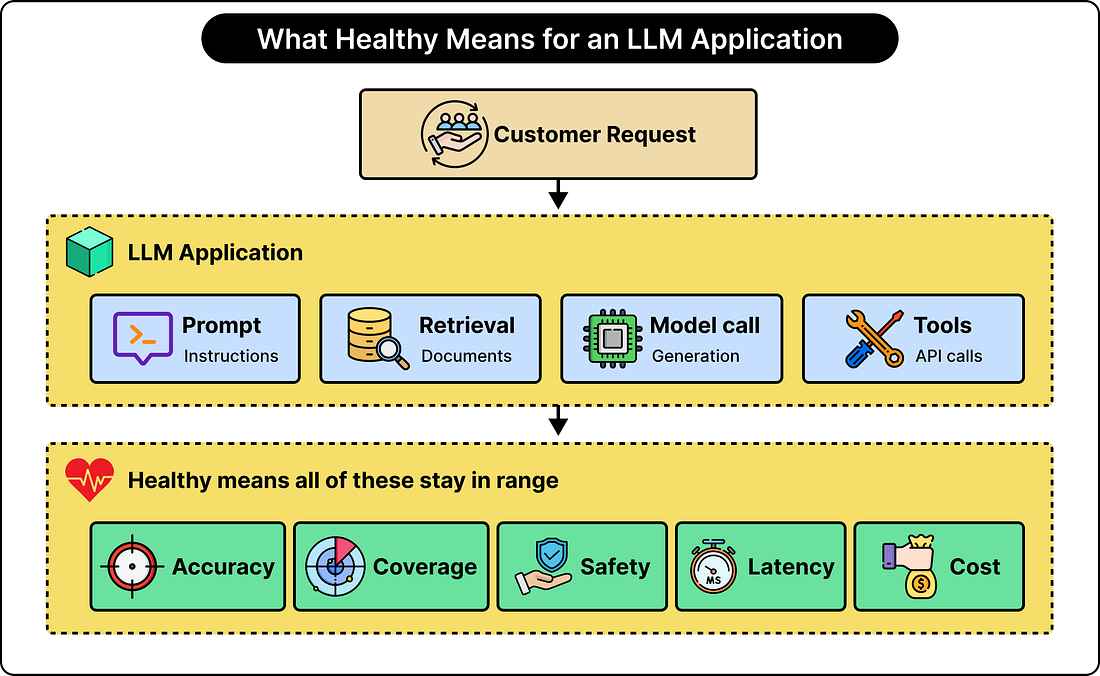
The answer is quite simple. An LLM is deemed healthy if it consistently generates useful results while remaining within acceptable limits for accuracy, safety, speed, reliability, and cost. For example, consider a customer-support assistant. We cannot say it is healthy by a single question such as “Did it return the correct output?”
We need to consider several different questions:
Did it understand what the customer was asking?
Was the answer factually correct based on the company documentation?
Did it answer the entire question?
Did it follow the required tone and format?
Did it avoid inventing policies that do not exist?
Did it refuse requests that it should not answer?
Did it respond within an acceptable amount of time?
Did the request cost an acceptable amount to process?
As we can see, these questions are all related to different dimensions of quality, where each dimension is important. We can have an assistant that is friendly and relevant, but it might generate factually incorrect answers. It might be accurate but so verbose that users can’t simply find the answer. It might produce excellent answers but take 30 seconds for every request. Therefore, while evaluating an LLM, we must measure multiple aspects of the system.
We also need to differentiate between the health of the LLM and the application. We can’t simply label the model as the source of all problems. The problems can be caused by various sources. For example, we might have an incorrect prompt, missing documents, poor retrieval logic, incorrect tool calls, stale data, or a change in the surrounding code.
Why Ordinary Tests Are Not Sufficient for LLMs?
Traditional software tests usually depend on deterministic behavior. If a function receives a known input, the test expects a specific output. For example:
Input: add(2, 3)
E