For over twenty years, the Translation Automation User Society (TAUS) and the Localization World (LocWorld) conferences have invited me to participate. Both events usually took place in the same city within a few days of each other. So when I saw this press release announcing that they were joining forces to launch “Vancouver Localization Week,” my first thought was, “Finally.”
TAUS was founded by Jaap van der Meer. He’s the first person I remember telling me that translation would someday become ubiquitous. He meant it would eventually happen automatically, everywhere practical. You wouldn’t need to open an app or hire someone to translate words. Translation capability would be built into whatever you were using (tools, appliances, systems, automobiles, consumer electronics, medical devices — you get the picture).
Generative AI has made Jaap’s prediction feel less theoretical, which is why I’ve been noodling on this topic.
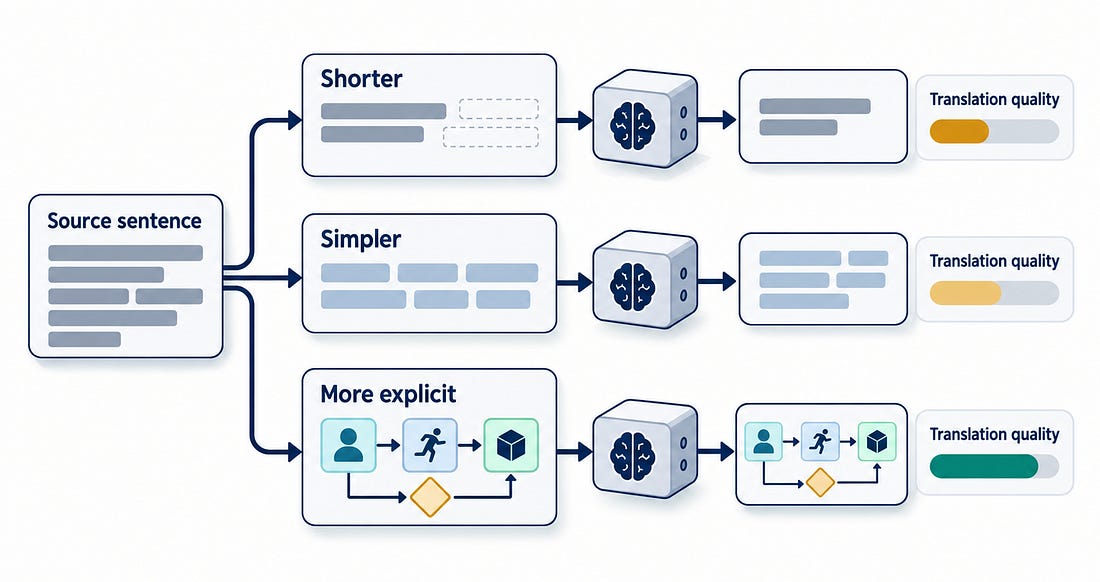
A 2021 study of neural machine translation pre-editing, by researchers Rei Miyata and Atsushi Fujita, found that making a source sentence’s meaning and structure more explicit improved translation quality more than making the sentence shorter or simpler.
The added explicit information isn’t always in prose itself. Translation systems can also gain insights from other sources (approved terminology lists, domain information, translation memory, document context, or other guidance) about how the source should be interpreted.
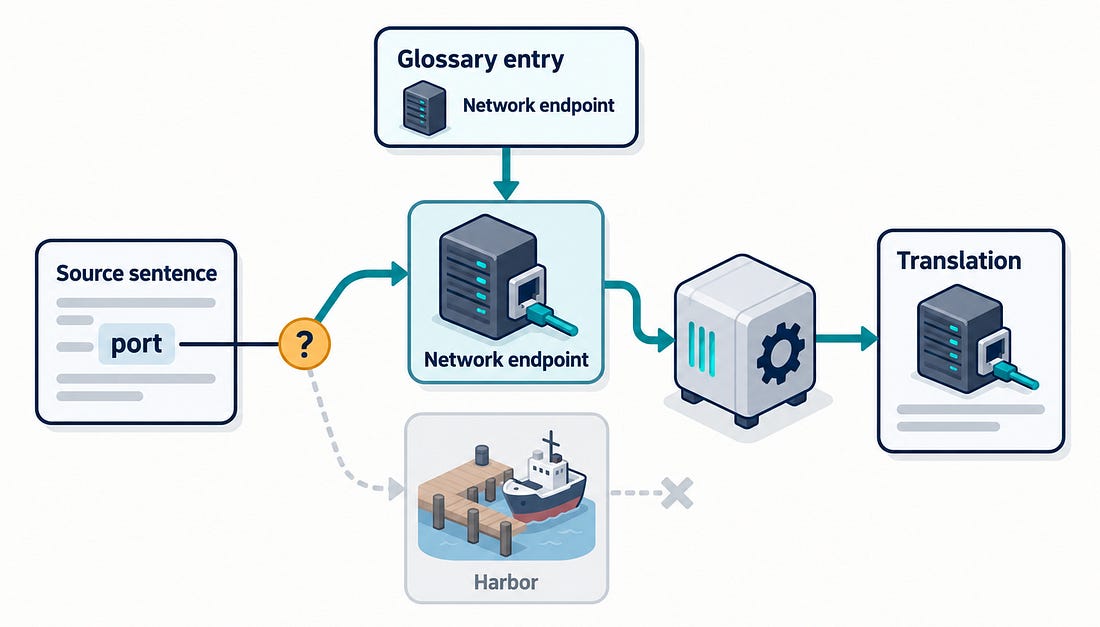
A glossary entry, for example, tells the system that “port” refers to a network endpoint rather than a waterside harbor; information the sentence being translated might not state explicitly.
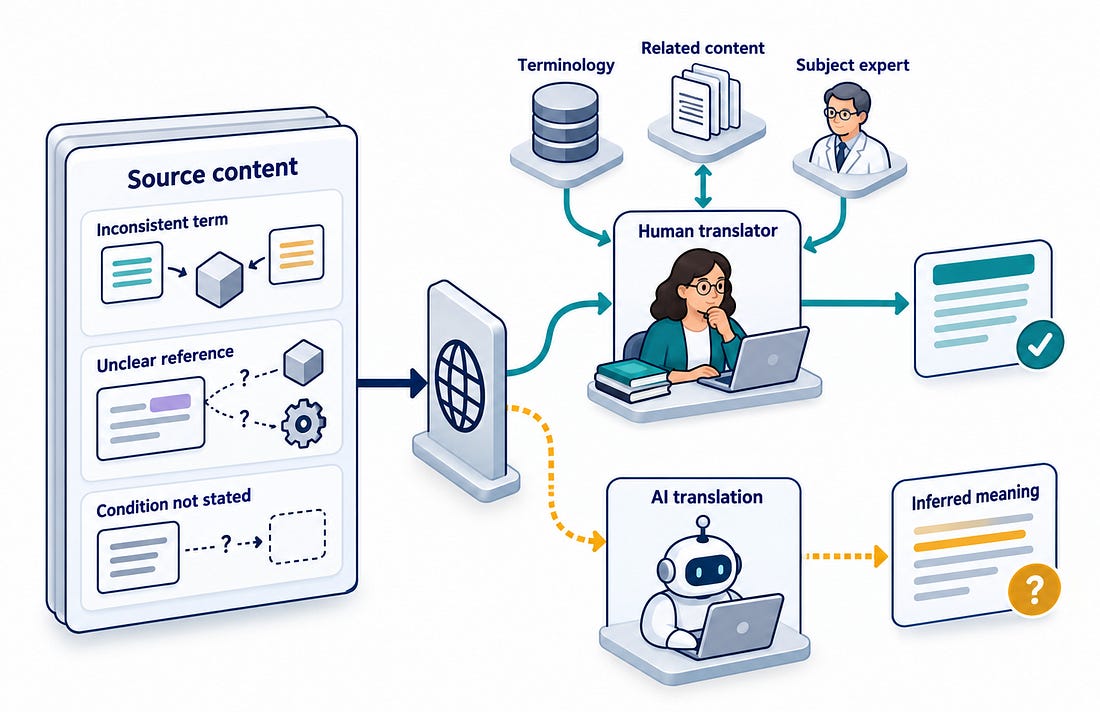
Localization pros often work to discover this kind of missing information. Translators determine which product state applies, resolve an unclear reference, or check which term the company has approved for use. As more and more companies attempt to automate content translation and localization, it becomes increasingly useful to capture that context once and make it available to the automated systems that need it (instead of asking someone to reconstruct it every time.)
I saw an early version of this issue last year at LocWorld in Monterey, where I moderated two panels. The first one focused on using linguistic intelligence technologies to reduce localization cost in the era of AI, the other on the intersection of large language models and technical writing. Both discussions showcased the work that happens before translation begins. Things like source quality, terminology, context, and the decisions made while content is being created).