| | In this edition: US defends Africa strategy and Libya deal, Kenya plots its energy future, and DRC r͏ ͏ ͏ ͏ ͏ ͏ |
| |  | Africa |  |
| |
|
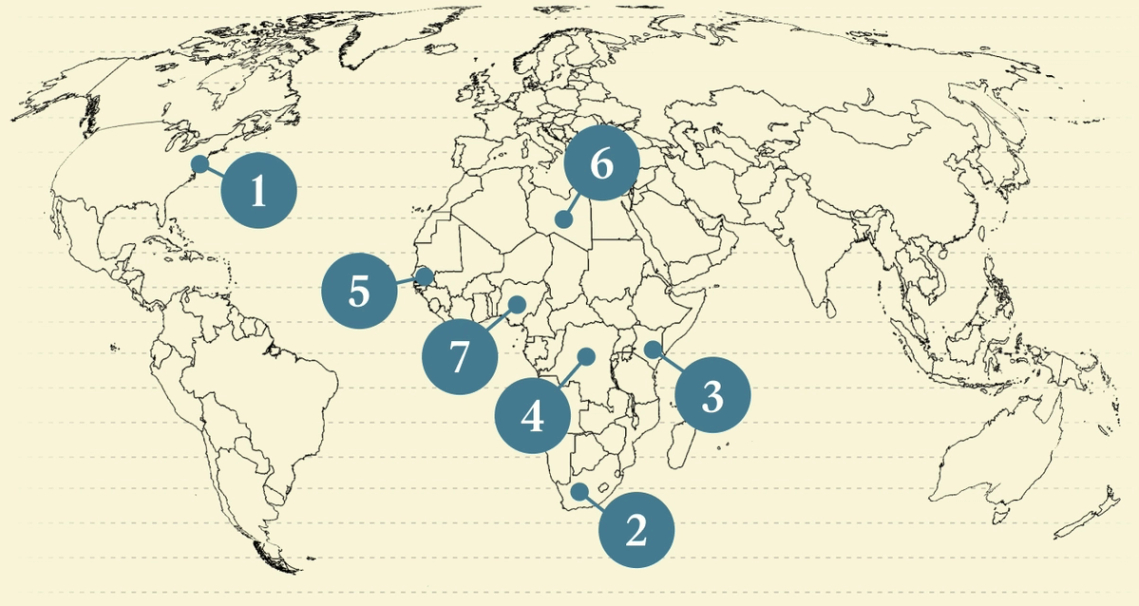 - US defends Africa strategy
- S. Africa investment freeze
- Kenya plans oil future
- Vaccine manufacturing push
- Data tackles risk premium
- US defends Libya deal
- Nigeria’s fiber optic rollout
 A Kenyan startup builds humanoid robotic arms |
|
 For decades, the debate around Africa’s natural resources has largely been over who gets the value from what the continent digs up and ships out. But at Semafor’s The Next 3 Billion summit in New York this week, the recurring theme was more nuanced. The question was what economic ecosystems can African economies build around their resources before they leave the continent? That means moving beyond extraction toward processing, manufacturing, infrastructure, energy, and the jobs that can come with them. It also reflects a changing approach to foreign capital. African governments increasingly want partnerships that build domestic capacity, rather than simply finance projects or provide an exit route for commodities. Nigeria’s trade minister Jumoke Oduwole put the ambition plainly when discussing the country’s talks with US companies on critical minerals, saying her government is looking for “partners that will make sure that the value chain development [and] the jobs are created on Nigerian soil.” DR Congo’s Prime Minister Judith Suminwa described diversification of both the economy and its foreign partners as a priority, saying partnerships should “bring a plus” to the country. The implication is that the choice is not necessarily between China, the US, Europe or the Gulf, but whether competition among them can be used to secure more lasting economic capacity. There is a compelling logic to that strategy. Countries that remain primarily exporters of raw materials are vulnerable to commodity cycles and capture relatively little of the value created farther down the supply chain. More refining, processing, power generation and transport infrastructure could create wider economic spillovers. But there is also a danger in making “value addition” the answer to every development problem. Processing minerals or refining oil requires enormous amounts of reliable electricity, transport infrastructure, capital, and technical expertise. In some cases, importing finished products may still be cheaper than producing them locally. And building a factory does not automatically create a competitive industry. The more interesting test, then, is whether Africa can turn its resource advantage into productive capacity without turning industrial policy into an expensive exercise in symbolism. The opportunity is real. The harder question is what African economies can build that will remain competitive after the foreign partners and commodity boom move on. |
|
| | Semafor Next 3 Billion • Exclusive |  | |
US presses Africa strategy |
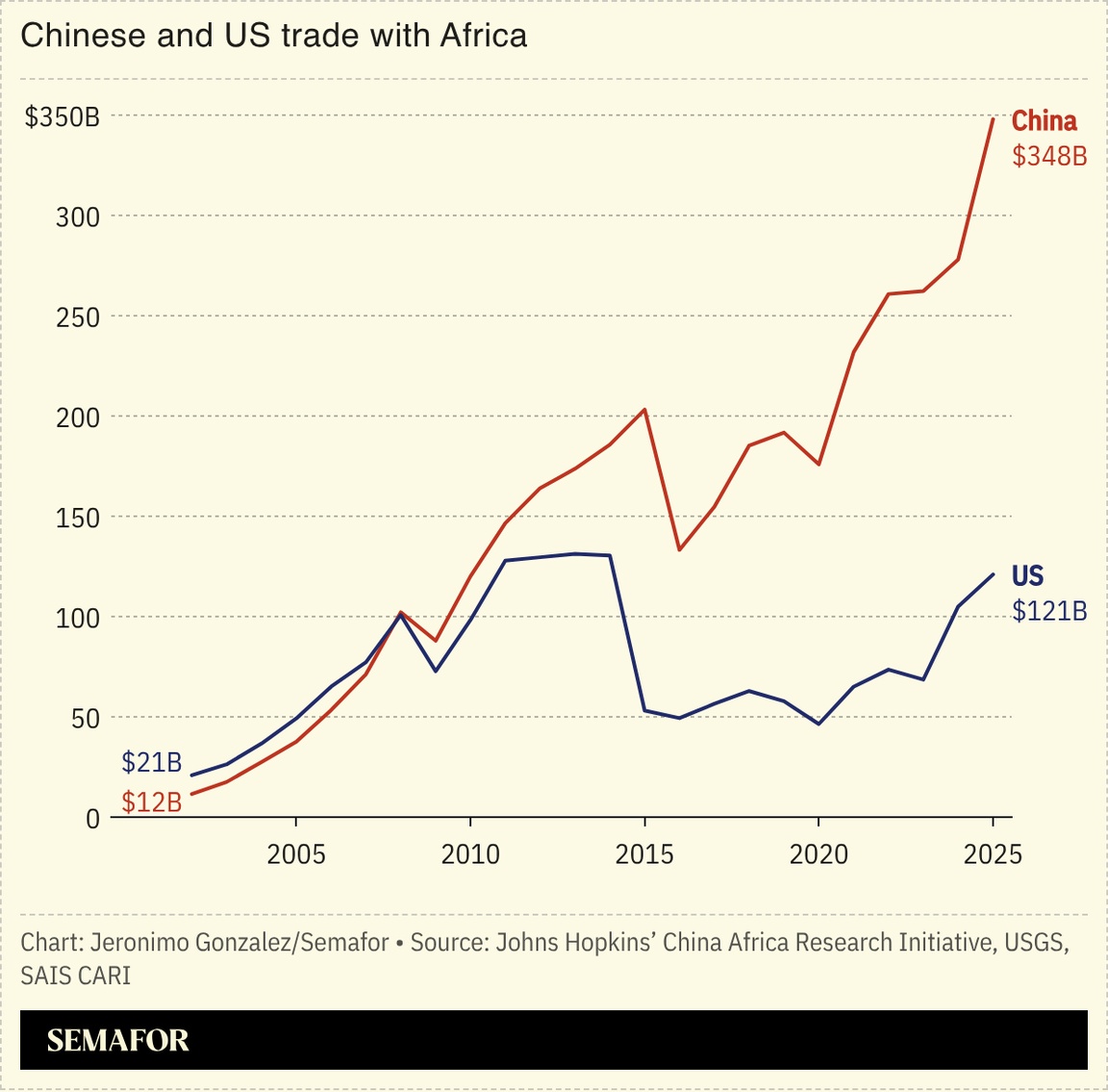 The US insisted it could still compete with China in Africa despite Beijing’s trade supremacy across the continent, though Washington’s tariffs risk eroding any such effort. Speaking at Semafor’s The Next 3 Billion event in New York, Development Finance Corp. head Ben Black defended the Trump administration’s Africa strategy, including hundreds of millions of dollars pledged for investments in digital infrastructure and mining projects. The impact of the Iran war, which has sent fuel and fertilizer prices soaring, as well as Washington’s protectionism, risks pushing African countries closer to Beijing, however. The tariffs are causing pain beyond Africa too: The head of the World Trade Organization told Semafor they could cost the global economy up to 7% of GDP. — Prashant Rao |
|
S. Africa faces US investment freeze |
 L. Brent Bozell III. Kris Connor/Getty Images L. Brent Bozell III. Kris Connor/Getty ImagesSouth Africa’s post-apartheid Black empowerment rules are holding back billions of dollars in American capital, Washington’s ambassador said. L. Brent Bozell III, reiterating US criticism of measures aimed at redressing inequalities caused by apartheid, singled out mandatory local equity transfers in mining and telecoms as a barrier to investment. Since early 2025, Washington has escalated pressure on Pretoria over property rights, rural safety, and foreign policy alignment. Bozell, in an interview with local media and state broadcaster SABC, said his country had “billions with [a] capital B” waiting on the sidelines at a time when Africa’s biggest economy needs it. “We shake our heads in disbelief that there isn’t a better partnership,” he said, adding that the US is questioning whether Pretoria remains a viable partner. Last week, the Trump administration imposed visa restrictions on unspecified South African officials it accused of “government-sponsored” discrimination, with Bozell saying it was the start of a series of measures against Pretoria. South Africa has put its position as a dominant global supplier of platinum group metals at the center of its efforts to repair its fractured ties with the US, which needs the precious metals to keep its industrial base humming. — Tiisetso Motsoeneng |
|
| | Semafor Next 3 Billion • Exclusive | | |
Kenya sees future as regional oil leader |
 Semafor SemaforKenya will break ground on a planned $16 billion refinery backed by Nigerian industrialist Aliko Dangote this month, a mammoth project that could turn the country into a regional fuel-processing hub, as East Africa seeks to reduce its reliance on imported petroleum products. Speaking at Semafor’s The Next 3 Billion event in New York on Tuesday, Kenya’s Investment, Trade, and Industry Minister Lee Kinyanjui said construction on the 700,000-barrel-a-day refinery at Lamu island would begin on Sept. 30. He said its location on Kenya’s Indian Ocean coast would allow crude from the Middle East and elsewhere to be refined and products transported across East Africa. Kinyanjui declined to put a figure on the refinery’s potential revenues, saying those details would be announced at the groundbreaking. The project would give East Africa a major new refining hub as Uganda’s plans for a 60,000-barrel-a-day refinery at Hoima face delays. Kampala’s final investment decision has been pushed to 2027, while Lamu could be operational around 2030 if construction proceeds as planned. The two projects could ultimately compete for regional markets, including landlocked Uganda, South Sudan, and Ethiopia. — Yinka Adegoke |
|
| | Semafor Next 3 Billion • Exclusive | | |
Health chief urges local vaccine push |
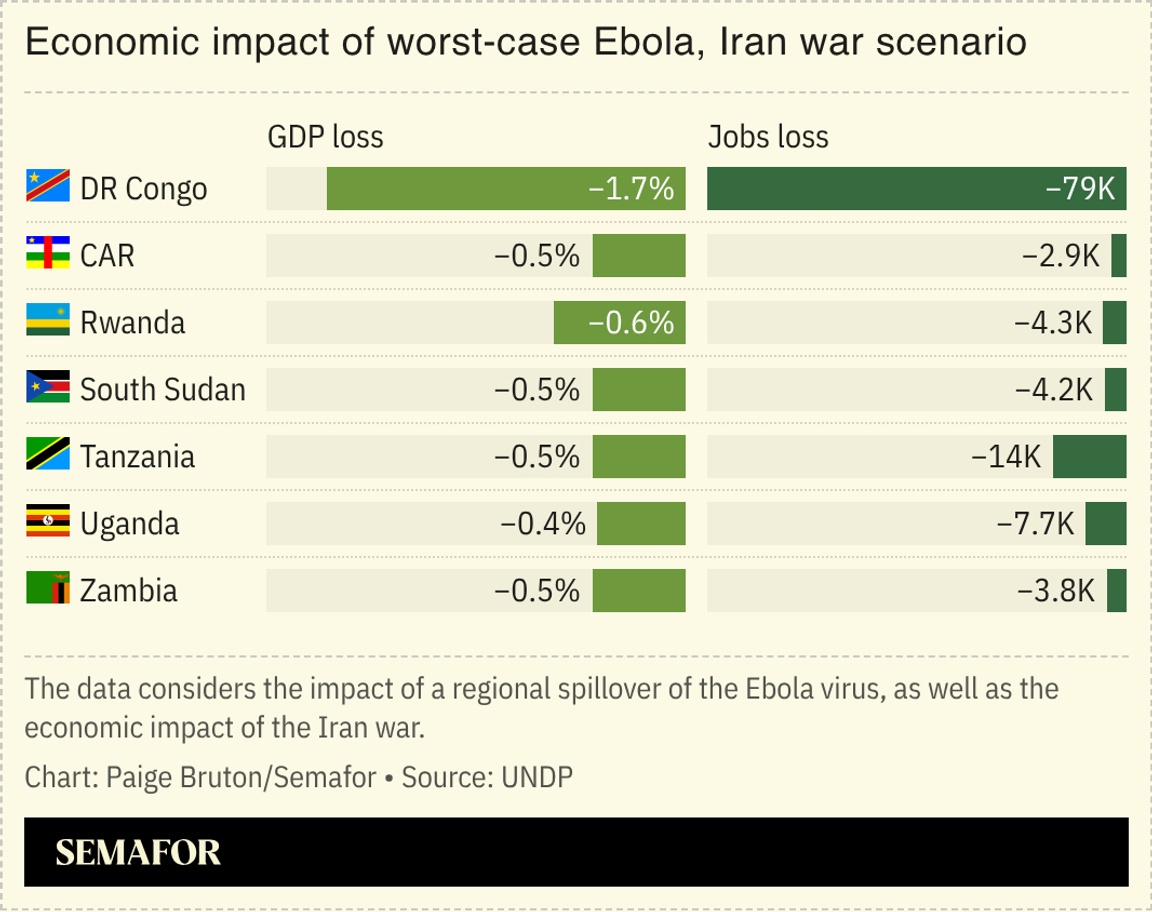 The head of the Africa Centres for Disease Control said Africa should begin making a range of vaccines locally, as the Bundibugyo Ebola outbreak hits the economies of DR Congo and its neighbors. A vaccine developed for the Zaire Ebola strain is currently in a Phase 3 trial to see if it can be used for Bundibugyo and results are expected by the end of this year. There are clinical trials for multiple other vaccine candidates being pursued, but “it will take some time” to know if any can protect against Bundibugyo, Jean Kaseya said at Semafor’s The Next 3 Billion. He estimated it may take about six months to determine. In a separate interview at the Semafor event, DR Congo’s Prime Minister Judith Suminwa said cases of the Bundibugyo strain were slow to surface because its malaria-like symptoms “can be interpreted as just a benign disease.” She said the government has committed $50 million to the response, including $3 million for research, with partners mobilizing hundreds of millions of dollars in support. More than 3,000 people have died in the Ebola outbreak, according to the World Health Organization. The WHO announced an end to Uganda’s outbreak in late August, but transmission is still ongoing in the DRC. — David Lim, Alexis Akwagyiram and Adrian Elimian |
|
| | Semafor Next 3 Billion • Exclusive | | |
IFC chief sees data tackling risk premium |
 Semafor SemaforThe head of the World Bank’s private-sector arm said investors “absolutely” overprice risk in Africa, inflating borrowing costs across the continent by treating dozens of diverse markets as a single investment story. Speaking at Semafor’s The Next 3 Billion event, Makhtar Diop, managing director of the International Finance Corporation, said a “contagion effect” means shocks in one country are often used to justify higher risk assessments across the continent, regardless of underlying economic fundamentals. “Whenever you have a shock in Africa, people tend to say that it affects the whole continent,” Diop said. Investors behave as though “something happening in Ethiopia is affecting Dakar,” he added. To challenge this perception, the IFC is opening up its Global Emerging Market Risk Database to investors and rating agencies, hoping that hard data on credit performance will help narrow the so-called “Africa risk premium” and bring down the cost of capital. — Tiisetso Motsoeneng and Alexis Akwagyiram |
|
|


