|
|
|
|
|
|
|
|
|
Internationally mobile millionaires are increasingly looking to diversify their financial options by building 'sovereign portfolios' around the globe, a report says. iStockPhoto / Getty Images
|
|
|
|
|
Good morning. If you suddenly found yourself with a few extra million dollars lying around (congrats!), where in the world would you want to live? Apparently, the world’s wealthiest are strategically planning not only where they live, but where their money lives, too. Let’s get into it. |
|
|
|
|
|
|
|
|
|
|
A recent report from Henley & Partners, a firm that advises wealthy clients on residence and citizenship, finds that countries are increasingly competing to attract and keep internationally mobile millionaires. |
|
|
|
|
Singapore is one of the standouts, scoring 79.5 out of 100 on the firm’s new “wealth mobility” ranking, which factors in everything from taxes and quality of life to political stability, rule of law and how easy it is for wealthy foreigners to gain residency. New Zealand scored 75.8, while Italy, Portugal, Switzerland and Greece were also among the countries highlighted as particularly competitive. |
|
|
|
|
And then there’s Canada. It wasn’t one of the standouts, but it also wasn’t among those singled out as losing their edge. In fact, Canada barely features in the report at all. That doesn’t surprise me, based on some reporting I did last year that showed it’s pretty hard to leave Canada as a wealthy person. |
|
|
|
|
Our southern neighbour, however, is experiencing a vastly different phenomenon. |
|
|
|
|
The United States remains the world’s biggest wealth-creation machine, but Henley said the country is also its largest source of clients seeking additional residence or citizenship options. Applications from U.S. nationals through Henley doubled in 2025, with nearly half of those directed toward European programs, according to the report. |
|
|
|
|
That doesn’t necessarily mean millionaires are packing their bags and abandoning the U.S. Henley said wealthy families are shifting further from traditional planning by increasingly collecting options: citizenship in one country, residency in another and investments somewhere else to build “sovereign portfolios” around the globe. |
|
|
|
|
In other words, diversification no longer applies just to your investment portfolio. If you’re rich enough, you can diversify your countries, too. |
|
|
|
|
Subscribe to the Retire Rich newsletter
Are you reading this newsletter on the web or did someone forward the e-mail version to you? If so, you can sign up for Retire Rich here. |
|
|
|
|
|
|
|
|
|
|
|
|
|
|
|
|
|
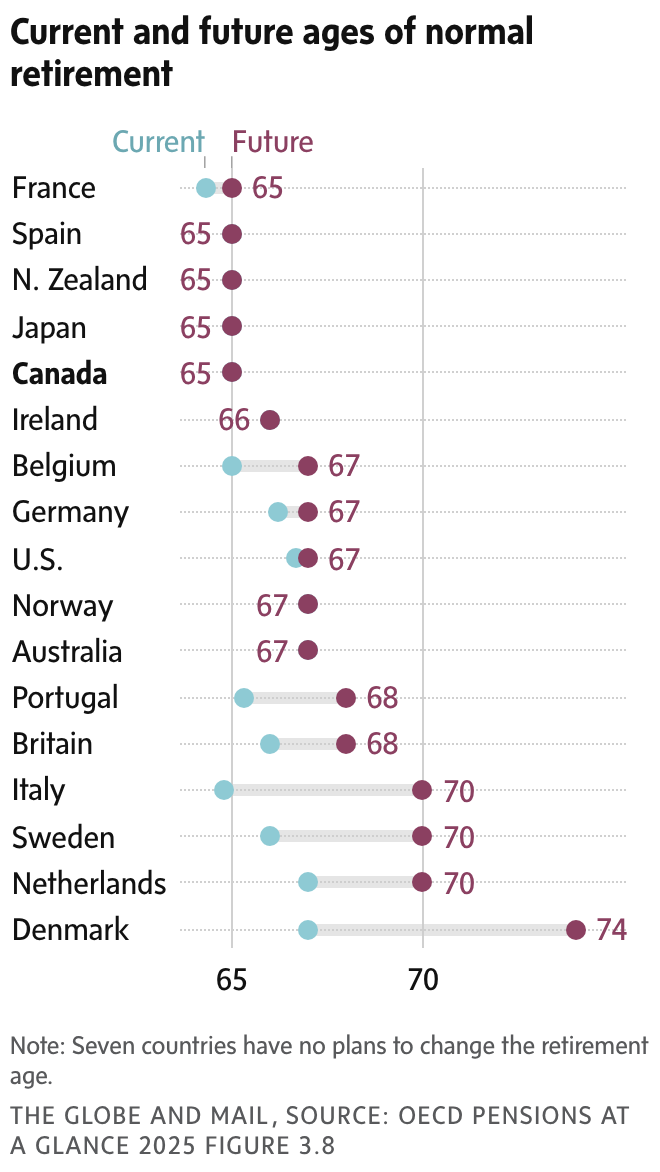
Canada is holding firm at 65 as its normal retirement age, even as many other developed countries push theirs higher. Frederick Vettese, former chief actuary at Morneau Shepell, writes that Canada may soon have to reconsider as its work force shrinks and countries such as Denmark move toward retirement ages as high as 74. |
|
|
|
|
|
|
|
|
|
|
|
|
|
|
|
Retirement can bring newfound freedom, but also unexpected financial and lifestyle challenges. AscentXmedia/iStockPhoto / Getty Images
|
|
|
|
|
|
|
|
|
|
|
The reality: More than a year after leaving full-time journalism, Carrick says retirement has brought plenty of freedom, but also a few surprises. He’s spending more than expected, partly because of having more free time for hobbies, events and travel, while finding that a satisfying retirement still needs structure and meaningful ways to fill the week. |
|
|
|
|
The good: A flexible schedule means more time for family, travel and everyday life, without work deadlines getting in the way. He says one of the biggest pleasures is simply being “off the clock” and having control over when and how he spends his time. |
|
|
|
|
Key take-aways: Retirement planning isn’t only about accumulating enough money. Carrick says retirees need to build their health and day-to-day lives, too, while trusting the financial plan they made. And don’t expect retirement to be one long vacation. Travel is only a small part of it, and getting ordinary life right matters just as much. |
|
|
|
|
|
|
|
|
|
|
|
|