
|
 |


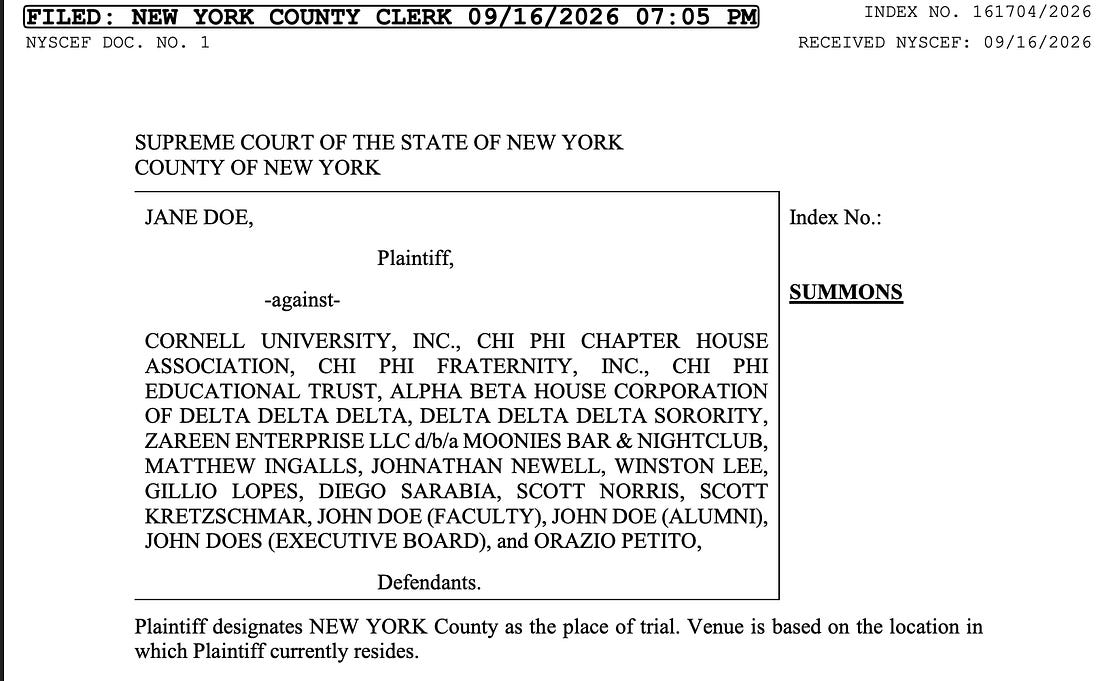
Jane Doe is the name by which we know the young woman who has come forward to say she was gang raped in a room at the Chi Phi fraternity house while she was a student at Cornell in 2024. Following the incident, the local DA looked at the case but has not prosecuted. Jane Doe filed a 101-page civil lawsuit, which sparked outrage as her allegations came to light.
 |
Last Thursday, New York Governor Kathy Hochul appointed state Attorney General Letitia James as special counsel, saying she’d lost confidence in the local DA.
The situation is complicated. Looking at news reports and media appearances by people involved, there appears to be a difference in who had access to what evidence when the DA appears to have decided against going forward, depending on whether you’re hearing from Cornell, local law enforcement authorities, or the DA himself. It makes sense to bring in a new prosecutor who can look at the evidence with fresh eyes and make independent decisions about whether there is sufficient evidence to prosecute a criminal case and, if so, against which potential defendants and on what charges.
Some of the evidence in the case which has been made publicly available is horrific, like a screen shot from a Snapchat conversation that uses language more reminiscent of a sex trafficking organization than a college party. But rape cases are often complicated, and here, there will be issues of consent and intoxication among others that will have to be carefully parsed based on the evidence and New York state law. And like so many victims of sexual assault, Jane Doe’s immediate reaction was to blame herself before she slowly came to see herself as a victim. That pattern complicates prosecutive decision-making.
For instance, when it comes to consent, Jane Doe’s civil complaint sets out one of the issues prosecutors will have to grapple with.
 |
New York’s college standards require affirmative consent. Consent can be initially given but then withdrawn. Although there have been reports that suggest that Jane Doe voluntarily went to the fraternity and had a prior relationship with at least one of the men involved, the civil case argues she was incapable of consent at the time sexual conduct occurred because of her incapacity due to alcohol and the ingestion of other drugs that she suggests they induced her to take. To further complicate matters, the standard for consent in New York can depend on whether a victim was voluntarily intoxicated. But under New York law, when consent can no longer be given, sexual activity must stop.
This shows why a thorough investigation is essential. Prosecutors cannot make a decision about whether they have a case until they understand precisely what happened. And while the question that underlies an investigation like this is whether a crime or crimes were committed, the real question prosecutors have to answer is “can we prove it beyond a reasonable doubt to a unanimous jury?” But the fact that rape cases can be difficult to prosecute doesn’t mean they shouldn’t be pursued. The facts must be assembled, the law assessed, and a decision made on that basis and no other.
There will be a lot of evidence for AG James to consider:
Police interviews with Jane Doe and others.
The Title IX investigative file—Federal law requires institutions that receive any federal funds to conduct a formal administrative inquiry into allegations of sexual assault, which can include victim, witness, and potential defendant statements among other materials.
Any additional material in possession of the University, for instance, other allegations of misconduct involving the fraternity.
Additional materials generated by the DA
Any relevant statements made to the media.
After evaluating the available evidence, James will likely have additional leads she will want investigators to run down for her. She may try to interview key figures. And because there are multiple possible defendants involved, she may try to develop a cooperating co-defendant.
But it’s important that we not prejudge the evidence and jump to the conclusion that a crime was committed and that it’s prosecutable. A rush to judgment isn’t helpful. Accusations have been made. Now it’s time to let a prosecutor with every reason to give Jane Doe the serious consideration she deserves a chance to do the work. Mimi Rocah, the former District Attorney in Westchester County New York, as well as a former federal prosecutor put it like this, “I hope that AG James conducts an investigation that everyone can have faith in. Not everyone will agree with the outcome whatever it is - but a fair process is essential to faith in the justice system going forward.”
In the civil lawsuit, Jane Doe alleges that Cornell, Chi Phi, Delta Delta Delta (her sorority), and others, including alumni and board members, failed to protect her “from being sexually assaulted and raped by multiple members of the Xi Chapter of Chi Phi Fraternity at Cornell University.” She also names individual defendants who she alleges committed “heinous criminal sexual acts against Plaintiff.” There are additional claims, including breach of contract and New York state law violations.
This case comes at a time when Americans have been actively reconsidering how we, as a society, approach sexual assaults and sex crimes. It started with the Me Too movement. The Epstein survivors forced many people to open their eyes, and E. Jean Carroll’s successful civil cases against Donald Trump raised the issue of why a woman might go decades before coming forward to accuse a man who assaulted her. This case forces us to look at an issue that people know has been overlooked for far too long—sexual assault on college campuses. As Jane Doe writes in her civil complaint, “she never knew that the University had been the scene of numerous incidents of sexual assault and rape in the months and years prior to her arrival. Students were afraid, protesting, and demanding reforms.” By the time she started school, Cornell was advising students on campus and “implementing anti-sexual violence training in the University’s Greek houses, advising incoming students about the risks of sexual assault and harassment in college, and offering support services to victims/survivors.” Cornell, of course, is not alone.
But unfortunately, instead of aggressively pursuing Title IX cases and its other authorities, the Trump administration has abandoned campus sexual assault cases to pursue its anti-trans agenda. As my former DOJ Civil Rights Division colleague Shaheena Simons posted on LinkedIn, “I post a lot about what my former DOJ office is doing on higher education. Here’s what they are not doing: They have not announced a single Title IX investigation, finding or resolution about campus sexual assault. The gutted Department of Education has similarly turned its back. Instead, DOJ’s (and ED’s) Title IX agenda is laser-focused on directing harm and hostility at trans students. This is how they purport to protect women and girls in schools.” She noted candidly that while prior efforts “weren’t ever enough and they weren’t always perfect … we prioritized students and we conducted fair and careful investigations.” Today, we have only a state investigation and a private civil case, with no federal action.
So we struggle with this issue, as with so many others, in an environment where the federal government turns a blind eye to important societal matters. The criminal investigation, along with the civil case, will be important to Jane Doe and to the men accused of raping her. But it will also have significance as we try to evolve our culture in the absence of leadership from the White House. Rachel Foster, a leading anti-trafficking attorney known for her work with the Epstein survivors, for which she was named to the Time100 list of the world's most influential people in 2026, put it like this: “Hopefully it will crack open something that needs to be cracked open.”
There is lots more to come. We’ll track it here at Civil Discourse.
We’re in this together,
Joyce