Robinson Kelly's Kickstarter campaign passed its goal 44 minutes after it went live, and so far he's raised over $59,000.
He spent 20 years in software, and when he started this he had never worked on a hardware product.
Kickstarter picked his campaign as a "Project We Love," and MusicRadar covered it the same week.
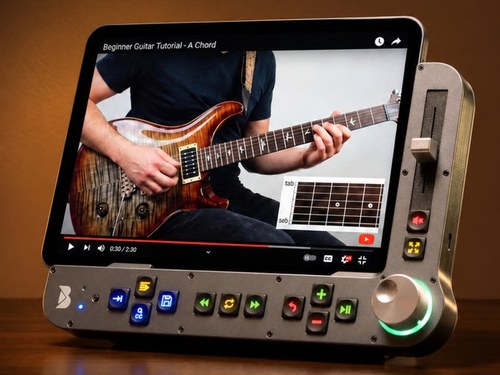
His product is called Benjamin. It's a control surface with illuminated buttons and a scroll wheel that lets musicians loop and slow down YouTube lessons on an iPad without fighting the touchscreen.
|
|
|
|
|
The idea came a few years ago, when he was learning bass guitar from YouTube. He'd drag the video back to replay a passage, miss the spot, and end up spending more time finding the part than playing it.
So he and his wife and co-founder, Ilana, decided to build a fix themselves, even though he didn't know if a product like this was possible.
In his words, "I have had to learn a huge amount and have no engineering background."
He was already a member of my Hardware Academy, where engineers and product experts help people develop their own hardware products, so he started asking questions.
The first ones were basic, like the time he took apart a cheap remote from Amazon and posted a photo of the circuit board to ask what he was looking at and which parts he could just buy.
It took him over nine months to get a first working prototype, which he assembled by hand inside a 3D printed case.
Then he got stuck on patents and wrote, "I don't often feel stuck - but the path forward is really unclear."
I suggested he file a provisional patent and get on with testing the market. Today he has patents granted in both Canada and the US.
His first custom board had errors that made the units very hard to assemble, and for a while the project stalled.
When he came back to it he needed an engineer to fix that board.
So he asked for advice on hiring an engineer, and I laid out his options and helped him work out what kind of engineer would be the best fit for his project.
Later, when he needed certified batteries, one of our engineers tracked down a source, and another member showed him how to check that a supplier's certification documents are legitimate.
Before he ever launched on Kickstarter, he tested demand with a reservation funnel, which is something he first learned about from one of our workshops.
A reservation funnel is a simple page where people put down a small deposit to hold a spot for your product.
Robinson ran his about five months before the Kickstarter, and he used it to test his pricing and his message on people who had never heard of him.
And for most of the time we were helping him, none of us knew what his product really was.
We knew it was some kind of remote control for an iPad. He worked, as he put it, "in near total secrecy" until his patents were in place.
He was never chasing huge volume either. Benjamin is a premium product for serious musicians, and as he told us, "We'd rather sell fewer high-value devices than bash out thousands of plastic toys that end up in landfills."
A lot of our members are doing the same, because not everyone wants to sell millions of units or build a huge company.
The day the campaign launched, he posted this for the other members:
"Wherever you are on your journey - know that it IS possible to go from knowing absolutely nothing about bringing a product to life to getting people to buy it before it actually even ships."
He still has to manufacture and deliver it, and he'd be the first to tell you he has miles to go.
So there are three lessons here.
First, Robinson never waited until he knew enough to ask. He asked the next question that was blocking him, got an answer from someone who had been there, made his own call, and kept moving.
Second, you can get expert help without giving away your idea. A question about a Bluetooth module, a battery, or how to hire an engineer reveals almost nothing about the product it's for.
Third, you can test demand before you have a finished product. A reservation funnel tells you whether strangers will put real money down, well before you launch.
If you're developing a product of your own, the same engineers and product experts who helped Robinson are waiting to help you inside the Hardware Academy.
If you ever plan to crowdfund, Robinson's campaign page is a great example of how to do it well. The photos are excellent, and the video shows the product being used so you understand it right away.
You can see it all on his Kickstarter campaign here.
Talk soon,
John Teel
Predictable Designs
|
|
|
|
|
P.S. Look around inside the Hardware Academy for free through October 18th, or get your first 10 days for $10 and ask your own questions too. Details here.
|
|
|
|
|