
|


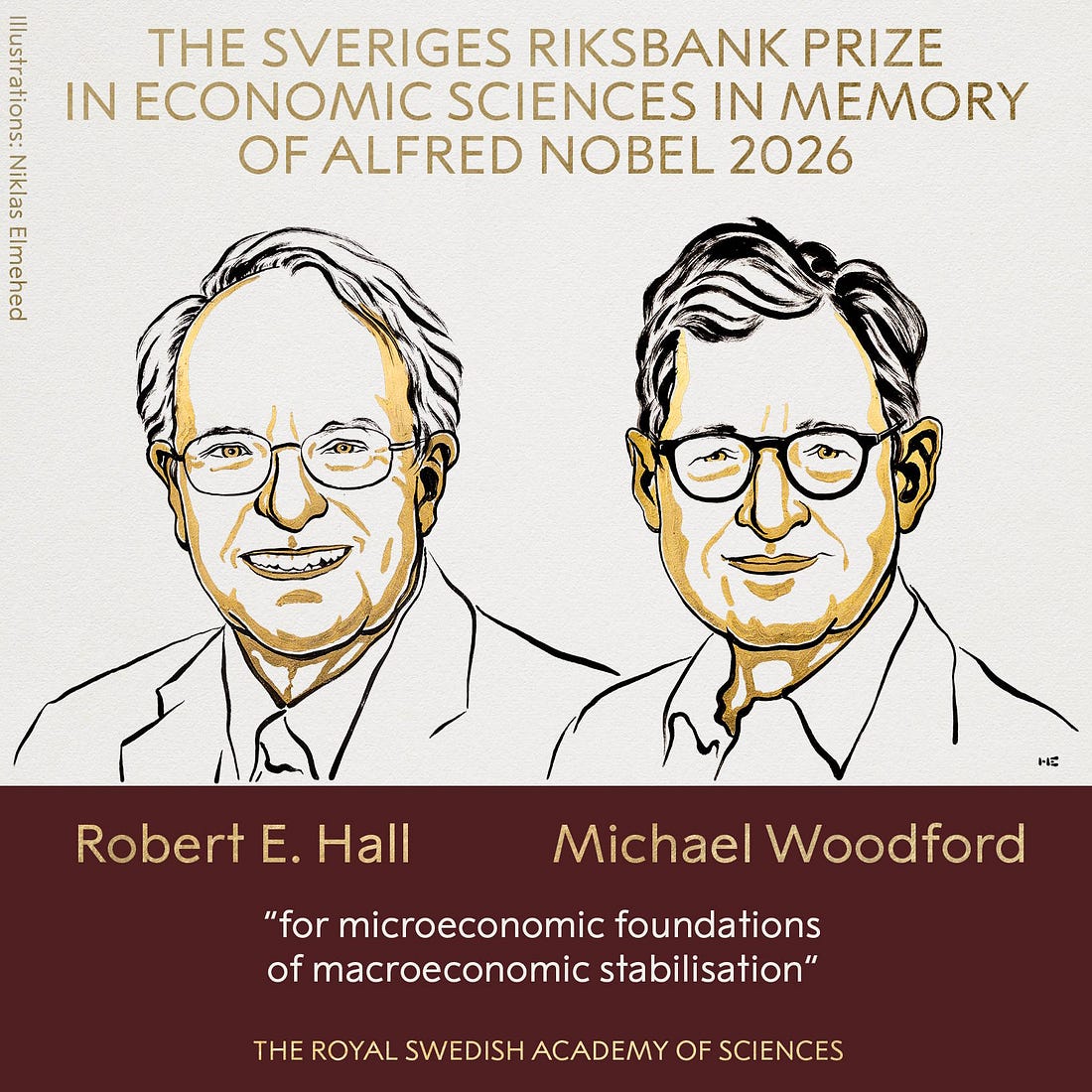 |
I have a Google Doc with a long list of posts I’ve been meaning to write. Far down the list was a line that read “New Keynesian macroeconomics deserves a Nobel”. Somehow I never got around to writing that post, and now I never will. Because today, it happened! This year’s Econ Nobel went to Bob Hall and Mike Woodford, two of the theory’s most important creators.
First, let me say that this prize is long overdue. In 2009, I asked my PhD advisor, Miles Kimball, who was the greatest living macroeconomist. Without hesitation, he answered “Bob Hall”, and said he would be very surprised if Hall didn’t win the Nobel at some point. Hall’s work is breathtakingly broad; if you want good summaries, I recommend Alex Tabarrok and Tyler Cowen (as usual). As for Michael Woodford, everyone I know assumed that if New Keynesian macro ever did get the prize, Woodford would be included, as he literally wrote the book on it.¹
But anyway, let’s talk about New Keynesian economics — what it is, how it came about, why it’s important, and why it didn’t get a Nobel until now. Let’s start with a brief history of modern macroeconomics.
Back in the 1960s and early 1970s, most economists tried to understand the macroeconomy by looking at relationships between macroeconomic aggregates. For example, “If income goes up by 10%, how much will spending go up?”. Or “If inflation goes up by 3 percentage points, how much will unemployment go down?”. ²
The problem with that is that correlation isn’t causation. Suppose you see that when inflation rises, unemployment goes down. That correlation is called a Phillips Curve. So you think “OK, if we raise inflation, more people will get jobs”. But you try that, and it doesn’t work — you push inflation up (by printing more money), but unemployment stays high. The correlation you saw before has now broken down. Now you’ve got two problems instead of one!
This is a very simplified version of what a lot of economists think happened in the 1970s. Whether that’s what really happened is a story for another day. But the stagflation of the 1970s prompted the econ profession as a whole to rethink how it modeled the macroeconomy. A lot of researchers asked: What parts of the macroeconomy are invariant to policy? What are the solid foundations we can stand on, so that when we try to make some sort of change, we don’t cause our own theories to crumble?
The answer most economists settled on was called “microfoundations”. They reasoned that the basic drivers of individual and corporate economic behavior shouldn’t change when macro policies like interest rates and government spending change. Most importantly, those drivers include:
Technology
Consumer preferences
The process by which people and businesses form expectations of the future
Do all three of these really stay the same when economic policy changes? Probably not completely. But it gave macroeconomists a place to start. So in the late 1970s and early 1980s, economists started to build macro models based on theories of individual and corporate behavior. These were called “microfounded” macro models.
The last of those three “microfoundations” — expectations — was particularly thorny to think about. Almost any sort of expectation-formation process that you write down allows policymakers to trick people over and over, by surprising them systematically. Economists thought that eventually, people should wise up to the government’s tricks. So they came up with the idea that consumers and businesses should, on average, be as smart as the economists making the models. If economists write down a model of how the world works, that model should be the average person’s mental model in the model. Basically, people generally know how the economy works, and they plan accordingly.
This idea is called “rational expectations”.
In 1978, Bob Hall wrote a very influential paper that convinced a lot of economists that this was the right track. Hall wanted to test a simple idea, originally developed by Milton Friedman: If people plan out their consumption in advance, then changes in the level of consumption should be completely random.³ Nothing from last quarter should be able to predict the change in consumption this quarter — because if something last quarter mattered for this quarter’s consumption, people would already have changed their consumption last quarter! Hall found that, sure enough, a bunch of variables that seemed like they should be important for consumption — especially last quarter’s income — didn’t actually help predict changes in consumption.
For a more detailed explanation, I recommend this post by John Cochrane:

Brian Albrecht has a good (brief) explanation as well.
At first blush, this might not seem like an important result. After all, absence of evidence isn’t evidence of absence — there might be other variables that do predict changes in consumption, that Hall simply forgot to test. And in fact, Hall did find one variable that predicted future changes in consumption: stock prices. So even in the formal sense, the basic theory didn’t quite hold. Nor did Hall’s result rule out the traditional Keynesian idea of consumption — if government spending surprises people, it can move consumption immediately, without creating any sort of predictable future change.
But it was an important result, for two reasons. First, if people plan ahead when making their economic decisions, it should be possible for policymakers to influence today’s behavior by making promises about what they’ll do in the future. Second, if it’s impossible for economists to predict changes in consumption, that implies that consumers are as good at planning their future consumption as economists are.
If that’s true, it’s an important lesson for policy: If you want to make people consume more, or if you want to make businesses hire more, etc., you have to do it in a way such that people generally unders