| | In this edition, lowball retention bonuses doomed the Perella-Piper Sandler merger, and insuring aga͏ ͏ ͏ ͏ ͏ ͏ |
 - Bonuses tanked Perella merger
- AI bond-insurance prices soar
- Is this AI expert real?
- Insurance villains
- BigLaw’s AI hiring spree
- Suntory likes being private
 Apple-Meta tie-up on Muse … Taiwan tightens AI chip ban on China … UBS eyed London |
|
Skimpy bonuses tanked Wall St. merger |
 Dado Ruvic/Illustration/Reuters Dado Ruvic/Illustration/ReutersScant retention bonuses tanked a merger between two Wall Street boutique banks. A deal between Perella Weinberg Partners and Piper Sandler was heading toward a handshake earlier this month when Perella’s CEO called some of his roughly 70 partners to describe their retention packages: $2.5 million in stock of the combined company for top bankers, with smaller producers tiered down to as little as $500,000, people familiar with the matter said. (“Offensively low,” per one banker.) Threats to quit ultimately helped kill talks that would have created, if not an M&A juggernaut, a firm better able to compete for a shrinking pool of deals. A spokesperson for Perella did not respond to requests for comment. Talent — and with talent, ego — is a nightmarish merger asset. The boutique deals that have worked mostly absorbed specialist advisers into balance-sheet heavy banks, like Chase’s 1999 acquisition of tech boutique Hambrecht & Quist, with some early signs of success at Mizuho-Greenhill. — Rohan Goswami |
|
AI debt insurance is getting pricey |
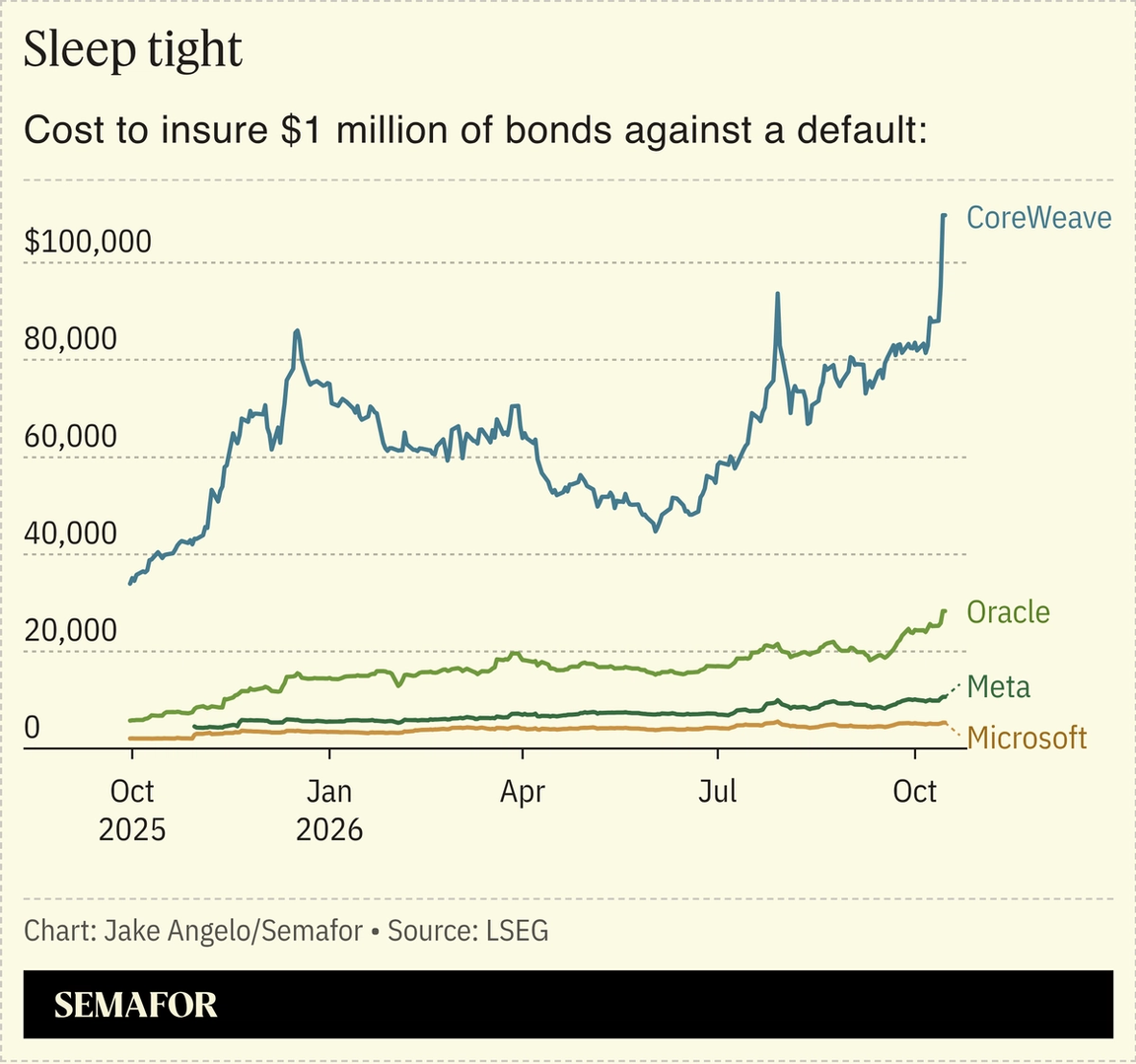 The latest sign of market nerves around AI is the rising cost of insurance contracts to protect against hyperscalers defaulting on their debt. The cost to insure cloud provider CoreWeave’s bonds for five years has risen more than 150% from a year ago, to $100,000 per $1 million of bonds. For Oracle, whose $160 billion of debt is teetering just above junk-rated status, the figure has risen 12% since the company sought to delay the start of its lease tied to a New Mexico data center. Even at AAA-rated Microsoft — whose debt a year ago was deemed safer than Treasury bonds — insurance policies now cost 25% more than they did three months ago. “If you want to make a bet that Microsoft could default and not pay their lease, you can go in the derivative market and do that,” Doug Ostrover, co-CEO of Blue Owl, which has billions of dollars staked on the creditworthiness of hyperscalers at data centers it backs, said on Semafor’s Compound Interest show. “We don’t. But it’s available to us.” — Ellen DiMauro |
|
Expert networks keep it real |
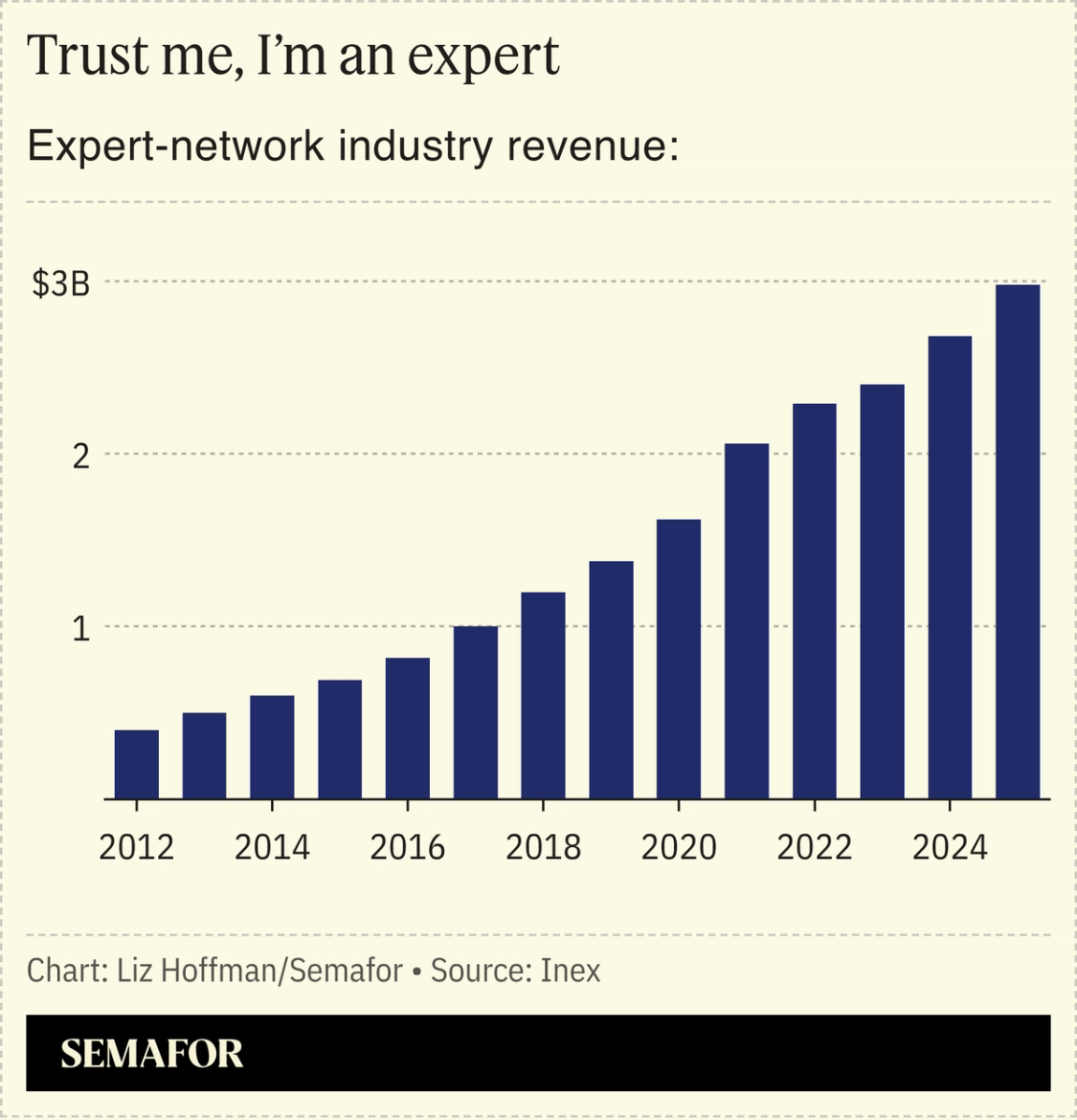 Here come the AI experts — and the pretenders. “Anybody who knows anything about AI” is in high demand from investors trying to play the AI trade, said Gemma Postlethwaite, CEO of expert network GLG. And there are plenty of deepfakes and people using AI chatbots willing to play the part. “We have to be able to deliver experts that not only are who they say they are, but know what they say they know,” Postlethwaite tells Semafor. To test for authenticity, GLG is doing additional screening and ID verification — increasingly on camera with questions designed to trip up AI avatars. It’s also parsing transcripts to find “situations where somebody’s expertise is going off-piste,” she said. “Think of it like a digital fingerprint of knowledge.” Verify, then trust. GLG is also connecting frontier AI labs with subject-matter experts to help train models in sensitive subjects, such as child psychiatrists who can craft responses to kids in crisis and nuclear or bioweapon experts to respond to bad actors looking for instruction manuals. — Liz Hoffman |
|
Scrutiny of insurance industry grows |
 777 founder Joshua Wander in 2023. Matthias Koch/IMAGO via Reuters. 777 founder Joshua Wander in 2023. Matthias Koch/IMAGO via Reuters.The founder of 777 Partners, the poster child for the underbelly of Wall Street’s insurance push, pleaded guilty to fraud Thursday. A Semafor investigation in 2023 found that 777, which announced itself with a bold bid to buy UK soccer club Everton, had been funnelling insurance policyholders’ money into risky bets that it ginned up itself. The collapse of 777, and the spotlight on exactly what it had been doing with policyholders’ life-insurance money, threatened to bring new scrutiny to what has become Wall Street’s favorite trade. It turns out the party pooper, as we wrote a few weeks ago, wasn’t 777 founder Joshua Wander, a hotshot outsider, but rather a consummate insider: Mark Walter, who did as much as anyone to invent the private equity-insurance trade and is now embroiled in a DOJ investigation that has generated scrutiny of the entire industry. — Liz Hoffman |
|
Data-center lawyers in demand |
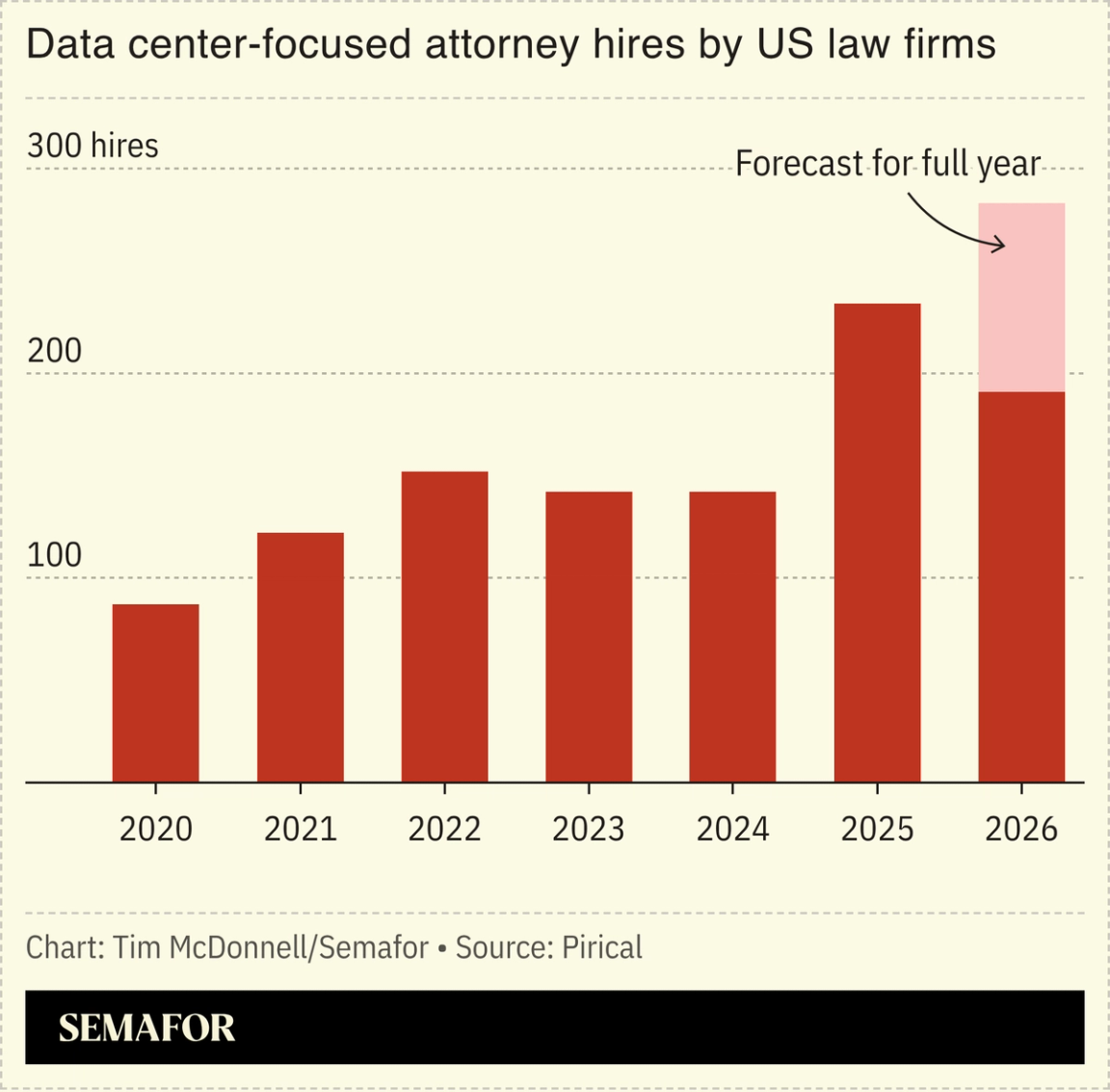 Speaking of demand for anyone who knows anything about AI, a talent war has broken out for lawyers with data-center experience. Top US firms are on pace to hire nearly 300 data center lawyers this year, three times more than in 2020, according to an analysis of public data by the legal business intelligence firm Pirical. Kirkland & Ellis and Dentons each have more than 200 lawyers who list data-center experience on their resumes. The hiring has shifted south from Washington to Texas, “which makes sense now that power availability decides whether a project gets built at all,” a Pirical analyst told Semafor’s Tim McDonnell. Law firms are always downstream of the hot new thing, spinning up sports, crypto, and human longevity practices. But as a vivid memo making the rounds on Wall Street laid out, law firms will get the AI boom coming and going. |
|
Suntory prefers being private |
 Irene Wang/Reuters Irene Wang/ReutersAs markets bounce around, it’s a good reminder that life is good as a private company. “We don’t have any stock price,” Suntory CEO Nobu Torii told Semafor’s Andrew Edgecliffe-Johnson. “Diageo is listed, Pernod is listed,” he noted, with both share prices down more than 50% in the past five years. “It’s a good chance for us to strengthen our brands,” he said and seize on Japan’s growing influence (Supreme clothing, manga comics) on Western culture. Being private grants freedom to companies — especially those in industries mid-pivot, as booze confronts tee-totalling Gen-Zers — to take big swings. Sazerac, which is also privately held, has tried to buy Jack Daniel’s parent Brown-Forman, and has grown itself into the largest liquor company in the United States. Suntory’s only deal of size this year was a $1.6 billion deal for a company that makes toothpaste and antacids. Would Suntory be a seller? “I would consider” it if a suitor showed up, Torii said, before Suntory PR clarified he was joking. |
|
 An AI chatbot told him to leave his wife. He decided to write a book about it. On this week’s episode of Mixed Signals, New York Times veteran and AGI Chronicles author Kevin Roose joins Max and Ben to talk about how he used AI aggressively to write his book without letting it actually write a word, and whether taking a grant from an AI safety-linked nonprofit is a problem. Plus, his new show at NPR and why he decided to leave The New York Times. |
|
You can now track America’s malaise in real time. The Misery Index, which adds the unemployment rate and inflation rate, has successfully predicted presidential elections since Lyndon B. Johnson’s economic adviser thought it up in the 1970s. But it depends on backward-looking data that’s released monthly. A startup founded by crypto enthusiasts is using real-time data from prediction markets to launch a Misery Implied Index. Futures can’t be far behind. |
|
|


