| | In this edition, why money won’t be the reason the AI bubble bursts, and an unlikely tie-up between ͏ ͏ ͏ ͏ ͏ ͏ |
 - Perplexity shares its sandbox
- AI task force gets to work
- The rise of model routing
- Apple and Meta get cozy
- Agents take over Christmas
 Money won’t be the reason the AI bubble bursts, and the quest to bring back the dodo is one step closer to being achieved. |
|
 Fear is rising that the AI bubble is about to burst under the weight of mounting debt, as my colleague Liz Hoffman detailed yesterday, including this great quote from an unnamed data-center financier: “We’re not an ATM for your dystopian future.” Perhaps lenders have grown tired of funding the data center buildout, but money is not going to be the thing that finally causes the AI train to go off the rails. Everything is bottlenecked. It’s not just chips, memory, and EUV machines. It’s refrigeration units that cool the GPUs and the raw materials needed to make components, like glass. If it weren’t for this bottlenecked supply chain, it’s likely AI revenues and user numbers would be growing much faster. Every time companies reach a new level of token efficiency, some new use case for AI is born that burns through ever more compute, proving Jevons Paradox. My favorite example of late: Decompiling video games to create mashups, something that used to take people years to do manually can now be done by AI in a weekend. It may be the thing that finally turns Gen-Zers into fans of AI. The total addressable market of AI is roughly 100% of the earth’s population, and demand for it will continue to soar. The enterprise market has only dipped its toes into AI, and the consumer hasn’t even begun to dive in. Anthropic told investors this week that it’s making 85% gross margins. Even if that number is a gross exaggeration, this is a cash cow business. They’ll service their debt obligations, in other words. I agree with the lender who lamented being an ATM for the AI industry, but probably for a different reason. Why would you want to lend money for measly interest payments when you could invest and get a massive return? There’s a reason hyperscalers and neoclouds reached for debt: It’s relatively cheap. |
|
Perplexity gives away its sandbox |
 Semafor SemaforAs companies look to increase security in an agentic AI world, Perplexity is giving away the software it has been using to combat rogue agents, the company told Semafor Thursday. Its “AI sandbox,” which it calls SPACE, is now an open-source project that outside developers can use. Perplexity says the tool can keep AI agents contained, and the company has lined up partners including CoreWeave, Akamai, and Crusoe. “A lot of companies are thinking about how to build secure AI agents, and in many cases they hit a wall,” said Zibi Braniecki, a member of the technical staff at Perplexity, in an interview with Semafor. Sandboxes, or isolated environments for testing and running AI models, have become a hot topic in the tech industry in the wake of reports from AI labs of models escaping their constraints, finding their way onto the open web and hacking unsuspecting victims like Hugging Face and the Australian government. — Reed Albergotti |
|
US’ AI task force rolls up its sleeves |
 US AI czar Jay Clayton. Nathan Howard/Reuters. US AI czar Jay Clayton. Nathan Howard/Reuters.The White House’s AI task force has adopted its charter, seen first by Semafor’s Ashley Gold — and now it has just 120 days to figure out how the government should handle the rapid development of AI technology. The task force agreed to commission a report from the President’s Council of Advisors on Science and Technology to evaluate AI risk related to cybersecurity and critical infrastructure protection, biosecurity and dual-use applications, and model control and accountability. It also agreed to make a working group tasked with implementing the White House accord that major AI CEOs signed this month, and agreed to create a “law enforcement and consumer protection coordination committee” including the Justice Department and FTC. It’s not yet clear how the task force’s policies will be enforced, but a White House official told Semafor one stick could be imposing export controls on AI companies that disobey it. |
|
Investor interest in AI routers grows |
 The inside of a data center. Brittany Hosea-Small/Reuters. The inside of a data center. Brittany Hosea-Small/Reuters.Investors are pouring cash into a hot new sector of the AI economy: model routing — a practice allowing developers and companies to easily switch between different AI models. Startup TrustedRouter, which launched publicly six weeks ago, is among a growing crop of model-routing firms looking to cut AI costs and reduce businesses’ dependence on any single model maker. The company this week closed a $6 million seed round, led by Sierra Ventures, it told Semafor. The biggest player in the routing space is OpenRouter, which has since agreed to sell to payments provider Stripe in a $7.5 billion deal. TrustedRouter, CEO Joseph Perla said, aims to differentiate itself by offering end-to-end encryption and verifiable confidential computing for some open-weight models, meaning neither TrustedRouter nor the data center running the model can read a customer’s prompts or outputs. “Security is just a pure baseline. It just has to be secure,” Perla said. The rise of routers also speaks to the surge in advanced open-weight models, many of which are from China, though an increasing number are originating in the West. Meta on Thursday released what it called “the most capable US open-weight model to date” — more on that below. — J.D. Capelouto |
|
 MIT Technology Review’s 10 Climate Tech Companies to Watch list features the startups and established businesses our newsroom believes have the best potential to address the threats of global warming. Subscribe to find out who made this year’s list, plus get bonus AI content. |
|
Meta and Apple mend fences |
 Jeenah Moon, Carlos Barria/Reuters Jeenah Moon, Carlos Barria/ReutersMeta’s new open-weight AI model can run locally on Apple’s Mac computers, the latest sign of AI reshaping old tech rivalries and building new ones. “Mommy and daddy” are “playing nice again,” Meta’s Alexandr Wang told Axios. Despite their historical animosity, Apple and Meta clearly see a market for running AI on personal hardware, not just in hyperscale data centers. And it shows Meta isn’t abandoning open source, after it reached the frontier last week with a new closed model. The surprising partnership makes for good marketing to Apple’s devoted users, but on-device AI isn’t new: I wrote about “AI laptops” from companies like HP back in 2024, though those ran much smaller models. To run the powerful new Meta system, Apple customers will need at least two of Apple’s top-end Mac Studios with a combined 1 terabyte of memory, a setup that can cost tens of thousands of dollars. (Since Meta’s model is open-weight, developers can run it on any hardware with enough memory, not just Apple’s.) The announcement shows that, while Apple may have missed the AI moment, its brand still carries some weight. And it might be getting over some of its dogmatic views on privacy that contributed to its sluggish approach to AI innovation. — J.D. Capelouto |
|
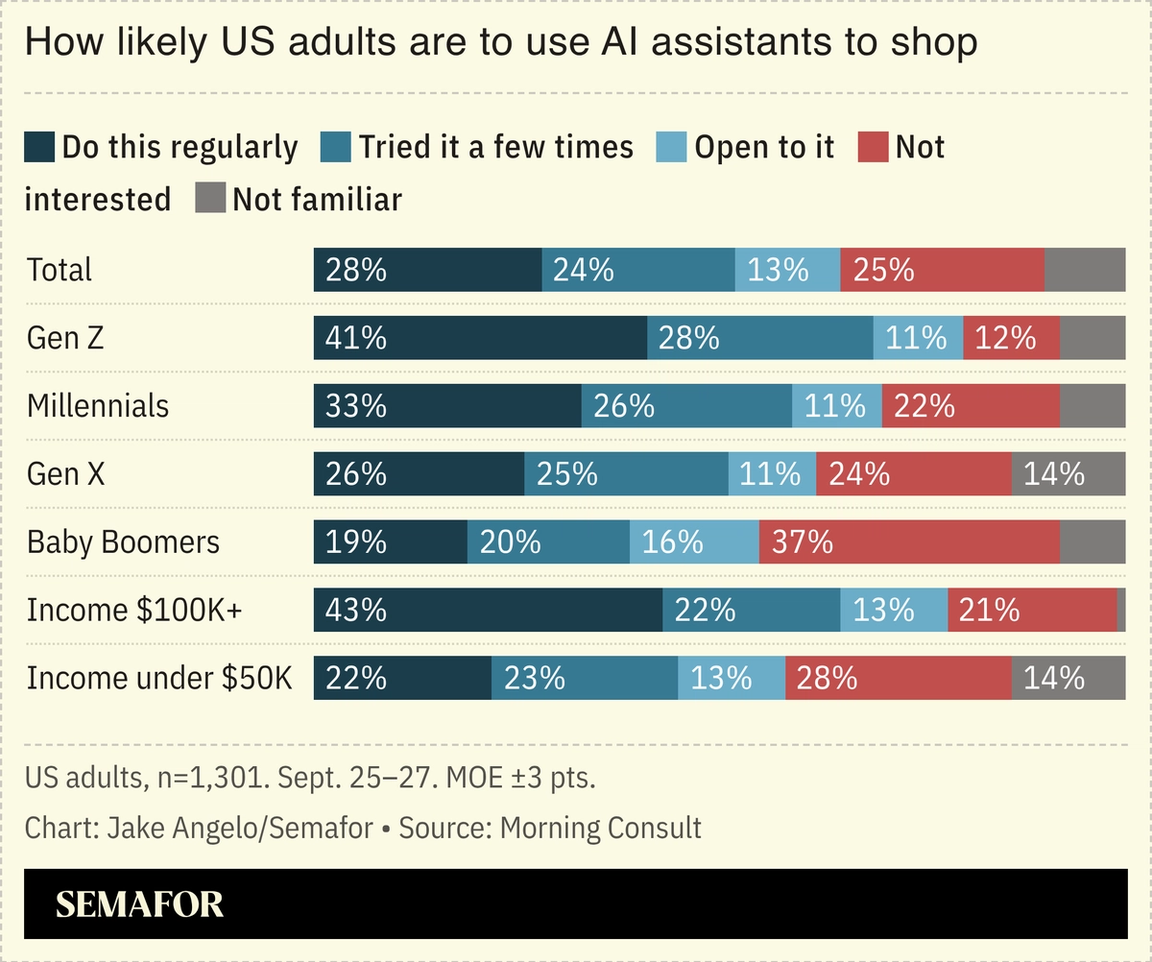 This coming holiday season, brands will have a new type of shopper to court: AI agents. Cheq, a cybersecurity company that verifies AI shopping agents, says it recorded a 100x surge in agentic traffic over a 45-day period following the release of consumer AI agents like Instinct and Meta’s Muse. While agents still make up a small fraction of online shoppers, they’re growing quickly, especially among a constant drumbeat of consumer agent releases, Cheq CEO Guy Tytunovich said. But not everyone is on board: Amazon and eBay have blocked agents to reinforce control over their ads businesses and checkout experiences. Consumers are hesitant, too. Shoppers are now as likely to be swayed by an agent’s recommendation as by an influencer, Morning Consult finds, but few are comfortable letting AI make purchases on their behalf. This holiday season will be the first true test of which brands are best at displaying their wares in ways that agents find irresistible. — Jake Angelo |
|
 An AI chatbot told him to leave his wife. He decided to write a book about it. On this week’s episode of Mixed Signals, New York Times veteran and AGI Chronicles author Kevin Roose joins Max and Ben to talk about how he used AI aggressively to write his book without letting it actually write a word, and whether taking a grant from an AI safety-linked nonprofit is a problem. Plus, his new show at NPR and why he decided to leave The New York Times. |
|
 Courtesy of Colossal Biosciences Courtesy of Colossal Biosciences“Gone the way of the dodo” — a popular phrase used to indicate something going extinct — may soon lose its meaning, if biotech startup Colossal Biosciences achieves its long-sought goal of resurrecting the bird. The company made a leap in that direction this week, unveiling an AI platform, GenoMorph, that it says can more easily flag the missing pieces in the genetic code that make a dodo a dodo. “Technological leaps forward like [wit |
|
|


