| Welcome, Weekenders! In this newsletter: |
| • The Big Read: Inside the Anduril-ization of local crime fighting |
| • The Arena: Sports betting is booming—and so are prediction markets |
| • Plus, Recommendations, our weekly pop culture picks—holiday favorites edition: “2046,” “The Holdovers,” “The Holiday,” “Little Women” (2019), “The Muppet Christmas Carol,” “National Lampoon’s Christmas Vacation” and “The Pink Panther” (1964) |
| |
| In the last year, quite a few of the tech elite have taken up powerful posts in Washington, eager to wield influence within the nation’s capital. And a good number of them have retreated from the task after finding the Swamp more impenetrable than even the name might’ve suggested. |
| Even Elon Musk has walked away from his experience there displaying an uncharacteristic amount of chagrin. Just last week, he described DOGE’s once much-hyped effort to digitize and streamline the federal government as only “a little bit successful.” (White House Chief of Staff Susie Wiles, meanwhile, described him as an “odd, odd duck” in a new Vanity Fair article I thoroughly recommend.) |
| Yeah, D.C. is the kinda town that can humble even the world’s richest person. But that’s not stopping another tech billionaire from wanting to turn himself into a bureaucrat: That would be NASA’s new chief, Jared Isaacman, founder of Shift4, a payment-processing company, who has nursed a decadeslong passion for aerospace by training as a fighter-jet pilot. |
| I admire Isaacman’s chutzpah—he must have a lot of it to look around at a place that has traditionally been so foreign and unfriendly to outsiders like him and not jet directly home. |
| More existentially, I wonder if Isaacman might wind up the most consequential member of the technorati to take a Trump administration job. He has a shot at it: Think about how much we’re talking about the commercialization of space these days. Sure, the effort is in its relative infancy, but hey, SpaceX is readying a 2026 IPO; Jeff Bezos’ Blue Origin reached a major milestone last month by successfully landing a rocket booster; and everyone keeps talking about data centers in space as if they’re entirely plausible. |
| If Isaacman can help push us into a future where even a fraction of the Space Inc. dreams happen, he might actually leave a credible, enduring legacy—one that outlasts, say, whatever we remember about David Sacks and his efforts to promulgate crypto and eliminate any effort to regulate AI, a segment of the U.S. economy that perilously seems to be swallowing the entire economy. |
| I appreciate how Isaacman endured a choppy path to get the NASA job: You get the sense he really wants it. He was initially nominated by Trump last year, then was unnominated by Trump as part of the feud that sent Musk into exile from the White House. Trump then renominated Isaacman last month, and on Wednesday, he won Senate confirmation by a substantial, bipartisan margin: 67 to 30—the kind of wide support Washington generally reserves for a new José Andrés restaurant. |
| A year ago, Isaacman, a high school dropout who founded his company at age 16, became the first private citizen to do a spacewalk. “When I looked away from Earth, it was a different sensation than I expected. It’s not a welcoming, peaceful feeling,” Isaacman told Forbes a couple days after the experience. “We didn’t evolve to be able to survive in absolutely harsh conditions.” I wonder if he’ll find the vacuum of cold space a warmer, friendlier environment than the corridors of power. |
| What else from this week… |
| • Warner Bros. Discovery officially rejected Paramount’s acquisition offer, reinforcing its preference for Netflix’s bid. I can’t imagine the saga will end there, but even as it goes on, I’ve been thinking about what the media tech giants will be buying and selling—then reselling and restructuring—20, 30, 50 years from now. |
| The fact that Warner Bros. is still such a prize speaks to the lasting appeal and commercial potential of movies. Will some David Ellison of the future hotly pursue some company in the future because of its back catalog of YouTube videos—or a catalog of podcasts, another category attracting Netflix’s attention? It’s strange to ponder. |
| As for Warner’s destiny, I bet Netflix will get it—and Matt Yglesias, for one, thinks it’s a good idea—but I’d also wager neither Netflix nor Paramount will own it a decade from now. |
| • Jonathan Haidt, you were right! New York state’s smartphone ban in schools has kids reverting from a state of digital zombiehood even as they say things about their former anesthetized existence that’ll break your heart. As one Harlem senior told New York magazine: “We’ve had a lot more school spirit. People are more willing to do stuff.” |
| • More and more, it’s impossible to ignore how the AI boom really does have some similarities to the construction of 19th-century railroads. |
| • The Wall Street Journal’s Joanna Stern set up a vending machine in the newsroom, run by Anthropic’s AI. It purchased live fish; gave away a PlayStation 5 for free; and offered to acquire stun guns, pepper spray and cigarettes. “Profits collapsed,” Stern writes. “Newsroom morale soared.” It’s nice to see an instance of AI integration at work get such a cheery response! |
| • But I do have a separate bone to pick with the Journal, which seems confused about the popularity of “Heated Rivalry,” the very viral HBO Max show about a pair of hot, closeted hockey players. The fusty-musties at the Journal can’t seem to understand why a show about hockey, an underloved sport in which the athletes’ looks are hidden under helmets and thick body armor, has become such a hit romance. C’mon! Who said the show’s appeal was at all about sports—or what happens when the players are fully clothed?—Abram Brown |
| |
|
|
 |
|
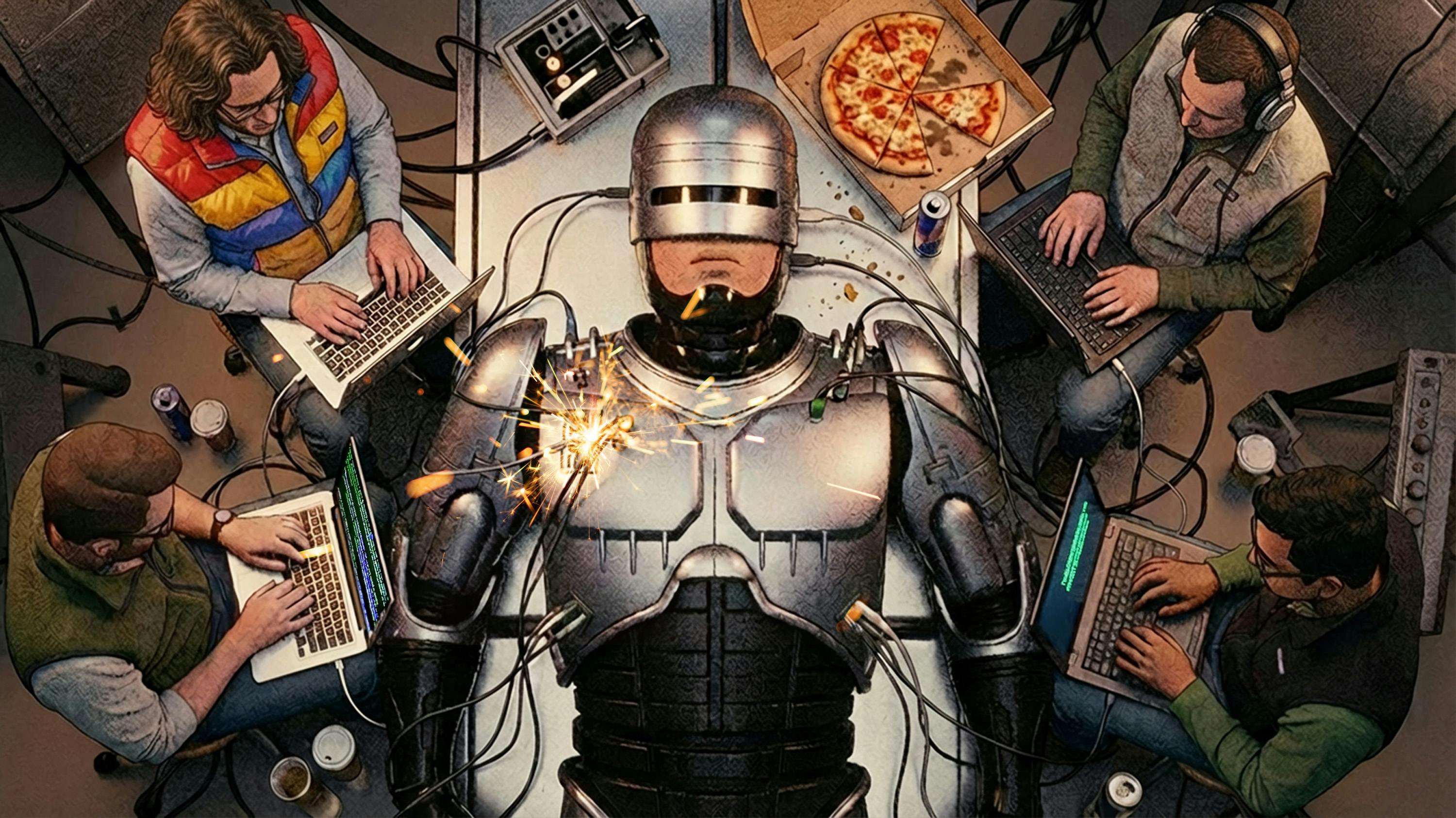
| Silicon Valley’s old taboos about selling technology to law enforcement and the government have disappeared, a shift prompted in no small part by the thriving success of Palantir and Palmer Luckey’s Anduril. |
| “Companies like SpaceX and Palantir and Anduril have just proved that you can build incredible businesses selling to the government,” said Blake Resnick, the 25-year-old founder of Brinc, which makes police surveillance drones. “I think that’s opened up a lot of eyes to the opportunity.” |
| Brinc is just one of at least two dozen startups that are fueling a startup boom in police and public safety tech. They make things like drones—and a lot of software, some of it quite like Palantir’s. And they sell it to city police departments and local public safety agencies, intensifying the digitalization of law enforcement that has already been occurring on a federal level—as you’ll read in my Big Read for Weekend. |
| The trend worries privacy advocates like Jay Stanley, an ACLU senior policy analyst, who think it’s contributing to a system of mass surveillance. “And mass surveillance is not good,” he said. |
|
 |
|
| As DraftKings, FanDuel and Coinbase jump on the prediction markets bandwagon, sports leagues are still figuring out what to the explosion of betting upstarts will mean for them, our Sara Germano and Yueqi Yang report. |
| Abram Brown is the editor of The Information's Weekend section. You can reach him at abe@theinformation.com or find him on X. |
| |
 |
| Watching: “2046” |
| Like more than a few women in “2046,” I too would like to somehow find myself in Hong Kong on Christmas Eve 1966, learning to cha-cha with Chow Mo Wan (Tony Leung). |
| The eighth movie by director Wong Kar Wai uses Christmas as a signpost of time as Chow alternates between womanizing and working on a science fiction novel, also called “2046.” I’d say more about the plot of “2046” the movie if it actually had one. (Wong famously shoots without a traditional written script.) Put broadly, it dwells much on loss and longing, pulling tightly on those feelings as it peers into the tiny rooms of the ruined Oriental Hotel, where Chow resides (in Room 2046). The visuals are lurid and sensual, many as carefully composed as museum artwork, and since much of the holiday season looks so samey-samey, the dreamlike surrealism is a nice treat.—Abram Brown |
| Watching: “The Holdovers” |
| If you saw Alexander Payne’s delightful Christmas film when it came out in 2023, enough time has passed: You’re due for a rewatch. If you haven’t seen it, you should. It’s an instant Christmas classic with a plot that’s wholesome enough to watch with your family, but it’s highbrow enough to ensure no one gets bored. The film involves a stern teacher (Paul Giamatti) and a bratty student (Dominic Sessa) marooned in a snowy boarding school campus over Christmas break. If you’re like me and fancy the idea of snow more than the reality of being knee-deep in it, you’ll enjoy taking in the wintry landscapes of New England and Boston from the comfort of your living room.—Theo Wayt |
| Watching: “The Holiday” |
| A grinch at The New York Times once described the plot of Nancy Meyers’ “The Holiday” as “equal parts charm and cringe.” As someone who considers Meyers the undisputed master of romantic comedy, I think the Times was displaying an unseasonable amount of derision. I find Meyers’ film entertaining rewatch after rewatch. |
| As for that plot, here it is: Iris (Kate Winslet), a London newspaper writer, decides to escape her stresses and unwind in sunny Los Angeles, something that always sounds great to me around this time of year. To do so, she swaps homes with Amanda (Cameron Diaz), who produces movie trailers. Through their temporary relocations, both women fall in love and realize things aren’t so bad. As they do, “The Holiday” features all of Meyers’ quintessential touches, like enviable interior design and heavy knit sweaters.—Ann Gehan |
| Watching: “ |