| | In this edition: Botswana’s economy forecast to shrink, One Good Text with David Miliband, and Afric͏ ͏ ͏ ͏ ͏ ͏ |
| |  | Africa |  |
| |
|
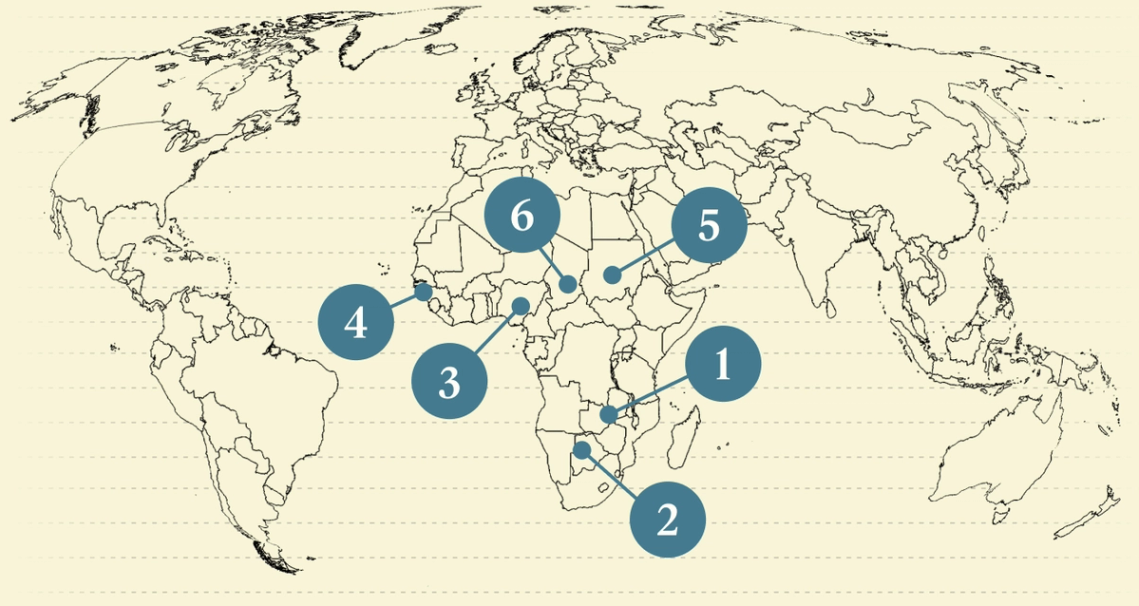 - Zambia expands parliament
- Botswana economy to shrink
- Nigerian oil boost
- Controversial vaccine trial
- Prioritizing Sudan
- Africa’s energy challenge
 The Week Ahead, and the revival of Zamrock. |
|
Zambia’s pre-election parliament change |
 Zambia President Hakainde Hichilema. Jekesai Njikizana/AFP via Getty Images. Zambia President Hakainde Hichilema. Jekesai Njikizana/AFP via Getty Images.Zambia will expand its parliament as part of constitutional changes that opposition groups say could favor the ruling party ahead of elections next year. President Hakainde Hichilema, who will seek a second term in the election scheduled for August 2026, has said some constituencies should be split into smaller ones because they were too big for effective service delivery. But his critics say Hichilema’s party can boost its share of the vote by dividing areas where it already has strong support. Leaders in other African countries — including Cameroon, Côte d’Ivoire, and Uganda — have in recent years been accused of using constitutional changes, such as altered term limits, to remain in power. Zambia, Africa’s second-largest copper producer, is still recovering from an economic crisis. It is restructuring about $13 billion in external debt after becoming the first African nation to default on its borrowing during the COVID-19 pandemic. The IMF last week said the country had reached agreements on most of its debt restructuring and “restored macroeconomic stability.” — Alexis Akwagyiram |
|
Botswana’s economy forecast to shrink |
 The amount by which Botswana’s economy is forecast to shrink this year, the country’s finance minister said, amid a prolonged downturn in the diamond market. Botswana, the world’s largest producer of diamonds by value, relies on the precious stones for around one-third of its national revenues and three-quarters of its foreign exchange receipts. The economic struggles have hit public services hard, leading the government to declare a national health emergency in August. President Duma Boko had promised to reduce Botswana’s reliance on diamonds before taking office at the end of last year. But the stones remain a priority. Gaborone is working on acquiring a majority stake in the diamond company De Beers — to increase its current 15% hold by buying shares from Anglo American — despite the IMF warning it could be a risky endeavor given the current diamond market. Angola’s state-owned diamond producer is also vying for a controlling stake. |
|
Heirs Energies lands $750M loan |
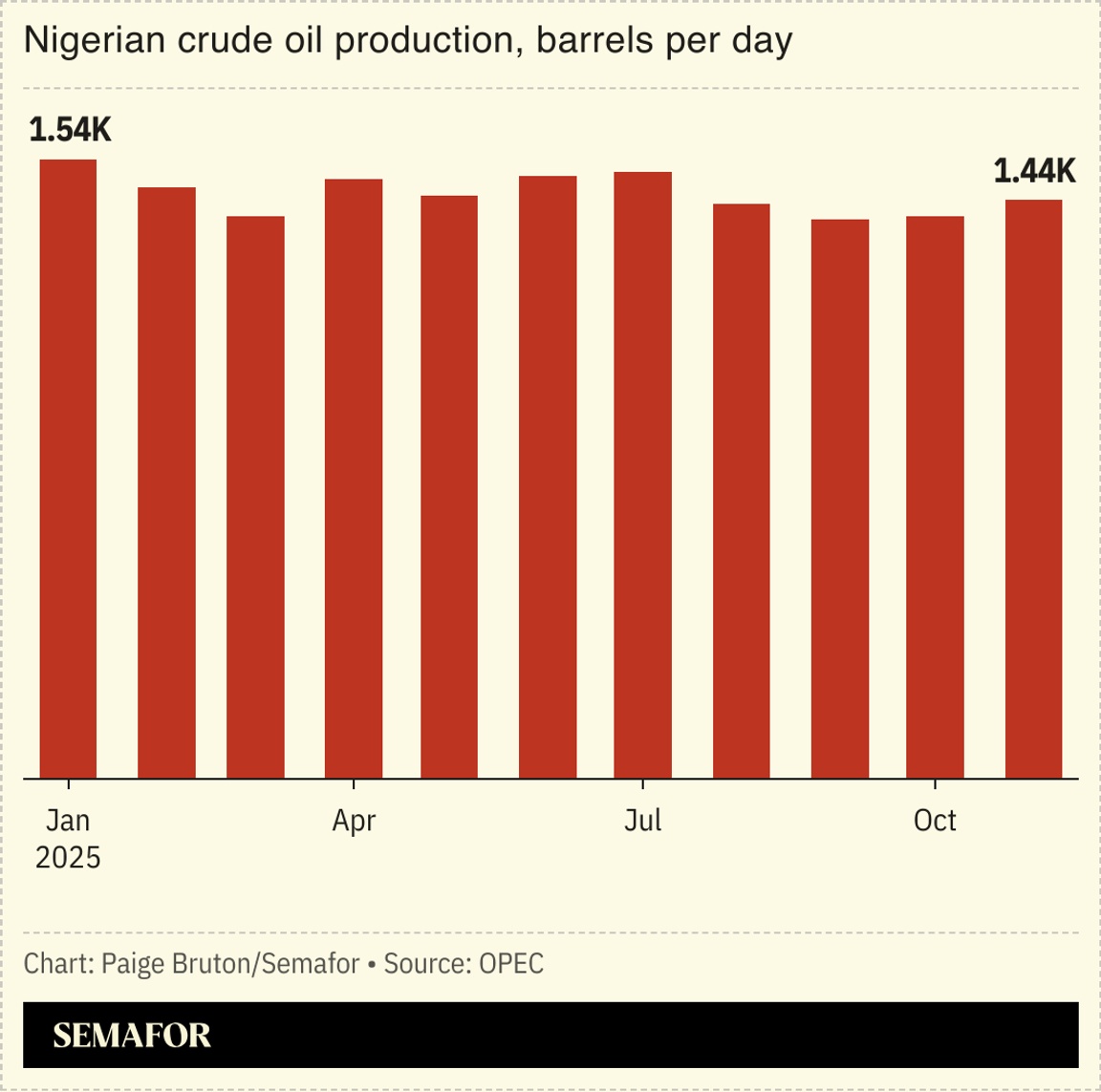 Nigerian oil and gas company Heirs Energies secured a $750 million loan from the African Export-Import Bank, to boost investment into an oil field that has doubled in capacity in four years. Heirs Energies is among a rising crop of indigenous firms looking to dominate the exploration landscape in Africa’s top oil-producing country and is part of a conglomerate owned by the Nigerian banking magnate Tony Elumelu. The company’s oil field in southern Nigeria is producing more than 50,000 barrels of oil per day this year, up from 25,000 bpd in 2021. The Afreximbank financing is targeted toward further increasing output, the company said. In October, Heirs Energies’ Chief Financial Officer Sam Nwanze said the company was looking to raise money to finance plans to double output to 100,000 bpd within three to five years. Oil and gas fundraising in Africa was benefiting from “a shift from international lenders wanting to focus once again on upstream oil and gas financing,” thanks to the influence of Washington’s interest in reviving the sector, Nwanze told Semafor. — Alexander Onukwue |
|
US plans Hep B newborn trial |
 Simon Maina/AFP via Getty Images Simon Maina/AFP via Getty ImagesThe US is planning to fund a controversial study in Guinea-Bissau into the effects of the hepatitis B vaccination on newborns. Washington is sending $1.6 million to a Danish research group “with ties to the US anti-vaccine movement,” reported NOTUS. The move comes days after a US panel of vaccine advisers voted to end the longstanding recommendation for vaccinations against the hepatitis B virus immediately after birth. Under the proposed five-year randomized controlled trial, the Danish research group will give some infants the vaccine at birth, and others the “standard” immunization in Guinea-Bissau, where the hepatitis B vaccine is first provided later, at six weeks of age. The birth dose is seen as crucial and scientists have raised concerns over the planned trial. “It is unethical to do a randomized controlled trial in which you withhold a proven, life-saving vaccine from newborn babies,” wrote a global health professor on BlueSky. The study’s researchers said they are not withholding any vaccines. “Half of the participants will receive an additional hepatitis B vaccine dose at birth that they would not otherwise have received,” they wrote. — Preeti Jha |
|
One Good Text with David Miliband |
The International Rescue Committee published a report last week that listed Sudan as the world’s worst humanitarian crisis. David Miliband, the former UK foreign secretary, is the IRC’s president and CEO. 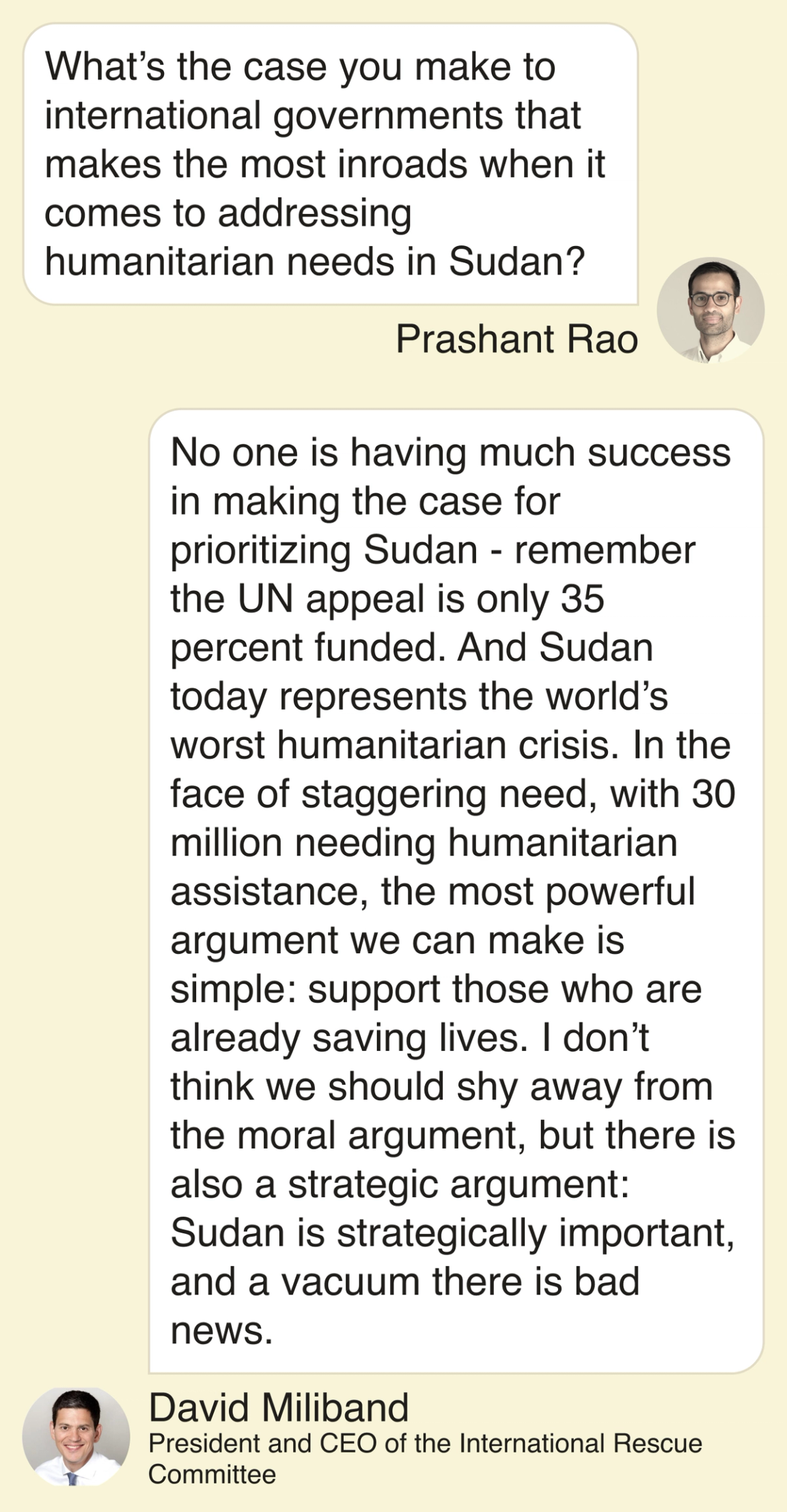 |
|
View: Africa’s energy trap |
  Mike Hutchings/Reuters Mike Hutchings/ReutersAfrica risks remaining trapped in a “low-energy, low-productivity equilibrium” unless it prioritizes industrial power demand, two experts argued in a column for Semafor. Across the continent, industrial potential is held back by costly and unreliable power supply, wrote W. Gyude Moore and Meron Tesfaye from the Energy for Growth Hub think tank in Washington. “Major development partners have inverted the historical sequence by prioritizing universal household access before securing large-scale industrial power,” they said, arguing that countries need to prioritize industrial demand alongside household access. “Industrial policy rests on cheap, reliable, large-scale energy. Without it, the path to prosperity does not exist,” wrote Moore and Tesfaye. |
|
 Business & Macro |
|
|