|
 |


 |
On November 18, Saudi Arabian Crown Prince Mohammed bin Salman (MBS) visited President Trump at the White House. During his meeting with MBS, Trump agreed to provide Saudi Arabia with unprecedented levels of cooperation and support.
Trump named Saudi Arabia a “major non-NATO ally,” a coveted designation that comes with “defense trade and security cooperation benefits, including access to joint research and development programs with the Pentagon and privileged access to US weaponry, training and loans.”
Further, Trump agreed to sell 300 Abrams tanks and an unspecified number of F-35 fighter jets to Saudi Arabia. Previously, Israel was the only country in the Middle East permitted to buy F-35s. Acquiring the advanced jets has long been a priority for MBS and the Saudi government.
Trump also agreed to cooperate with Saudi Arabia on civilian nuclear energy and to provide Saudi Arabia with access to advanced AI chips.
In addition to the practical benefits to Saudi Arabia, the visit helped burnish the international standing of MBS, who American intelligence concluded directed the murder of a U.S.-based journalist, Jamal Khashoggi. Trump called MBS a “very good friend of mine.”
Now, a few weeks later, MBS appears to be returning the favor.
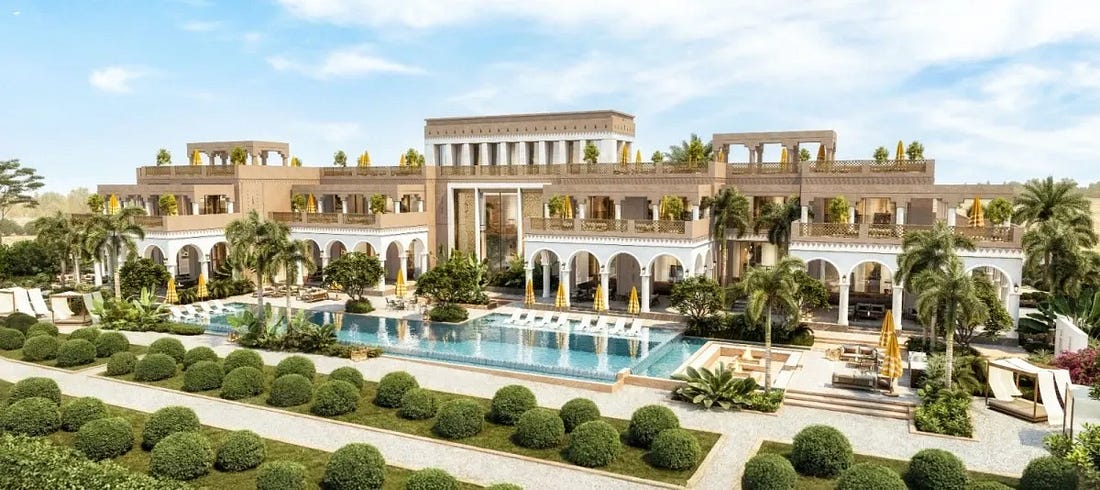
The Trump Organization announced it would be partnering with Dar Global to build a $7 billion “Trump-branded hotel and golf course” in Saudi Arabia. The development in Diriyah “will include 500 mansions, priced between $6.7 million and $24 million.”
The project is part of Diriyah, a $63 billion development financed by the Saudi Public Investment Fund (PIF). MBS is the chairman of PIF.
Eric Trump, in the press release announcing the new development, said it “will redefine luxury and excellence in the region, setting a new standard that reflects the brand’s enduring commitment to quality, prestige and timeless elegance.”
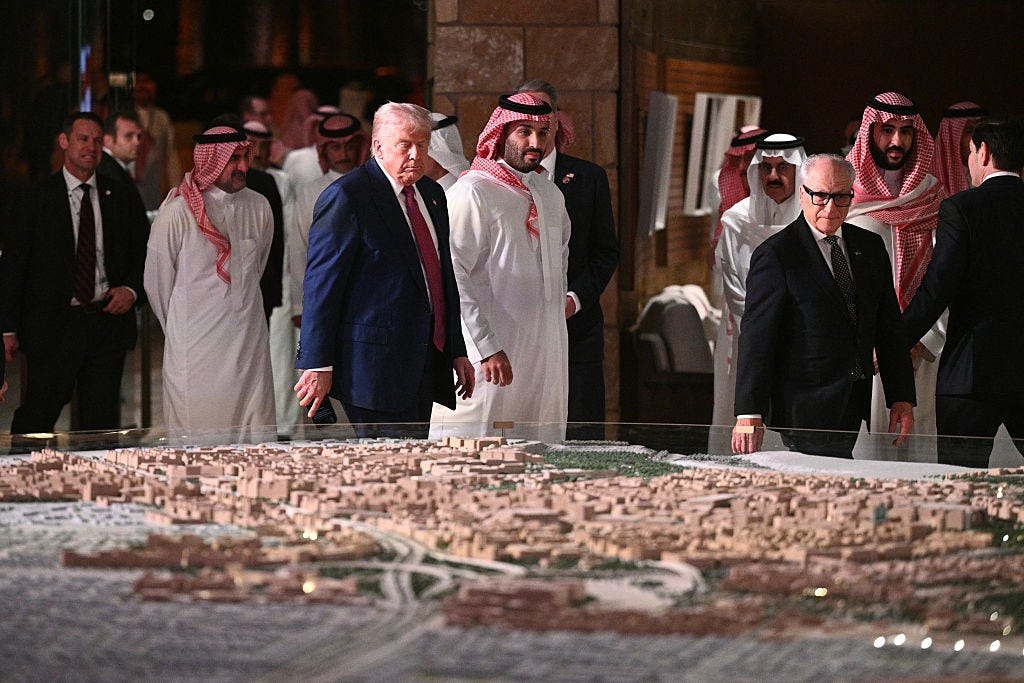
When Trump visited Saudi Arabia last May, MBS took him on a tour of Diriyah and showed him a model of the redevelopment project.
 |
Among other financial incentives, these deals involve the developer paying millions in fees simply to license the Trump name. About 80% of the money will flow directly to Trump, according to reporting on similar deals by Forbes.
During Trump’s first term, he established an ethics agreement that prohibited the Trump Organization from engaging in any new foreign deals — because such deals constituted an obvious conflict of interest. In his second term, Trump dropped that prohibition and instead agreed that the Trump Organization would not sign any deals directly with foreign governments.
The $7 billion development in Diriyah appears to violate that restriction. Dar Global, the Trump Organization’s official partner, is closely tied to the Saudi government. Moreover, the entire Diriyah development is funded by the Saudi government through the PIF. The Trump Organization press release notes the new development is part of the master plan being implemented by the Diriyah Company. But the Diriyah Company is a wholly owned subsidiary of PIF.
According to Jerry Inzerillo, who heads the Diriyah Company, Trump was “amazed“ by the project when he visited last year. “As a developer, he loves scale, he loves quality, he loves finishes,” Inzerillo said.
The White House generally deflects questions about conflicts of interest related to the Trump Organization by noting that the company is being held in a trust during his presidency. But the trust is just a legal artifice and does nothing to eliminate conflicts. Trump’s interest in the Trump Organization is being formally held by his son, Donald Trump Jr. However, Trump retains his ownership stake and has access to information about its financial performance. The ethics agreement prohibits Trump’s involvement in “day-to-day” management but is silent on larger strategic decision-making.
The Trump Organization also announced a separate $3 billion deal with Dar Global to construct Trump Plaza in Jeddah, Saudi Arabia.
No false equivalencies. No corporate overlords. No B.S.
Support accountability journalism.
|
