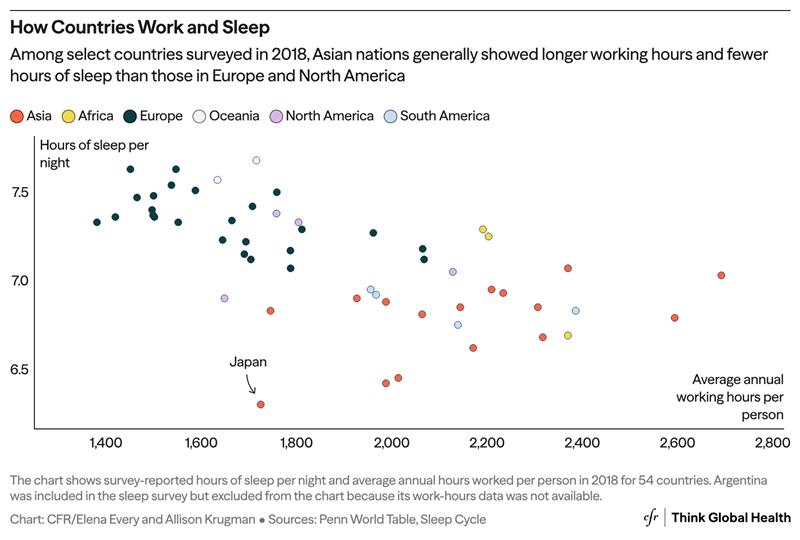
On Sunday, Japan’s first woman Prime Minister Takaichi Sanae won the biggest electoral victory in her party’s history just 110 days into her tenure. The landslide re-sparked comparisons between Takaichi and her role model, UK Prime Minister Margaret Thatcher, who twice consolidated power via landslide victories. But the two align on more than just their political popularity—both Takaichi and Thatcher have garnered attention for their minimal sleep schedules. Unlike Thatcher, however, who was applauded for her work ethic, Takaichi has drawn criticism.
That criticism comes amid growing awareness of karoshi, a Japanese term coined in the 1980s that means death from overwork. In 2021, approximately 750,000 deaths worldwide were attributable to karoshi. To assess how Japan’s work-life balance compares globally, CFR Research Associate Elena Every looks at the cultural and policy barriers that influence labor and productivity across countries.
Next, Lawrence O. Gostin, Georgetown University’s founding O’Neill chair in global health law, outlines how by withdrawing the United States from the World Health Organization, gutting the U.S. Centers for Disease Control and Prevention, and dissolving the U.S. Agency for International Development (USAID), President Donald Trump is shattering the norms and values of international institutions the United States helped create.
As global health funding plummets, Ipchita Bharali, Gavin Yamey, and Osondu Ogbuoji from the Duke Center for Policy Impact in Global Health, draw on their recent study, which highlights the overlooked economic, soft power, and health gains that donor countries receive from their contributions.
Until next week!—Nsikan Akpan, Managing Editor, and Caroline Kantis, Associate Editor