|
Does anyone know why we're still doing tariffs?
The ridiculous policy has taken on a life of its own.
|

| |||||||||||||||


 |
In case you haven’t heard, the Supreme Court just ruled many of Donald Trump’s tariffs illegal:
[T]he Supreme Court ruled that the unilaterally imposed [tariffs] were illegal…No longer does Trump have a tariff “on/off” switch…Future tariffs will need to be imposed by lengthy, more technical trade authorities — or through Congress…
In a 6-3 ruling, the Supreme Court said that affirming Trump's use of the International Emergency Economic Powers Act (IEEPA) would "represent a transformative expansion of the President's authority over tariff policy."…Chief Justice John Roberts said that IEEPA does not authorize the president to impose tariffs because the Constitution grants Congress — and only Congress — the power to levy taxes and duties.
This doesn’t mean that Trump’s tariffs are going to suddenly vanish. More are on the way. There are older laws passed by Congress in the 1960s and 1970s that authorize the President to raise tariffs under certain circumstances. Here’s a summary by the Yale Budget Lab:
[T]he president has other sources of legal authority to enact tariffs without further congressional action. These authorities generally fall into two groups: those that require investigations by federal agencies but have few if any restrictions on the eventual tariffs imposed (Sections 201, 232, and 301) and Section 122, which provides a temporary authority to impose tariffs without an investigation, but is limited to a 15 percent rate for only 150 days. There is another authority, under Section 338 of the Tariff Act of 1930 (otherwise known as Smoot-Hawley) that would allow the President to impose a 50 percent tariff with no investigation or time limitations, but no President has used this authority before, raising again concerns about future legal challenges.
For now, all those other laws still stand, and Trump is going to use at least some of them. He immediately invoked one of the other laws, called Section 122, to put a 10% tariff on all imports from all countries, and then raised that to 15% a day later. This means the overall statutory tariff rate on U.S. imports (or at least, on the mix of imports from 2024), which would have fallen to around 9% after the SCOTUS ruling, will actually fall only a tiny bit:
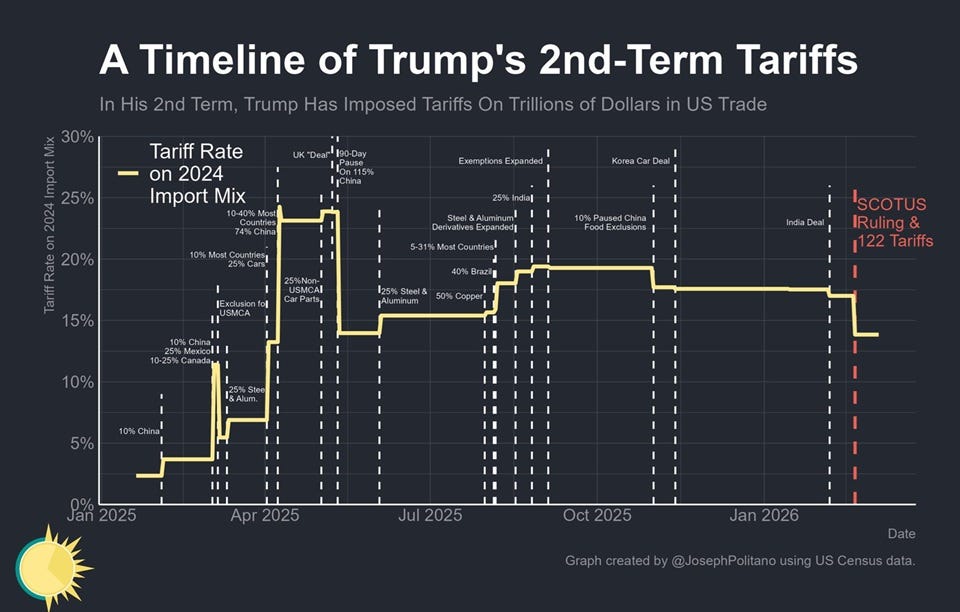 |
But tariffs are very complex, and there are a ton of exemptions. Because these tariffs are more blanket than the ones SCOTUS just struck down, and because they interact with other tariffs that are still on the books, the new regime could raise effective tariff rates to even higher levels than before the SCOTUS decision.
That Section 122 tariff is supposed to be temporary — it only lasts 5 months — but Trump can presumably just renew it for another 5 months when it ends, until he gets sued again and it goes back to the Supreme Court. Then if that doesn’t work, he can use the various other laws, getting sued each time. In other words, Trump will be able to keep imposing large tariffs for the rest of his term in office.
So the fun continues. Whee!!
What was the point of these tariffs? It has never really been clear. Trump’s official justification was that they were about reducing America’s chronic trade deficit. In fact, the initial “Liberation Day” tariffs were set according to a formula based on America’s bilateral trade deficits with various countries.¹ But trade deficits are not so easy to banish, and although America’s trade deficit bounced around a lot and shifted somewhat from China to other countries, it stayed more or less the same overall:
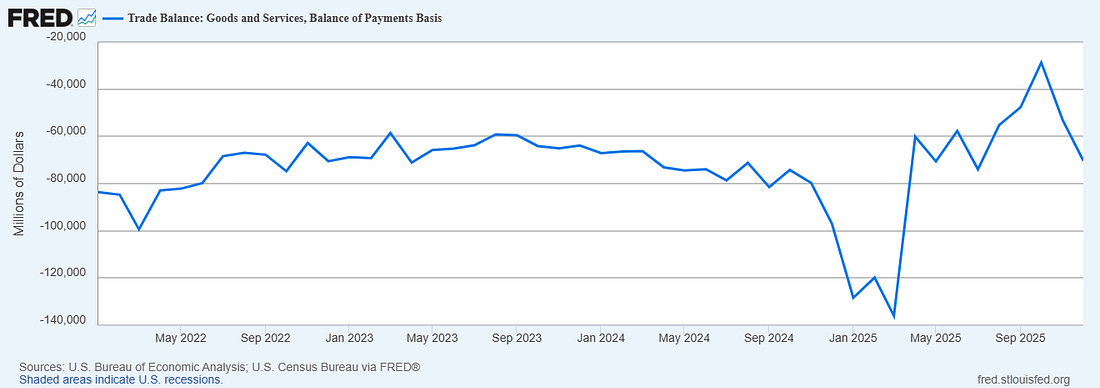 |
Economists don’t actually have a good handle on what causes trade deficits, but whatever it is, it’s clear that tariffs have a hard time getting rid of them without causing severe damage to the economy. Trump seemed to sense this when stock markets fell and money started fleeing America, which is why he backed off on much of his tariff agenda.
Trump also seemed to believe that tariffs would lead to a renaissance in American manufacturing. Economists did know something about that — namely, they recognized that tariffs are taxes on intermediate goods, and would therefore hurt American manufacturing more than they helped. The car industry and the construction industry and other industries all use steel, so if you put taxes on imported steel, you protect the domestic market for American steel manufacturers, but you hurt all those other industries by making their inputs more expensive.
And guess what? The economists were right. Under Trump’s tariffs, the U.S. manufacturing sector has suffered. Here’s the WSJ:
The manufacturing boom President Trump promised would usher in a golden age for America is going in reverse…Manufacturers shed workers in each of the eight months after Trump unveiled “Liberation Day” tariffs, according to federal figures…An index of factory activity tracked by the Institute for Supply Management shrunk in 26 straight months through December…[M]anufacturing construction spending, which surged with Biden-era funding for chips and renewable energy, fell in each of Trump’s first nine months in office.