Novo Nordisk’s weight-loss woes, smart souvenirs from Paris’s Le Giftshop and soundtracking Burberry’s runways.
|
Tuesday 24/2/26
|

|
|
London
Paris
Zürich
Milan
Bangkok
Tokyo
Toronto
|
|
|
|

Good morning. Yesterday it was Peter Mandelson’s turn to be put in the back seat of a car and whisked away for police questioning. What will it mean for the UK and Keir Starmer? Tune in to Monocle Radio for the latest. Here’s what’s coming up in today’s Monocle Minute:
THE OPINION: US military build-up in the Middle East is a statement of intent
HEALTH: Novo Nordisk’s weight-loss woes
DAILY TREAT: Pick up smart souvenirs from Giftshop
Q&A: Building Burberry’s sound with DJ Benji B
|
|
The largest US military build-up in the Middle East in decades fuels uncertainty in Tehran
By Inzamam Rashid
|

|
The concentration of US firepower around Iran now looks less like signalling and more like sequencing. For months, tensions between Washington and Tehran have simmered over nuclear thresholds, regional proxies and the careful choreography of red lines repeatedly tested but never quite crossed. What distinguishes this moment is not the rhetoric but the hardware. The assets now in play suggest that the US is no longer merely demonstrating resolve – it’s positioning itself for choice.
Since late January, a carrier strike group built around the USS
Abraham Lincoln has been operating in the region – substantial enough on its own. But increasingly, there are more. The USS
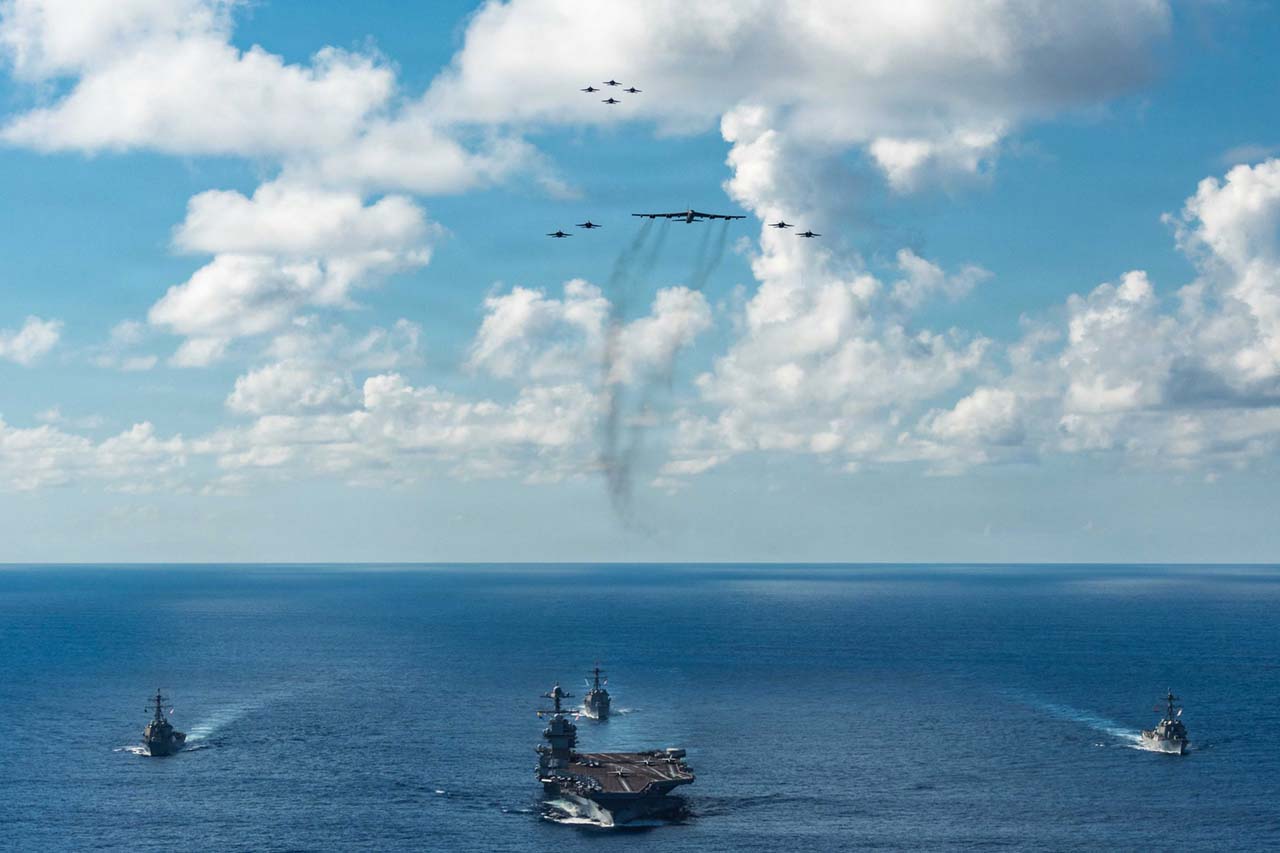
Gerald R Ford, the largest aircraft carrier in the world, has been positioned at the mouth of the Mediterranean and is moving eastward. Two carrier strike groups – one in the Arabian Sea and one in the Mediterranean – would give Washington overlapping arcs of airpower and cruise-missile reach. Around them sit at least 11 air-defence destroyers, three littoral combat ships and two to three attack submarines equipped with Tomahawk missiles. That is the naval element of the equation: visible, mobile and readied to project force.
The second part is both logistical and defensive. In the past month, more than 250 US military airlift flights have landed in the Middle East and surrounding hubs, moving large equipment and air-defence assets. Over the past two weeks, C-17 Globemasters and C-5 Super Galaxies – the US Air Force’s broad-shouldered, heavy-lifting aircraft – have been shuttling equipment into American facilities across the Gulf. The likely purpose is straightforward: harden bases against retaliation before any strike begins.
|
|
|
Up in the air: The US’s expanded presence had lead to uncertainty
|
|
At Al Udeid Air Base in Qatar, aircraft numbers have climbed from 16 to 29, including seven C-17s and 17 KC-135 refuelling tankers. Unlike those behemoth aircraft carriers, tankers are a more subtle indicator of intent. They extend range, loosen political constraints and allow aircraft to operate from further afield if host nations hesitate.
The final element is geographical. Flight tracking over the past week shows multiple waves of KC-135 tankers moving from the US via the UK to bases in Greece and Bulgaria. Six were tracked on 16 February; another 10 followed on 18 February, staging through the UK before heading southeast. The message is implicit. Even if access to some Middle Eastern bases becomes politically fraught, aircraft could operate from southern Europe, with tankers bridging the distance. The movements of US assets confirm that Washington is deliberately widening its geography.
Overlaying all the traffic and hardware is command and control. Six E-3 Sentry AWACS aircraft – the distinctive radar-domed platforms that map the battlefield in real time – are now in theatre. With sufficient tankers and airborne early warning cover, a large-scale air campaign moves beyond theory and threat.
Diplomacy, for now, is running in parallel. A fresh round of US-Iran talks is scheduled in Geneva this week, with Oman mediating. The timing is awkward; negotiations are resuming just as the military appears closest to operational readiness. Taken together, the naval mass, reinforced air defences, tanker bridge to Europe and expanded airborne command assets suggest that Washington could sustain a significant campaign. Today’s US administration, perhaps more than others, is capable of tilting leverage toward action. The open question is not capability, it is intent. Hopefully this military posturing is enough to lure Tehran to the table and strike a deal.
Inzamam Rashid is Monocle’s Gulf correspondent. For more opinion, analysis and insight, subscribe to Monocle today.
|
|
HITACHI ENERGY
 MONOCLE MONOCLE
|
|
health: denmark
Novo Nordisk’s weight-loss woes deepen as its latest drug falls short
We’re not ones for kicking folks when they’re down but things seem to be going from bad to worse for Danish pharmaceutical giant Novo Nordisk (writes Michael Booth). The drugmaker was once Europe’s most valuable company thanks to its discovery of obesity treatment Wegovy. But since peaking in 2024, its share price has fallen by roughly two-thirds amid disappointing clinical trial results, a poorly handled change of CEO and mass redundancies. Increasing competition and a lack of control over copycat drugs produced by US compounders have also hit hard.
It was hoped that the approval of an oral version of Wegovy in December would help to pull the company out of its slump. Instead, more disappointment has followed. Novo’s next would-be breakthrough weight-loss treatment, Cagrisema, appears underwhelming, even before launch. A study published yesterday found it to be less effective than rival Eli Lilly’s Tirzepatide. Novo had been counting on Cagrisema to reignite growth in a market already unsettled by concerns over side effects and the tendency for users to regain weight after stopping treatment. By now, shareholders must be hoping for a miracle.
Further reading?
–Is Novo Nordisk’s slimming down symptomatic of a broader Danish business naivety? Our Copenhagen correspondent thinks so.
|
|
• • • • • DAILY TREAT • • • • •
Find smart souvenirs at Giftshop
Since its launch in 2023, Paris’s Giftshop has worked with 50 of the French capital’s best restaurants and hotels to provide smart souvenirs, including Savy, Brasserie Lipp and La Grande Épicerie de Paris. “We wanted to challenge the idea of the Parisian keepsake, moving away from the anecdotal or decorative and towards objects that feel culturally grounded,” says co-founder Mathieu Lebreton.
The brand’s bricks-and-mortar boutique in the Palais-Royal occupies a site that once housed gastronomic institution Le Bœuf à la Mode, which was frequented by the likes of Napoleon and Colette. Monocle recommends picking up a butter knife from À La Mère de Famille, Paris’s oldest chocolatier, or a dinner plate from Au Pied de Cochon, the city’s first 24-hour brasserie.
giftshop.club
|
|
|
Sponsored by Hitachi Energy
|
|
|
|
|
|
Q&A: Benji b
DJ and producer Benji B on building Burberry’s sound and the power of British music
The autumn/winter edition of London Fashion Week concluded last night with British luxury fashion house Burberry showing its collection at Old Billingsgate – a former Victorian fish-market-turned-events-space (writes Grace Charlton). Providing the soundtrack to the evening was British DJ, producer and radio presenter Benji B, who has collaborated with the brand since Daniel Lee was appointed chief creative director in September 2022. “When I see feet tapping at a show I know that I’ve done a good job,” he tells The Monocle Minute.
Here we hear from Benji B about this season’s inspiration and why the UK’s music scene is a soft-power tool.
| | | | |