|
 |
Welcome to Popular Information, a newsletter dedicated to accountability journalism.


 |
“We did not protect President Trump.”
That is what Deputy Attorney General Todd Blanche said on January 30, after what he described as the final release of the Department of Justice’s (DOJ) files on convicted sex offender Jeffrey Epstein.
It turns out that was not true.
According to a new report by NPR, the DOJ is withholding “more than 50 pages of FBI interviews, as well as notes from conversations with a woman who accused Trump of sexual abuse decades ago when she was a minor.” The New York Times also reported Wednesday that the DOJ withheld summaries of three FBI interviews with the woman about her interactions with Trump. They released a fourth FBI interview, where the woman made allegations about Epstein.
The missing files were first discovered by independent journalist Roger Sollenberger.
The failure to disclose the interviews about Trump and related files seemingly puts the administration in violation of the Epstein Files Transparency Act. That law, signed by Trump last year, prohibits the withholding or redacting of documents “on the basis of embarrassment, reputational harm, or political sensitivity, including to any government official, public figure, or foreign dignitary.”
The DOJ released a statement on Tuesday claiming that any document withheld “falls within one of the following categories: duplicates, privileged, or part of an ongoing federal investigation.”
The interviews about the allegations against Trump, however, are not duplicates. Nor is it clear what legal “privilege” would allow the DOJ to disclose FBI interviews where the woman is questioned about her allegations against Epstein, but not interviews with the same woman about Trump. On CNN earlier this month, Blanche indicated that there were no ongoing investigations, saying that the DOJ already determined in July “there was nothing in there that allowed us to prosecute anybody.”
In a second statement, released by the DOJ on Wednesday afternoon, the DOJ directly addressed the missing interviews, referring to them as “documents produced to Ghislaine Maxwell in discovery of her criminal case.” The suggestion was that the documents were withheld pursuant to a protective order in that case. But the DOJ, in a court filing, already acknowledged that those documents were not subject to the protective order. Further, as Sollenberger noted, the DOJ released many other files from the Maxwell discovery.
Congressman Robert Garcia (D-CA) said, “The DOJ appears to have illegally withheld FBI interviews with this survivor who accused President Trump of heinous crimes.”
The withheld documents also undermine Trump’s claim that he was “totally exonerated“ by the release of the files. Trump cannot be exonerated by the release of the files when key documents related to serious criminal allegations were not disclosed.
Released files reveal the woman “came forward in July 2019,” days after federal officials arrested Epstein. The woman alleged, according to a summary of one interview that was disclosed, that Epstein “repeatedly assaulted” her in the 1980s, when she was a minor.
Summaries of three interviews regarding the woman’s allegations against Trump are being withheld. But a brief description of the woman’s allegations was included in a 2025 DOJ slide presentation that was released.
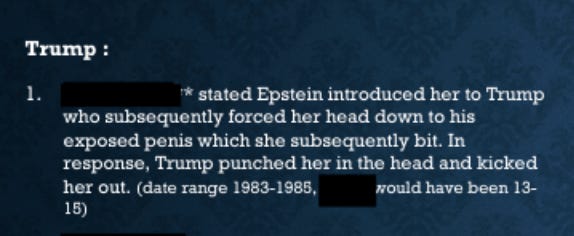 |
According to the slide presentation, the woman claimed that Trump attempted to force her to perform oral sex. When she resisted, Trump allegedly “punched her in the head.” This allegedly occurred when the woman was between 13 and 15 years old.
The revelation that FBI interviews with the woman about Trump are being withheld raises serious questions. Why did the FBI interview the woman three times regarding her interactions with Trump? Why has the DOJ gone to such extremes to keep these interviews from the public?
No corporate overlords. No false equivalencies. No BS.
Upgrade to a paid subscription to support independent accountability journalism.