India’s Climate Policy Pivot, Elections Across Asia, and U.S. Ties to Asia |
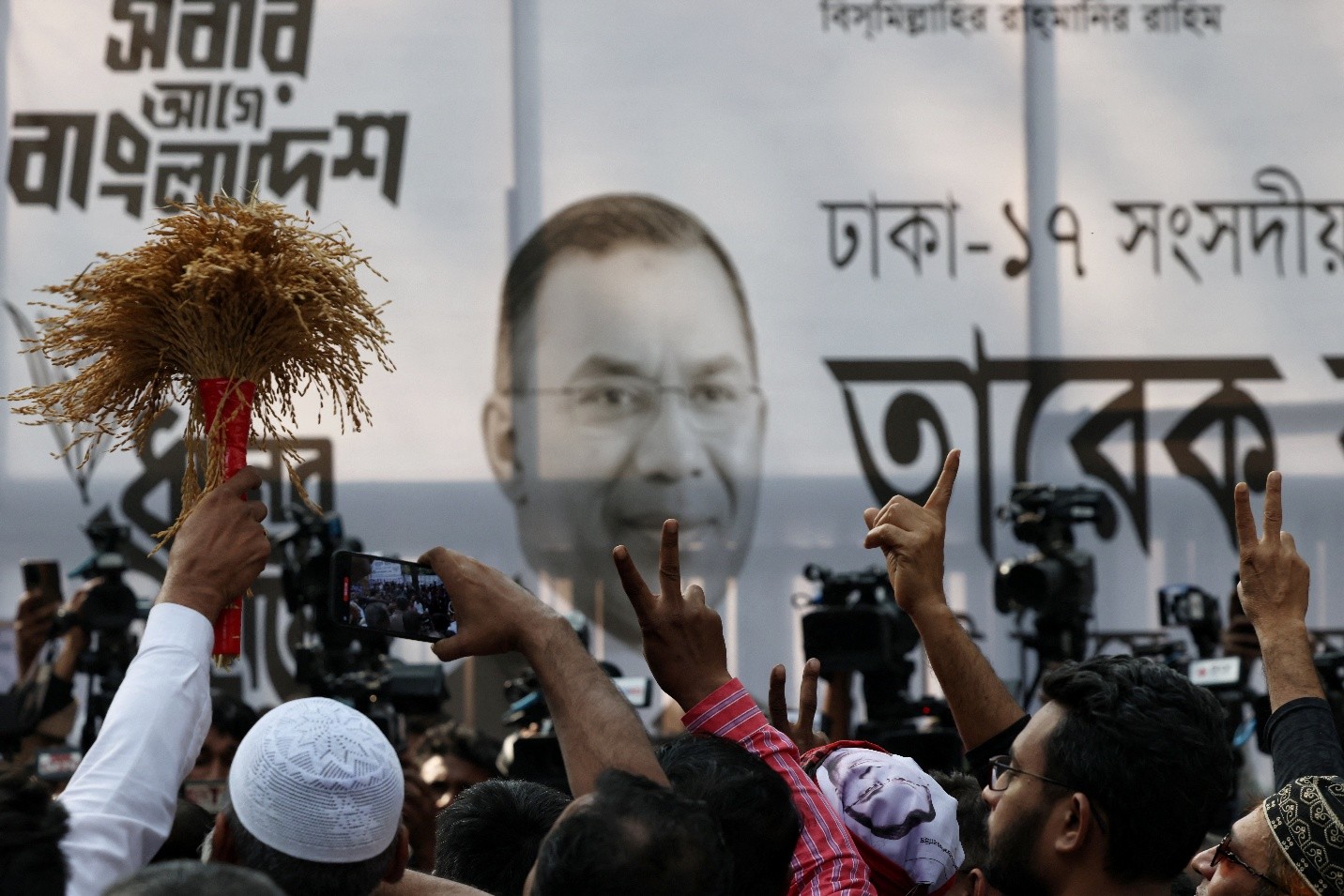
Supporters of the Bangladesh Nationalist Party (BNP) show victory signs in front of a banner with BNP Chairman and newly elected Prime Minister Tarique Rahman’s photo in Dhaka, Bangladesh, after the general election on February 13, 2026. (Mohammad Ponir Hossain/Reuters)
|
In this month’s newsletter, Council on Foreign Relations (CFR) experts dive into the outcomes of consequential elections across Asia, India’s pivot to clean energy, and the United States’ changing relations with its Indo-Pacific partners, among other topics. |
|
|
India’s Clean Energy Odyssey |
|
|
India’s recent climate and energy policies have positioned the country as a leader on global climate issues. Senior Fellow for India, Pakistan, and South Asia Manjari Chatterjee Miller analyzes the break between the United States and India on climate and energy norms in a CFR article. Read more
|
|
|
India is attempting a veritably revolutionary energy transition away from coal and toward cleaner sources, writes Senior Fellow for Climate and Energy Clara Gillispie in a CFR article. She argues that to achieve its aggressive decarbonization objectives, India needs to be even more disruptive of its current energy makeup. Find out more
|
| |
Elections in Bangladesh, Japan, and Thailand |
| |
Across Asia, Gen Z is still struggling to turn protest into success at the ballot box, argues Senior Fellow for Southeast Asia and South Asia Joshua Kurlantzick in a CFR article. Case in point: although student protestors toppled the Bangladesh government in 2024, the country’s national election in February featured a landslide victory for the ruling Bangladesh Nationalist Party, while the favored Gen Z party got only six seats. Read Kurlantzick’s take
|
|
|
Ahead of a snap election called by Japanese Prime Minister Takaichi Sanae on February 8, John E. Merow Senior Fellow for Asia-Pacific Studies Sheila A. Smith and Research Associate for Asia-Pacific Studies Chris Baylor penned a three-part series analyzing the policy priorities of voters that would shape the election results. They address how the public’s concerns over the growing number of non-Japanese in society, money in politics, national security, and the need for political reform played a role in determining the 2026 election. Get the full story
|
| |
The results of Thailand’s most recent national election defied some poll predictions, with the conservative Bhumjaithai Party far outpacing the reformist People’s Party (PP) and other competitors. In a new article for CFR, Kurlantzick analyzes how PP’s political missteps, Bhumjaithai’s mastery of patronage politics, and nationalist currents buoyed by Thailand’s conflict with Cambodia contributed to the election’s outcomes. Read on
|
| |
Breaking from a fifteen-year period of deepening ties with the Indo-Pacific, the United States has made a strategic turn toward the Western Hemisphere under the second administration of President Donald Trump. Kurlantzick argues in a CFR article that the approach has strained U.S. relations with India, Japan, and others, leaving Asian allies questioning the United States’ reliability. Get his take
|
|
|
The new U.S.-Taiwan Reciprocal Trade Agreement should provide welcome stability to bilateral economic ties, but differences over the bilateral trade balance, moving more semiconductor manufacturing to the United States, and Taiwan’s currency intervention will remain, notes Fellow for Asia Studies David Sacks in a CFR article. Read his analysis
|
| |
For China Books Review, Senior Fellow for Asia Studies Joseph Torigian reviews a startling new Chinese-language biography of former Chinese Communist Party Chairman Mao Zedong’s onetime enforcer that reveals the folly of hoping that party officials will break ranks—and suggests that long-held theories about why Mao launched the Cultural Revolution are wrong. Read the full review
|
| |
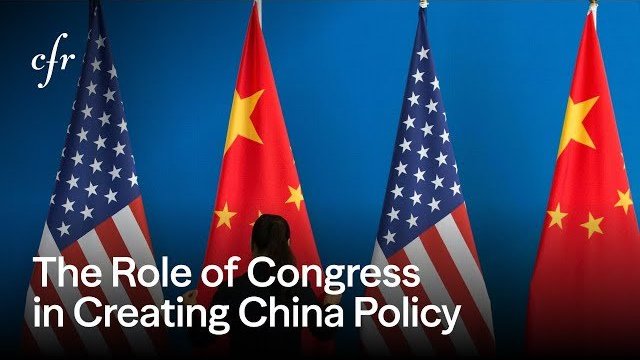
In a conversation moderated by C.V. Starr Senior Fellow for Asia Studies and Director of the China Strategy Initiative Rush Doshi, U.S. Senators Christopher Coons (D-DE) and Pete Ricketts (R-NE), both members of the Senate Committee on Foreign Relations, discuss the role of Congress—relative to the executive branch—in formulating, resourcing, and creating China policy. The event was co-organized by the Council on Foreign Relations’ China Strategy Initiative and the 21st Century China Center of the School of Global Policy and Strategy at the University of California, San Diego, as part of the annual Washington China Forum. Watch the conversation
|
| |
|
Torigian joins the Driving With Dunne podcast to shed light on the family origins and meteoric political rise of China’s dominant and inscrutable leader, Xi Jinping. Listen to the episode |
| |
|
“The Goal Has Always Been to Silence Him,” Says Analyst on Jimmy Lai’s Sentencing (Rush Doshi, CNN) Historic First Phase of India-U.S. Trade Deal Sets Stage for FTA: Former Envoy (Kenneth I. Juster, NDTV)
Bangladesh Elections Test Ties With India as China Deepens Outreach (Joshua Kurlantzick, Japan Times)
2026 Election: Why Did the People’s Party Fail to Achieve Its Dreams? (in Thai) (Joshua Kurlantzick, The Standard)
Bangladesh’s Free Election (Joshua Kurlantzick, Morning Dispatch)
Bangladesh Verdict Shows How Gen-Z Fails to Turn Demonstrations Into Political Success: Report (Joshua Kurlantzick, IANS) B’desh Verdict a Setback for Gen-Z Political Movement (Joshua Kurlantzick, Shillong Times)
Donald Trump Endorses Japan’s Sanae Takaichi Ahead of General Election (Sheila A. Smith, Financial Times)
Japan’s Elections: Is the Opposition Too Splintered to Pose a Threat? (Sheila A. Smith, DW News)
Takaichi Carried Japan’s Ruling LDP to Stunning Election Win: Analyst (Sheila A. Smith, Channel News Asia)
Thai, Japanese Stocks Surge on Ruling Parties’ Election Wins (Sheila A. Smith, Bloomberg Television)
How Japan’s Leader Rescued Her Party From the Abyss (Sheila A. Smith, New York Times)
Takaichi Landslide Puts Japan at Crossroads: Trump Ally or “G6” Anchor? (Sheila A. Smith, Nikkei Asia)
Japan PM Takiachi Chases Mentor Abe’s Dream (Sheila A. Smith, Nikkei Asia)
2026 Lower House Election: Insights Experts on Future Outlook (in Japanese) (Sheila A. Smith, Yomiuri Shimbun)
In Xi’s Purge of the Military, a Search for Absolute Loyalty (Joseph Torigian, New York Times)
Reading Between the Party Lines: How Xi Wields Books as a Political Weapon (Joseph Torigian, The Australian)
Zhang Youxia’s “Seven Deadly Sins” and the Demise of the Myth of a “Second-Generation Red” Family Connection (in Chinese) (Joseph Torigian, BBC)
Xi Purged His Army’s Commander in Chief, a Move That Surprised Even Him (in Hungarian) (Joseph Torigian, Telex)
The End of a Princeling (in German) (Joseph Torigian, Der Spiegel)
What Is Happening at the Top of the Chinese Army, After the Dismissal of Its Top General for Corruption? (in French) (Joseph Torigian, RTS)
Book Reviews: February 2026 (Joseph Torigian, U.S. Naval Institute)
|
|
|
|