|
Almost Timely News: 🗞️ How To Measure Whether AI Will Take Your Job (2026-03-15)
AI won't take your job, it'll just take 80% of the tasks that make up your job
|

| |||||||||||||||


Almost Timely News: 🗞️ How To Measure Whether AI Will Take Your Job (2026-03-15) :: View in Browser
 |
The Big Plug
👉 I’ve got a new course! GEO 101 for Marketers.
👉 Just updated! The Unofficial LinkedIn Algorithm Guide, March 2026, now with new information straight from LinkedIn!
Content Authenticity Statement
100% of this week’s newsletter content was originated by me, the human. Learn why this kind of disclosure is a good idea and might be required for anyone doing business in any capacity with the EU in the near future.
Watch This Newsletter On YouTube 📺

Click here for the video 📺 version of this newsletter on YouTube »
Click here for an MP3 audio 🎧 only version »
What’s On My Mind: How To Measure Whether AI Will Take Your Job
In this week’s newsletter, let’s talk About Anthropic’s recent workplace AI study that many folks, including myself, shared. In it, they showed the theoretical maximum impact of AI on professions and then the current use based on Claude aggregated usage.
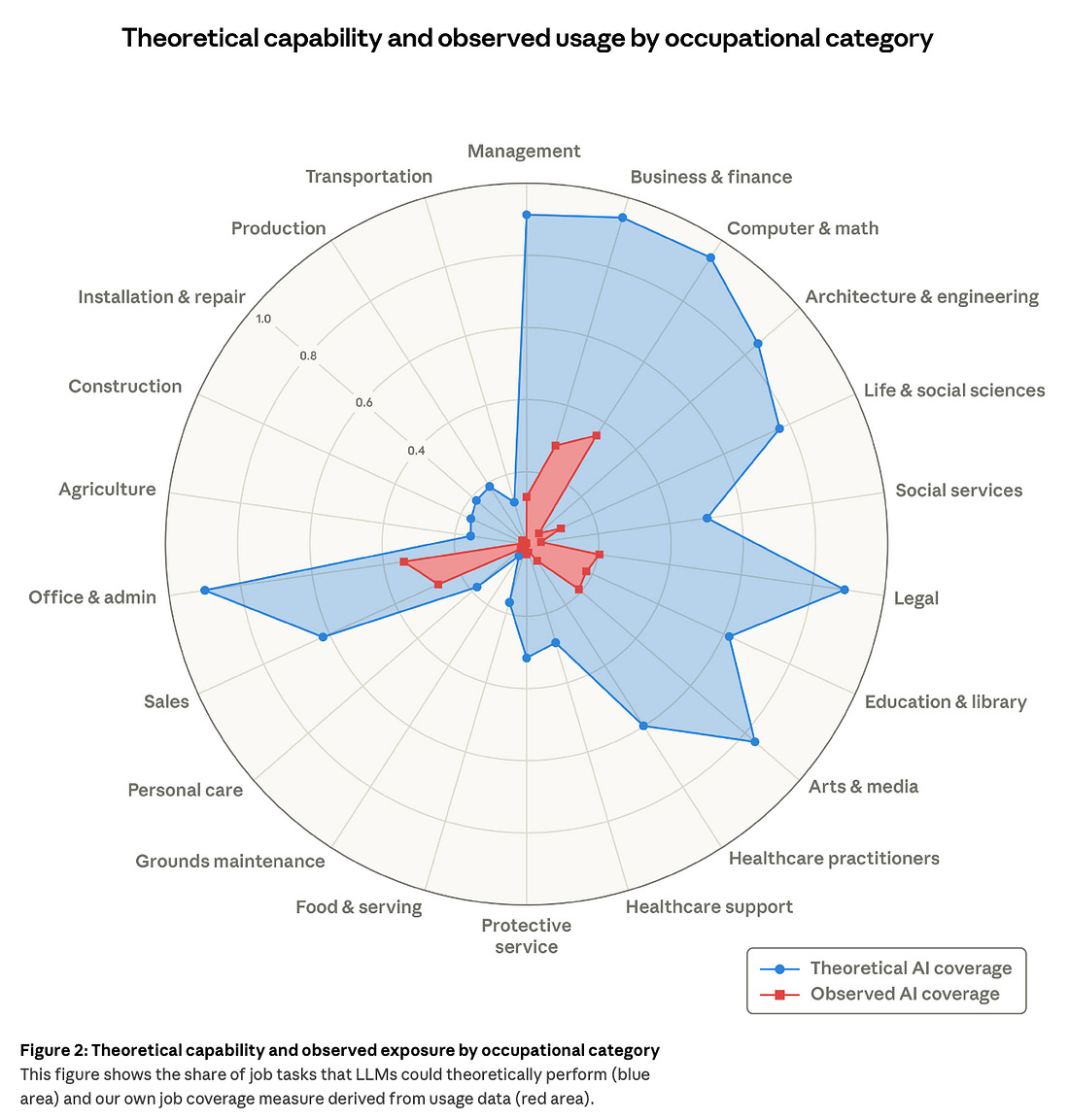 |
I thought the study overall was directionally helpful, to understand broadly what industries are already seeing impact and what the probable highest impact areas are, but these are at the macro level. That’s understandable both from a privacy protection angle as well as having enough data.
But that got me thinking - what if we could drill down further, to understand our personal exposure to AI in a more focused way? What if we could see the theoretical maximum impact for our specific careers or even our current jobs?
One of the biggest questions everyone has at every event I speak at is w”hen is AI going to take over my job?” People want to know about AI’s impact to them personally. They want to know “how exposed am I or my kids or my friends to AI and employment risks”.
How could we go about doing this? Unsurprisingly, we use AI for it. Let’s explore how.
Part 1: Identifying Tasks
At Trust Insights we spend a heck of a lot of time on frameworks to help contextualize AI. One of ours, the TRIPS framework, looks at five factors to evaluate any task:
Time: How much time does a task take? The more time a task takes, the better a candidate it could be for AI.
Repetitiveness: How repetitious is a task? The more repetitive a task is, the better it might be for AI to handle it.
Importance: How economically important is a task? The more valuable a task is economically, the more sense it makes to have AI do that task. Assuming the same quality of output but dramatically increased speed, AI can add to the bottom line faster for more economically important tasks.
Pain: How painful is a task? The more painful a task is, the better candidate it is for AI. AI adoption goes up as painful tasks go down.
Sufficient Data: How many examples do you have of successful task outcomes? The more success examples and data you can provide, the better AI will do at a task.
The TRIPS framework is often something that we use when we’re auditing companies for AI readiness, but it’s also something that AI itself is quite good at evaluating.
Our first step is to understand the most common tasks for any given position. The easiest way to do this is to grab a small collection of job descriptions. Head over to your favorite job board and put in your job title or position - your current one, and if you’re thinking about making a change, an aspirational job title. Copy and paste 3-5 job descriptions for that position so you get a sense of what’s involved in a job, then put that all in a text document.
Once you’ve done that, ask your favorite AI of choice to make a granular list of tasks that comprise the job. Here’s a starting prompt.
Based on the job descriptions in {your text file name}, infer a list of the top 25-100 individual tasks a person in this job is most likely to perform, in descending order of frequency. We define a task as a singular work output. An example of a task is creating a weekly report. Part of your analysis should include 3-7 broad categories of tasks from the job descriptions; this field should be named task_category. Format your response as YAML array with the task name, task category, a concise one sentence description of the task, the percentage frequency that the task occurs weekly in that job, and five columns from the Trust Insights TRIPS framework, scoring the task on an integer score of 1-5 for each of the 5 dimensions, inferring scores based on the job description and your background knowledge. Use your web search tools if you are not confident in your estimates. Return your result as a YAML array. If there are more than 100 tasks, truncate at 100. Ask me questions until you have enough information to complete the task.
Copy and paste the TRIPS framework after. What you’ll end up with is a pile of YAML, a data format that AI is excellent at reading. This is likely to be quite extensive, and that’s good. The more granular and specific we can be, the better.