|
|
|
|
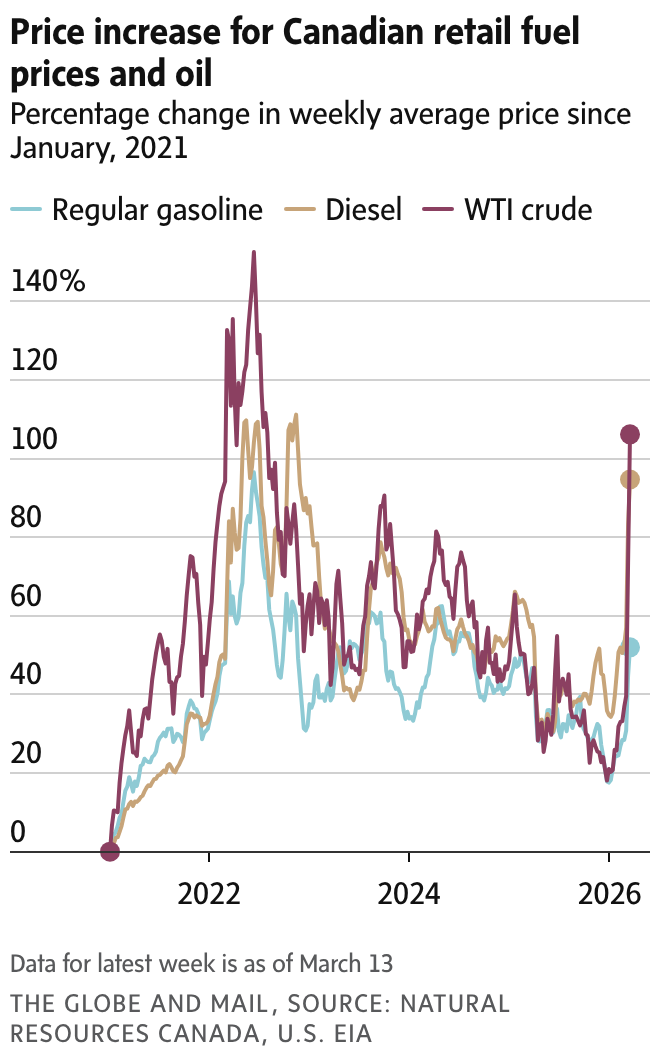
Good morning. Oil prices continue to surge as the war in the Middle East could potentially push prices to demand-destruction levels of US$200 a barrel. We’re watching Canada’s energy vulnerabilities and opportunities, how this crisis is affecting fertilizers and farmers, and its role in the Bank of Canada’s interest rates. To soften the blow, we’ll wrap up with some good news on IPOs. |
|
|
|
|
|
|
|
|
|
|
|
|
|
|
|
|
Real estate: New data from Equifax Canada show that homeowners with stronger credit scores are increasingly defaulting on mortgage payments. |
|
|
|
|
Financial crime: Law-enforcement agencies in Canada, the U.S. and Britain are teaming up for a week-long blitz aimed at tackling cryptocurrency investment scams. |
|
|
|
|
Middle powers: Canada and five other Nordic countries are vowing closer collaboration as a middle-power bloc after Prime Minister Mark Carney joined in a summit on Sunday in Oslo. |
|
|
|
|
|
|
|
|
|
|
|
|
|
|
|
An LPG gas tanker at anchor as traffic is down in the Strait of Hormuz, amid the U.S.-Israeli conflict with Iran, in Shinas, Oman, March 11. Benoit Tessier/Reuters
|
|
|
|
|
|
|
|
|
|
|
Hi, I’m Kate Helmore filling in for Chris Wilson-Smith today. In our usual Monday fashion, here are five files that I think are worth watching this week. |
|
|
|
|
1. Canada’s second chance in the global LNG race |
|
|
|
|
Canada is the fifth-largest producer of natural gas but ranked 19th out of 24 countries in exporting LNG last year, reported The Globe and Mail’s Brent Jang. A lot of this comes down to a failure to build LNG export terminals, a race Canada resolutely lost to the U.S. a decade ago. |
|
|
|
|
|
|
|
|
While in the U.S. eight LNG export terminals have opened since 2016 – and another four are slated to be operating by 2028 – the only LNG export terminal running so far in Canada is the Shell PLC-led LNG Canada project in Kitimat, B.C. |
|
|
|
|
But opportunity might favour Canada once again as the war in Iran has driven an energy crisis and put a fire underneath Canada’s energy sovereignty policy. |
|
|
|
|
The Strait of Hormuz was effectively closed shortly after the United States and Israel launched attacks against Iran on Feb. 28, causing skyrocketing energy prices. Iran has said the strait, through which one-fifth of global oil exports normally pass, is open to all except the United States and its allies. The U.S. has so far received lukewarm commitments from allies in response to calls to protect the waterway. |
|
|
|
|
While the crisis is bound to have negative effects on Canadians (more on that next), it is an opportunity for a country with abundant LNG reserves. |
|
|
|
|
“The opportunity has come back around again, because of geopolitics and just surging demand for natural gas,” said François Poirier, chief executive officer of TC Energy Corp. |
|
|
|
|
2. Why energy superpower status can’t fully protect us |
|
|
|
|
The situation in the Strait of Hormuz means the world is in the midst of the “largest supply disruption in history,” said the International Energy Agency. |
|
|
|
|
Asian countries are taking the brunt of the pain because roughly 85 per cent of the oil passing through the Strait ends up in these markets. Nepal is rationing cooking gas, Myanmar has enforced alternative driving days based in licence-plate numbers, Bangladesh is capping fuel purchases and China has ordered its state-owned energy companies to suspend fuel exports to conserve supplies. |
|
|
|
|
|
|
|
|
|
|
|
|
Canada is a long-time exporter of oil. A jump in prices squeezes consumers the same way it does in other countries, but it spells opportunities for industry – it boosts the profits of oil and gas companies, generates royalties and tax revenues for governments and lifts Canadian exports. |
|
|
|
|
But timing is key. It would also take more than a two-week jump in prices before producers responded by investing in more production, sources told The Globe. |
|
|
|
|
3. Bank of Canada expected to hold rates steady |
|
|
|
|
Because central banks tend to look past commodity price shocks when setting monetary policy, the Bank of Canada is expected to hold interest rates steady at 2.25 per cent come Wednesday. |
|
|
|
|
However, the question will be whether the BoC is taking lessons from the previous drastic supply shock. The global pandemic rippled throughout the economy and sent prices soaring. Monetary policy did not keep up, and inflation got out of control. |
|
|
|
|
|
|
|
|
|
|
“They’re going to have to sound more hawkish in the sense of saying, ‘If we see any of this becoming broad-based and there’s a move up in [inflation] expectations, then we might hike,’” Paul Beaudry, a former Bank of Canada deputy governor and an economics professor at the University of British Columbia, told Mark. |
|
|
|
|
4. Iran conflict is also driving up fertilizer prices |
|
|