|
 |


Fulton County did not mince words in its amended response to the government’s motion to quash.
A motion to quash is an attempt to prevent a witness from testifying. Here, the federal government wants to keep the FBI agent who signed the affidavit that persuaded a federal magistrate judge that the government had probable cause to seize Fulton County’s ballots and other election records off the witness stand. Fulton County has requested the agent’s testimony at the hearing on its motion to return those records, a motion we discussed most recently earlier this week.
The government has a great deal of authority to limit circumstances in which its employees can testify under rules known as “Touhy (two-e) Regulations.” But its discretion isn’t limitless, and here, the County is challenging whether the regs permit this government to withhold this particular witness’s testimony in these circumstances. It is also challenging the decision to prohibit the agent from testifying as “arbitrary and capricious.”
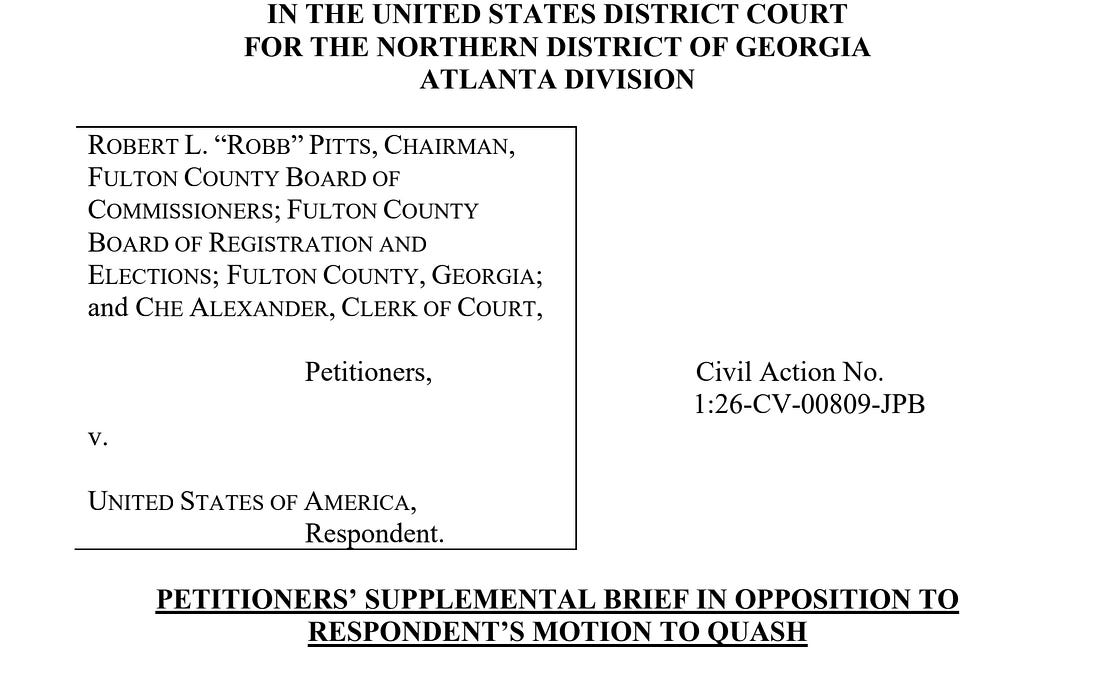 |
“Special Agent Evans’s testimony,” they write, “is central to this motion. His affidavit—which misstated and omitted key facts that if accurately disclosed would have undermined any pretense of probable cause—provides the sole support for the warrant at issue.” The County also did something important here, not insisting that it was entitled to go on a fishing expedition when it questioned the agency, but instead, voluntarily offering to respect any “relevant privileges” which might restrict the agent from answering some questions. The Trump administration wouldn’t budge. That won’t help their credibility with the Judge.
Fulton County makes that point clearly: “It is of course a litigation advantage to present and rely on a witness while barring all examination by the adverse party, and Respondent has offered no reasoned justification for it. That kind of raw opportunism, as well as Respondent’s shifting purported justifications for denying the request, is the height of arbitrary and capricious decision-making.”
The County argues that:
The government can’t use the Tuohy Regulations to resist a proper civil subpoena about matters the witness signed an affidavit, under oath, about, especially since the government previously agreed to unseal the search warrant.
Even if they can, withholding the witness’s testimony is arbitrary and capricious. He could testify to the matters at hand, with DOJ still having the opportunity to object to any individual questions it deems improper. Declining to let him testify at all is “transparently arbitrary and capricious conduct that seeks to substitute Respondent’s judgment for the Court’s.”
The County explains that it needs the witness’s testimony because “only the agent affiant could address why a warrant was sought (after applicable statutes of limitations had lapsed), how (if at all) the agent verified the information in the affidavit, why the agent relied on those he interviewed (without identifying their bias or credibility), and why he made the decisions to omit or characterize information as he did – all of which would inform the magistrate reviewing the request.”
You may recall from our discussion when it was unsealed that there are serious questions about omissions in the affidavit and serious questions about the basis for finding probable cause. Fulton County argues that DOJ “does not want Evans’s material misstatements and omissions on display at an evidentiary hearing. So with increasing resistance, Respondent [that’s DOJ here] now seeks to walk back prior statements and relies on an evolving list of excuses for refusing to make Evans available.”
Fulton County also provides the court with a detailed history of its efforts to resolve this issue with the federal government, which involves rapidly shifting positions by the government on whether it would make the witness available and what the reason for refusing to do so was. Fulton County calls the government’s final position, that “the Touhy regulations create a safe harbor” for the FBI Agent, “no matter what he told the magistrate judge and no matter what he concealed,” insufficient to justify keeping the agent off the witness stand.
DOJ will have an opportunity to respond with a brief of its own. After that, the Judge has said he will resolve the matter at a hearing on Friday, March 27, 2026. Fulton County has made some technical legal arguments about when the Tuohy regs do and do not apply, and about its entitlement to a hearing that the government is likely to resist strongly—unless it decides to change positions again. It would be well advised to work this one out. Because the odd thing about this entire proceeding is that by resisting return of the records, DOJ is running the risk of exposing all sorts of internal information about its decision to obtain the warrant.
That could prove painful for the government. The 2020 election has been litigated, relitigated, and its result confirmed. Given all of that, and the affidavit's reliance on a biased, discredited source to resuscitate the argument that something criminal happened, it’s hard to imagine there was a legitimate concern the government was pursuing. Even if there was, the statute of limitations has already run, meaning the government couldn’t charge a crime that occurred more than 5 years ago. If DOJ simply agreed to Fulton County’s motion to return the records, the prospect of a hearing exposing any of what happened at DOJ would terminate. Fulton County would retake custody of original voting records, but federal prosecutors could be permitted to keep copies. Any valid investigative purpose would be served that way.
And of course, there is more dirty laundry that could come out in the course of a hearing in this matter. Why did DOJ use a U.S. Attorney from St. Louis to oversee a matter in Georgia? Why did Tulsi Gabbard, the Director of National Intelligence (DNI), who has no role in domestic law enforcement, make an appearance during the search? It’s hard to see what the government hopes to win here and easy to see how much they have to lose. That makes it easy to entertain the suspicion that this is all directed, if not directly out of the Oval Office, then from somewhere nearby, and that it’s about politics, not justice.
Trump is in the middle of throwing as much voter suppression spaghetti at the wall as possible, and waiting to see what sticks. Everything from the SAVE Act, to trying to get state voter rolls, to supporting outrageous partisan gerrymandering and political spending before the Supreme Court, to directing DOJ’s Civil Division to abandon its traditional role protecting voters’ rights, to wresting control out of the hands of local elected Democrats in places like Fulton County. It’s important that we see each of these strategies in the context of the larger approach this administration is taking. Trump is trying to see what he can get away with so he can put a clumsy thumb on the scale come the midterm elections. He’ll abandon the spaghetti that doesn’t stick and work with whatever he can get away with. Our job is to keep the spotlight on what he’s doing.
We’re in this together,
Joyce