What matters in U.S. and global markets today

Get full access to Reuters.com for just $1/week. Subscribe now.


Morning Bid U.S.

Morning Bid U.S.

A Reuters Open Interest newsletter

What matters in U.S. and global markets today


By Mike Dolan, Editor-at-Large for Finance and Markets

There were some glimmers of hope in the energy markets on Wednesday as oil prices slipped back and stocks caught a break after Iran indicated to the UN that it would allow some ships from non-combatant countries to pass through the Strait of Hormuz.

Meantime, Washington continued to talk up the chances of negotiation, with reports circulating of a 15-point plan involving a month-long ceasefire. Iran continues to deny any talks are underway, however, and missiles continue to fly around the region.

I’ll get into that and more below.

But first, check out my latest column on how Gulf states' shaken faith in U.S. military protection could ripple through the petrodollar system.

And catch today’s episode of the Morning Bid podcast, where I discuss oil's latest moves and what recent business surveys tell us about how the real economy is absorbing the energy shock.

Subscribe to hear Reuters journalists discuss the biggest news in markets and finance seven days a week.


Data refreshes every time you open this email. For more U.S. market news, click here. Please send any feedback to morningbid@thomsonreuters.com.


Today's Market Minute

  • Israel and Iran exchanged airstrikes on Wednesday as Iran's military rejected President Donald Trump's claim the U.S. was in negotiations to end the war, saying the U.S. is negotiating with itself.
  • The Iran war is taking a toll on major economies, according to business surveys on Tuesday which showed how rising energy prices and uncertainty were dampening activity and raising inflation expectations.
  • President Trump's approval rating fell to its lowest point since he returned to the White House, hit by rising fuel prices and disapproval of the Iran war, a Reuters/Ipsos poll found.
  • When the Iran war ends, there’s likely to be a scramble for contracts to rebuild damaged energy infrastructure. ROI Global Energy Transition columnist Gavin Maguire breaks down which sectors and companies could play a part.
  • As gold and U.S. Treasuries stumble, the safe‑haven playbook might need a rethink, argues ROI Markets Columnist Jamie McGeever.
 

Fifteen points to ponder

Amid all the conflicting Iran war headlines coming out, traders appear to be choosing to look on the bright side. Brent crude eased to as low as $98 per barrel on Wednesday, while U.S. crude hovered around $88.

Asian equities closed comfortably up, meantime, with South Korea’s KOSPI gaining around 1.5% and Japan’s Nikkei nearly 3%. European shares rose by more than 1% after the open, while U.S. futures were up before the bell.

And in another sign of the buoyed sentiment, gold - which has behaved more like a risk asset lately - was up by nearly 2% on Wednesday morning as it benefited from a softer dollar and easing concerns about higher interest rates.

Nevertheless, it’s clear the war has caused a significant hit to economic confidence. Tuesday saw the first sweep of business surveys from March, which showed stalling private sector growth in the eurozone, rising U.S. inflation fears and more.

Overall, uncertainty is the order of the day as it remains unclear who exactly President Trump is negotiating with and whether a swift alleviation of energy disruption can really be secured. A spokesperson for the Iranian Armed Forces accused the U.S. of negotiating with itself.

Elsewhere, private credit jitters continued as Ares joined Apollo and other asset managers to become the latest to halt redemptions after a wave of investors sought to exit certain funds.

And in technology news, South Korean chipmaker SK Hynix is reportedly planning to list in the U.S. in the second half of 2026, while Elon Musk’s SpaceX could file for an IPO as soon as this week or next week, according to The Information.

With that, onto today's column.


Gulf war rattles petrodollar foundations

Whatever the outcome of the Iran war, one question is already inescapable for the Gulf's energy-rich economies: is the U.S. security umbrella still worth the price?

Since the U.S. and Israel launched strikes on Iran on February 28, it's been its Gulf neighbours who have suffered most from missiles and drones that followed - tearing through energy infrastructure, damaging economies, and exposing the limits of a supposed U.S. security umbrella.

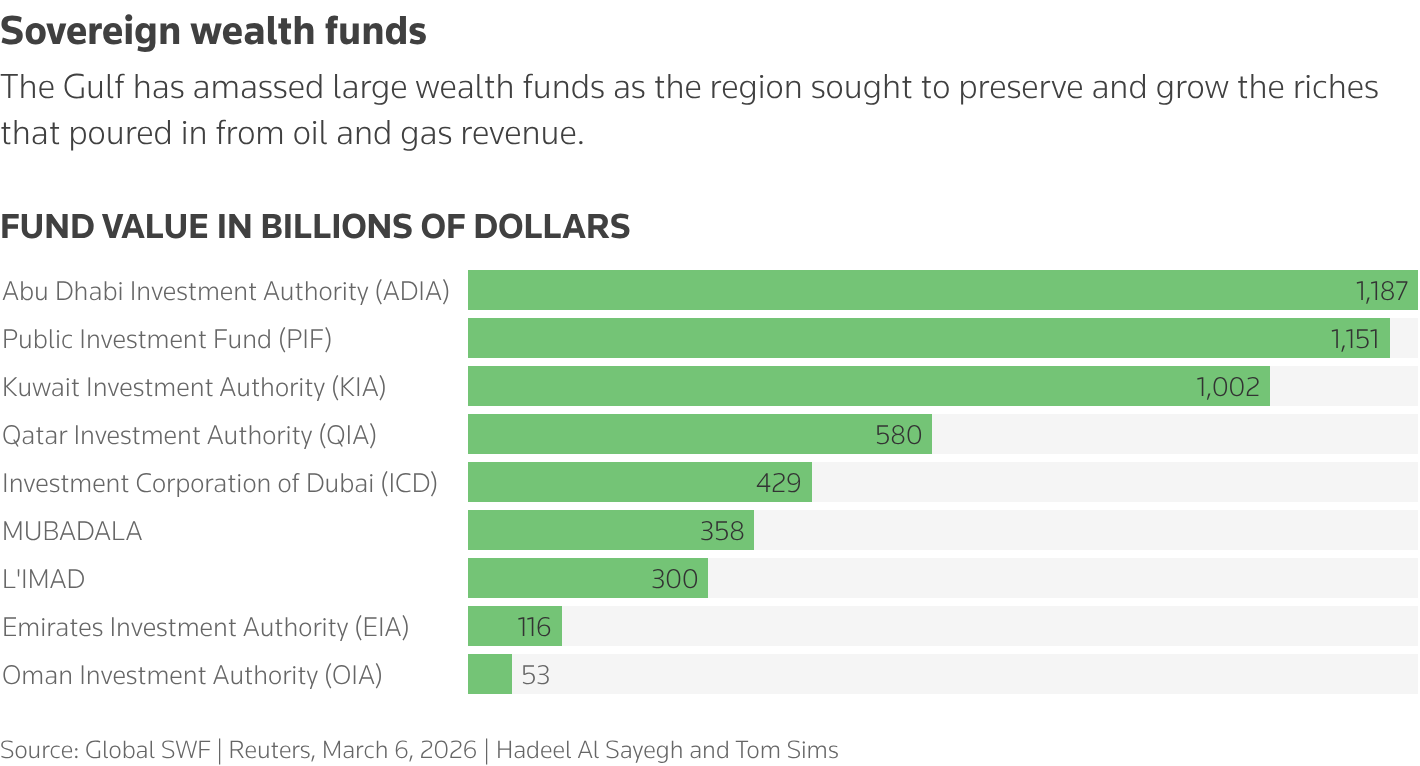
That reckoning carries consequences far beyond the military. At stake is a potential rethink ‌of the financial, trade and military ties at the very heart of their dollar-based economies — and of the hundreds of billions in dollar reserves underpinning them.


Graphics are produced by Reuters.