After falling around 2% on Wednesday, both Brent and WTI crude futures ticked back up on Thursday as traders digested the latest mixed signals from the U.S. and Iran. The benchmarks are now hovering around $105 and $93 per barrel, respectively.
Global shares were unsteady as hopes for an imminent ceasefire faded. In Asia, Japan’s Nikkei lost 0.7%, Hong Kong’s Hang Seng index fell by 1.7% and South Korea’s KOSPI index was down 2.7%.
Europe's STOXX 600 fell on Thursday morning, while U.S. stock futures were also down before the bell.
Gold fell back too, once again failing to register any safety bid and instead shedding some of the recent gains it owed to prospects for a resolution to the energy shock.
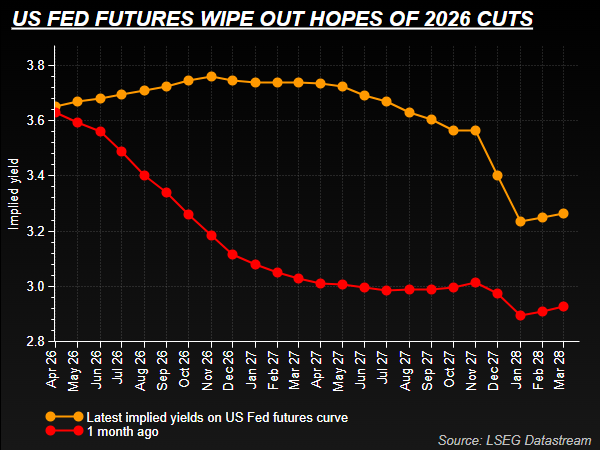
Treasury markets were on edge after another series of poor debt auctions and mounting longer-term inflation risks, with Wednesday’s import price data already showing a much bigger jump in February than forecast before the war.
Elsewhere, it was announced that President Trump has re-scheduled his hotly anticipated trip to China for mid-May. Meantime, Alphabet and Meta lost a U.S. court case over whether the design of their social media platforms harm children.
In technology news, Arm Holdings stock jumped over 16% on Wednesday after predicting that its new in-house data-center chip would generate roughly $15 billion in annual revenue in five years. The chip, which is geared toward powering “agentic” AI, marks a departure for Arm, which has previously licensed chip designs to giants such as Nvidia.
With that, onto today's column.