
|
 |
Welcome to Popular Information, a newsletter dedicated to accountability journalism.


 |
On Monday, a federal judge dismissed Trump’s $10 billion defamation lawsuit against the Wall Street Journal. The lawsuit alleged that the Wall Street Journal defamed Trump when it reported on a bawdy letter allegedly authored by Trump in 2003 in celebration of Jeffrey Epstein’s 50th birthday.
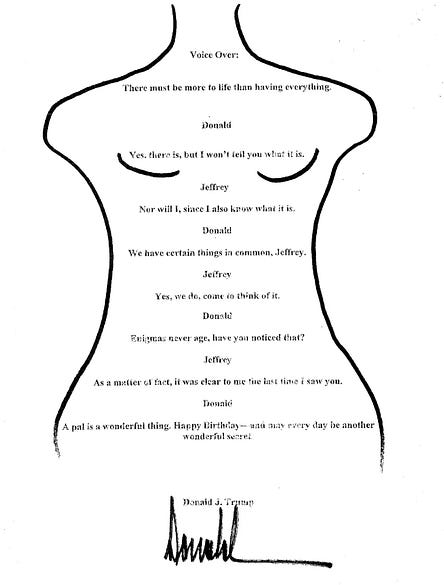
According to Trump’s lawsuit, the letter, which includes a line drawing of a naked woman, was “fake and nonexistent,” and the Wall Street Journal “concocted this story to malign President Trump’s character and integrity and deceptively portray him in a false light.”
The alleged letter, as reported by the Wall Street Journal, is structured as an imagined dialogue between Trump and Epstein. “We have certain things in common, Jeffrey,” Trump says. “Enigmas never age, have you noticed that?” The letter concludes: “A pal is a wonderful thing. Happy Birthday — and may every day be another wonderful secret.”
 |
In a 17-page order, Judge Darrin Gayles found that, even assuming everything in Trump’s complaint is true, Trump’s lawsuit “comes nowhere close” to meeting the standard for defamation. Gayles does not weigh in on whether the 2003 Trump letter was genuine, but notes that the lawsuit fails to establish that the reporters acted with “actual malice.”
Specifically, Gayles notes that the reporters reached out to Trump and others for comment, and printed Trump’s denial that he authored the letter in the piece. This showed that the reporters both investigated the letter’s authenticity and allowed readers to draw their own conclusions.
At this stage, Gayles did not even consider the most damning fact about the lawsuit. The same letter featured in the WSJ report was provided to the House Oversight Committee by the Epstein estate in response to a subpoena. This directly undermines Trump’s claim that the letter was simply invented by the WSJ reporters, who do not control the Epstein estate’s archives. While Gayles did not consider the letter obtained by the House Oversight Committee, he does note that “the produced documents certainly appear identical to the album and Letter referenced in the Article.”
The lawsuit is not officially dead yet. Gayles dismissed the case “without prejudice,” which means that Trump can refile the case and attempt to allege facts that meet the actual malice standard. “President Trump will follow Judge Gayles’s ruling and guidance to refile this powerhouse lawsuit against the Wall Street Journal and all of the other Defendants,” a Trump spokesperson said in a statement. “The President will continue to hold accountable those who traffic in Fake News to mislead the American People.”
It is unclear what allegations could credibly be added to the complaint to meet the actual malice standard. If Trump’s attorneys were aware of such facts, they would have been included in the original complaint.
The dismissal is the latest in a series of damaging blows to the lawsuit and Trump’s contention that the letter was fake. Trump initially said the letter was not written by him because it’s “not the way I talk.” This was echoed by Vice President JD Vance, who posted, “Does anyone honestly believe this sounds like Donald Trump?”
But Popular Information illustrated that many of the distinctive elements of the letter — including “enigma,” “pal,” and referring to himself in third person — were frequently used by Trump.
