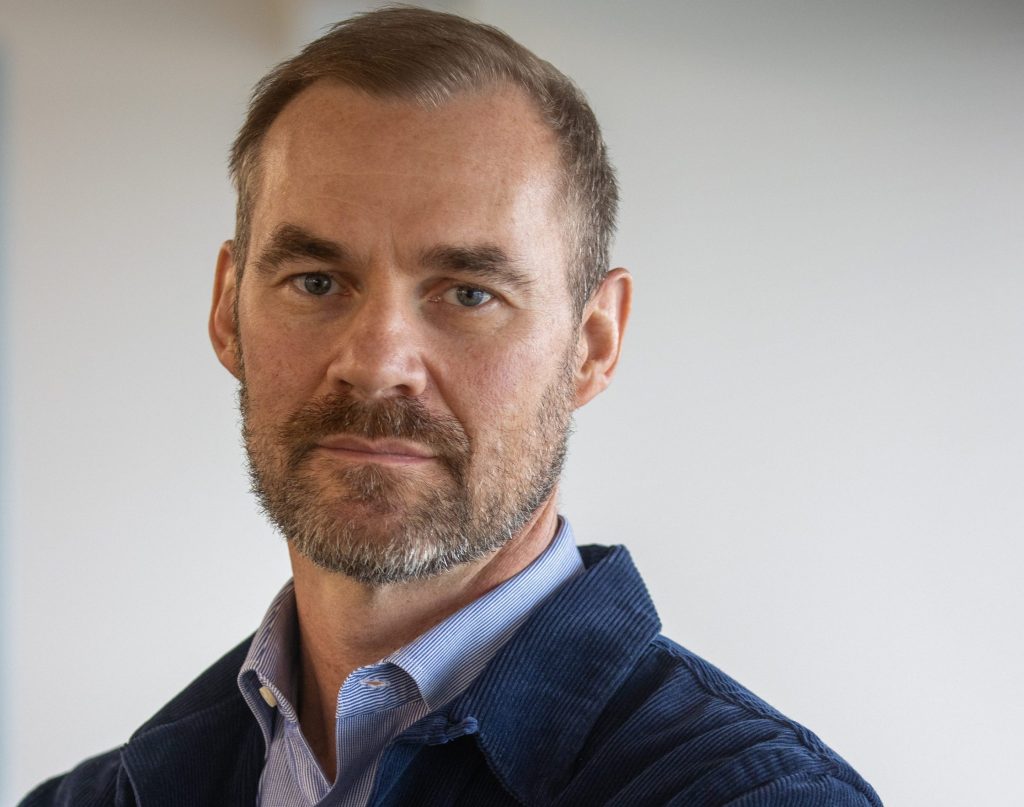
Chad Rigetti has devoted his career to quantum computing—a phrase you’ve perhaps most recently encountered in Marvel’s
Ant-Man and the Wasp: Quantumania.
Superhero movies aside, quantum computing is somewhere between reality and moonshot. In the most rudimentary terms (all I feel remotely qualified to give you), a quantum computer uses counterintuitive rules of physics to compute some information exponentially faster than “classical” computers. It’s real—though it’s so far failed to scale or find widespread commercial use—and it holds an air of science fiction, even in how an expert like Rigetti thinks about it.
Take his new company’s name. It’s drawn from Patrick Rothfuss’s sci-fi novel
The Name of the Wind.
“In the book, ‘sygaldry’ is a discipline that involves inscribing runes or letters on different objects to govern heat or light flow,” Rigetti told
Fortune. “It’s also an engineering discipline with some degree of precision to it. If you do it wrong, you
can blow things up.”
Sygaldry is the company Rigetti cofounded in 2024 after leaving Rigetti Computing, the developer of quantum computer circuits that he founded in 2013 and went public via SPAC in 2022. Sygaldry’s been quiet for years, but recently spoke to
Fortune, exclusively revealing for the first time that it raised funding. Sygaldry has raised a total of $139 million, including a $105 million Series A led by Breakthrough Energy Ventures that closed in March. The company’s $34 million seed round was led by Initialized Capital and closed back in August.
At Sygaldry, Rigetti and cofounders Idalia Friedson and Michael Keiser are looking at one of AI’s central questions: How are we going to power all these data centers? Rigetti believes that quantum can offer answers, as Sygaldry designs servers for AI data centers that include both quantum hardware and classical chips.
The idea is this: work with multiple quantum hardware types that help run AI workloads faster than Nvidia’s GPUs can. Rigetti’s goal: “To have machines in commercial production that are providing speed up for these AI workloads around the end of the decade.”
“Quantum is going to be a fundamentally more efficient way of translating power into intelligence,” said Rigetti.
This is key to the investing thesis, Carmichael Roberts, Breakthrough Energy Ventures managing partner, told
Fortune via email, that “the energy intensity of large language models continues to grow at a rate that is unsustainable” and that there’s a path to breaking this paradigm Sygaldry can capitalize on. It won’t happen all at once, Daniel Dart, Rock Yard Ventures founder and Sygaldry investor, said. “AI added new capabilities, and quantum will remove limits,” Dart said. “Think of the move from the horse and carriage to the automobile and the airplane.”
Commercialization by 2030 seems reasonable enough, but consider: People have long been talking about quantum computing the way they talk about nuclear fusion. It’s a future that’s always 50 years away, the old joke goes. Rigetti, however, does believe we’re nearing a turning point. “I think the future is coming very quickly, especially now,” he said.
Rigetti seems to think about the future a lot, and where a sci-fi-ed version of our future might meet a real one.
“The future we want to build is the Star Trek version of the future,” he said. “That’s where, despite eons of progress, humans remain masters of their technology, and not vice versa. We need to develop AI in an intentional, strategic, conscious way so it ultimately augments the best things that make us human.”
See you tomorrow,
Allie Garfinkle
X: @agarfinksEmail: alexandra.garfinkle@fortune.comSubmit a deal for the Term Sheet newsletter
here.
Joey Abrams curated the deals section of today’s newsletter. Subscribe here.