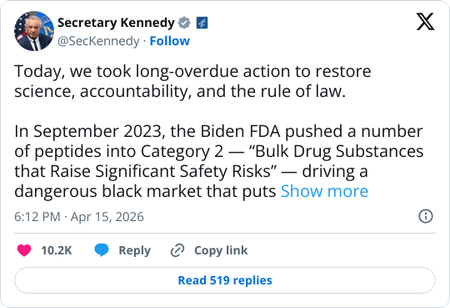
| |  | The Lead Brief | The Food and Drug Administration is cracking open the door to potentially allowing compounding pharmacies to make about a dozen peptides, prompting cheers from some industry players who view the products as the next wellness gold mine. The agency announced Wednesday that it will be convening a federal panel specializing in compound pharmacy issues — called the Pharmacy Compounding Advisory Committee, or PCAC — in July and again by the end of February 2027. The panel will discuss whether to give compounding pharmacies, which make bespoke versions of medications, the green light to manufacture certain peptides that regulators had banned amid concerns about their safety. But the restrictions haven’t stopped Americans from trying to procure them — largely from gray market websites — and inject themselves in the name of wellness. The products, which are marketed to help with weight loss, muscle recovery and antiaging, are labeled “for research purposes only.” This includes Health Secretary Robert F. Kennedy Jr., who has talked about being a “big fan” and previously vowed to end the “war on peptides.” Critics of these products warn that many are unproven and potentially dangerous — while proponents argue that fears are overblown and proper oversight could help consumers obtain peptides from legitimate producers more safely. My colleagues Rachel Roubein and Lauren Weber in The Washington Post newsroom have a new report detailing the state of play, including the view that more studies need to be done on these products. “Compounding pharmacies are being hammered by patients and prescribers to prepare these peptide drugs, and legally, they can’t do it. Not yet, anyway,” Scott Brunner, the chief executive of the Alliance for Pharmacy Compounding, told my WaPo colleagues. “And that is stimulating the illicit, non-pharmacy actors in the gray market.” → The Pharmacy Compounding Advisory Committee, which makes policy recommendations to the FDA, last met in 2024 following the settlement of a lawsuit brought by a provider and pharmacy that argued regulators hadn’t gone through the proper procedure when restricting more than a dozen peptides from being compounded. The administration is “taking a huge first step to provide patients and providers with access to these peptides, and we look forward to providing the agency with more information on these peptides and presenting at the PCAC hearings,” said Lee Rosebush, a lawyer who represents custom pharmacies that produce bulk quantities of custom drugs — called outsourcing facilities — and industry groups seeking to expand access to peptides. He tells me the industry wants to ensure that accredited compounding pharmacies are producing products with ingredients that meet strict quality standards and are required to tell regulators if patients have any adverse side effects. Rosebush is also a lawyer at BakerHostetler who helped bring the lawsuit, arguing that the FDA acted improperly in 2023 when it removed 19 peptides from a list of drugs compound pharmacies are able to produce. It ended in the 2024 settlement that’s paving the way for the action happening now. Following the FDA’s official announcement about the potential changes in a policy document updated Wednesday morning, Kennedy posted about the moves on social media. He called it a “long-overdue action to restore science, accountability and the rule of law.” Minutes after the post, the stock price of telehealth platform Hims & Hers Health jumped, ending the day up by 14 percent. The company has expressed interest in getting into the peptide space once regulations are clarified. Pat Carroll, a physician and chief medical officer at Hims & Hers, said the FDA’s actions are an “important step” in ensuring that peptides are “overseen by vetted health care professionals.” “Our medical team believes certain peptide therapies hold meaningful potential in helping Americans live healthier lives, and we are actively exploring how to expand access in a way that will be aligned with FDA guidance and reflects our commitment to consumer safety, transparency, and clinical excellence,” Carroll said in a statement. | 

_tstmp_1756933376-1920-1080.png)