| | In today’s edition: How AI is bringing top executives together, and other highlights from Semafor Wo͏ ͏ ͏ ͏ ͏ ͏ |
| |  | Technology |  |
| |
|
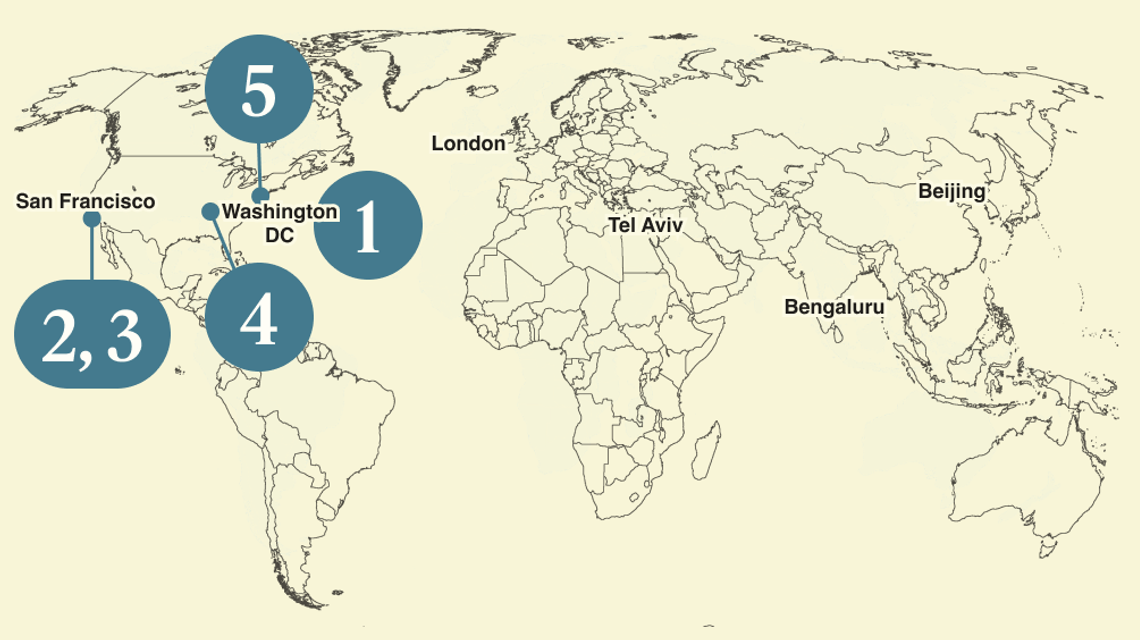 - Semafor World Economy
- AI’s impact on C-suite
- Dispute over jobs impact
- Wealth management shift
- New locations for data centers
 The case for funding the “wrong” research, and the CIA ups its AI use. |
|
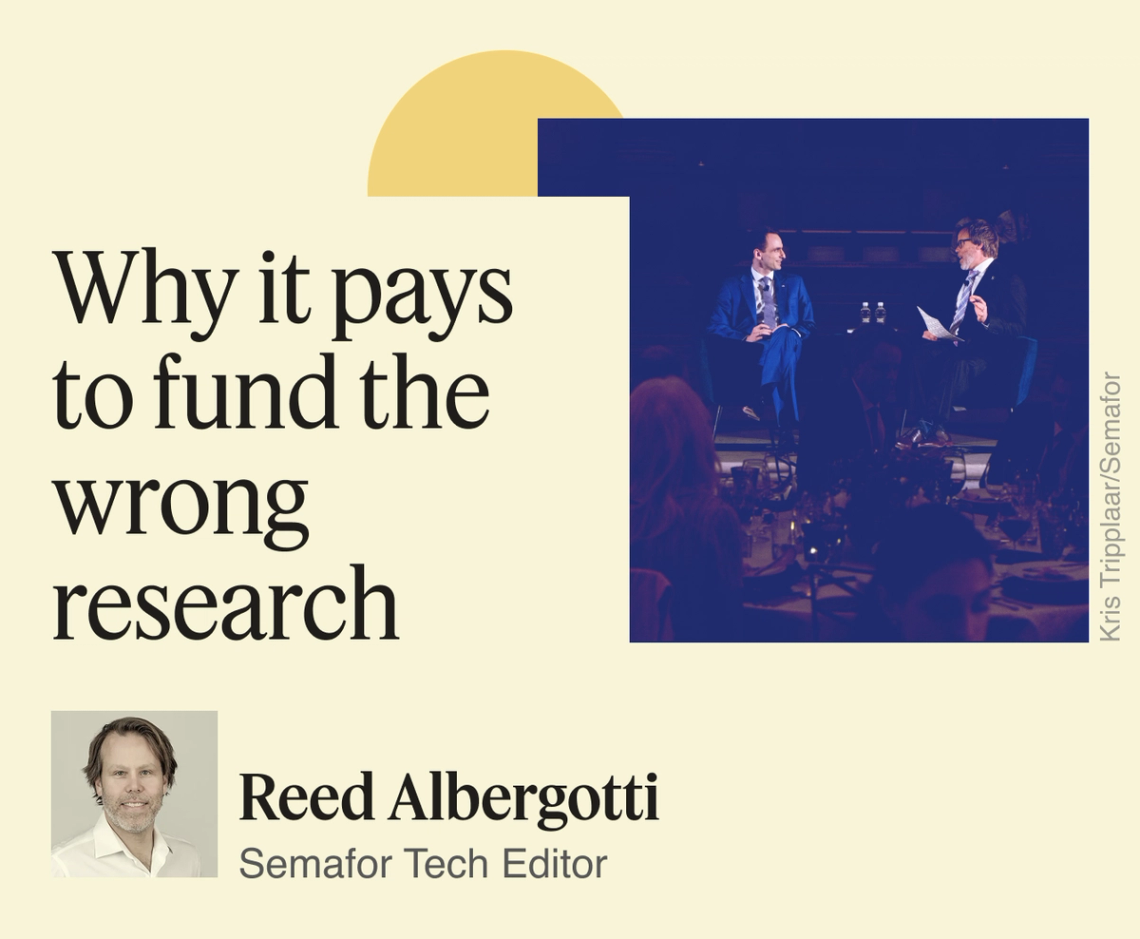 I had two big questions this week for Michael Kratsios, director of the White House Office of Science and Technology Policy, at Semafor World Economy in DC. If the administration’s policy is to cut funding for the wrong research, how do you determine which scientific endeavors lack merit? And even if you agree the current system of government-funded academic research is in need of reform, why not fix it rather than take a sledgehammer to it? What I took away from our conversation is that it’s easy to identify good, or important, scientific research. But it’s nearly impossible to identify the “wrong” things to study. Unless, of course, there’s been a breakthrough in time travel. The US government’s job when it comes to scientific research is to grease the wheels of new tech that’s critical to economic and security interests, but that isn’t quite far enough along for private investors. It’s also to fund research that might prove useful many decades in the future. Kratsios identified some of those areas, like AI, quantum computing, and nuclear fusion, and has some good ideas for how to better track research and faster results. And as we talked just feet from the Declaration of Independence in the National Archives on the eve of the country’s 250th birthday, Kratsios waxed poetic about the uniquely American mixture of public-private partnerships, free capital, and swashbuckling entrepreneurship. But if the US wants to have the same technological success for another 250 years, it needs to be okay with funding the “wrong” scientific research. Look at G.H. Hardy, a mathematician whose work ended up being crucial in biology, genetics research, computer encryption, and quantum computing. “No discovery of mine has made, or is likely to make, directly or indirectly, for good or ill, the least difference to the amenity of the world,” Hardy wrote in a 1940 essay titled The Mathematician’s Apology. Likewise, many people might have considered Stanford’s $4.5 million National Science Foundation grant for “digital libraries” a waste of money. But that grant became PageRank, which led to the creation of Google, which generated about $2,700 in economic value per American last year alone, according to Google’s estimates. It doesn’t take a math genius to do a cost-benefit analysis on scientific research. But one thing is true for Kratsios — you miss 100% of the shots you don’t take. |
|
Highlights from the stage |
|
CTO and CHRO find common ground |
  Omar Abbosh. Tasos Katopodis/Getty Images for Semafor Omar Abbosh. Tasos Katopodis/Getty Images for SemaforThe people who manage technology and the people who manage people are starting to converge. As C-suite staff go, chief technology officers and chief human resources officers haven’t always overlapped much. But as more AI agents are employed in businesses, top executives are increasingly having to work together to manage the workforce. “You have this amazing power couple between the CHRO and the CTO, who provide the right tools and the right culture to people so they can bring to life our career architecture we have for all our employees,” Omar Abbosh, CEO of Pearson, said at Semafor World Economy. Mihir Shukla, CEO of software firm Automation Anywhere, agreed, adding that together, the CTO and CHRO need to “map out what roles go away, what roles evolve, and what new roles entirely are created from this.” Despite the new overlap, he said those two roles are safe from AI-related trimmings. — Rachyl Jones |
|
Politicians, tech CEOs clash on AI layoffs |
 Jason Droege. Lexi Critchett/Semafor Jason Droege. Lexi Critchett/SemaforPoliticians and tech CEOs aren’t on the same page about AI-related job displacement. Speaking at Semafor World Economy on Thursday, Scale AI interim CEO Jason Droege said companies are “washing the layoffs,” using AI as an excuse for ordinary reductions in headcount. Earlier this year, Block’s Jack Dorsey blamed the technology for a 40% workforce reduction, and Amazon said a 14,000-person layoff was partly caused by AI. Droege pressed on, saying there will be no employment “apocalypse” from the technology. The statements run counter to views from politicians like Sen. Mark Warner, D-Va., who just an hour earlier said job disruptions are in a “hair on fire” moment due to AI. A telecommunications investor before he entered politics, Warner said that most CEOs are publicly downplaying the scale of job losses that they are telling him about privately, because they worry the news would “freak people out.” |
|
The changing role of wealth managers |
 Penny Pennington. Lexi Critchett/Semafor Penny Pennington. Lexi Critchett/SemaforA month ago we wrote about an analyst’s message that in the AI age, employees need to figure out what their job really is. For wealth managers, the core task may not actually be managing wealth, Edward Jones managing partner Penny Pennington suggested at Semafor World Economy. Until recently, “only very wealthy people could get a dynamically managed portfolio,” she said. But increasingly, AI can “provide that kind of dynamism in the background, at vast scale.” A financial adviser spending less time building and managing portfolios has more time to be “a human… getting underneath the life of that family, about what they’re afraid of, about what happens next,” she said, adding that great financial advice needs to be tailored to the individual. The workflow change is similar to what’s happening with software developers, who are trading their time spent coding to engaging directly with customers. |
|
 On this week’s episode of Mixed Signals, Patrick Radden Keefe joins the show to talk about page-turning journalism, his own celebrity, and the humanity behind his work. Patrick discusses his new book, London Falling, how he finds stories that pull readers in, and the balance between mystery and resolution. He also touches on his unexpected celebrity, the shift from page to screen, and why real people and messy emotions make the best stories. Listen to the latest episode of Mixed Signals now. |
|
Data center firms eye corporate parks |
 John Santora. Tasos Katopodis/Getty Images for Semafor John Santora. Tasos Katopodis/Getty Images for SemaforWorkspace CEOs say they’re seeing tech companies desperate for data centers turn to empty corporate parks for relief. John Santora, CEO of WeWork, told Semafor World Economy that companies have met some resistance from town leaders in suburban and rural areas, but predicted that would ease. “What’s happening now is they realize as they begin to sit there for four or five years, they don’t have the tax base either way,” Santora said. While some are becoming residential spaces, “you’re seeing some shift to data centers, because [the towns] need the cash.” Diane Hoskins, global cochair at design firm Gensler, echoed the sentiment: “That industrial park — it might be a data center,” she said. Residents in areas where data centers are coming online have fought against them, citing concerns about energy and water consumption, noise pollution, and what they claim as a general unsightliness. In response, some tech companies have hired design firms like Gensler to spruce up the exteriors, we previously reported. WeWork is a sponsor of Semafor World Economy. John Santora made his comments in an unsponsored editorial interview. |
|
 Jason Reed JIR/Reuters Jason Reed JIR/ReutersThe CIA used AI to create the first intelligence report written without human involvement. The US intelligence agency’s Deputy Director Michael Ellis said AI’s role was only likely to grow: Within two years, “AI co-workers [will be] built into all of the agency’s analytic platforms.” The technology will speed up the process of analyzing vast amounts of information gathered by human spies and their tools. The report is not the first use of AI in intelligence — both the CIA and Britain’s MI6 were doing so in 2024 — but it may be the first written with no human involvement. Ellis added that AI is vital to maintain an intelligence lead over China. — Tom Chivers |
|
| |  | | | You’re receiving this email because you signed up for briefings from Semafor. |
|


