
|
 |
A preview for Solo Chiefs—subscribe to get the full picture.
16 Second Brain Practices for Solo Operators (2026)
Your Human Brain Is Ghosting You: How to Stop Forgetting Your Earlier Decisions.
|

| |||||||||||||||


 |
I waste half my workday relearning the things I repeatedly forget.
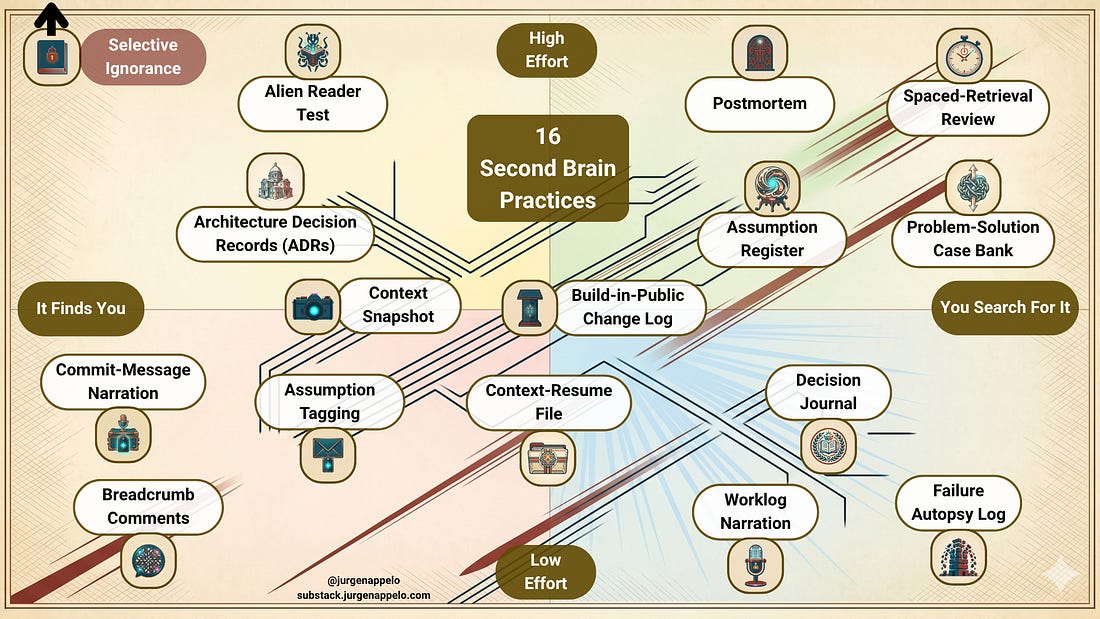
A map of 16 second brain practices to help solo operators remember decisions, recover context, and stop breaking their own systems.
Just this morning, I spent several minutes looking for the official documents of the notary. And when I found them, I thought, “Why are they here, for God’s sake?” That was at least the fifth time I’ve been looking for those same documents. Most likely, I’ll be searching for them again next year.
Last week I opened a Make scenario I’d built in February. It had a strange routing choice—three filters where two seemed enough. I stared at it for ten minutes, trying to work out why Past Me had done something so odd. Then I spent another twenty minutes deciding Past Me was an idiot and simplifying it.
Then everything broke.
Turned out Past Me had a good reason. Present Me just couldn’t remember it, couldn’t ask anyone, and had already committed the change.
If you run a one-person business, there’s no colleague who remembers why the pricing page looks like that. There’s no team Slack where someone says, “Don’t bother. We already tried that in Q2 and it broke.” There’s no helpful institutional memory floating around in other people’s skulls.
There’s just your fallible brain.
And your overloaded mind is already busy switching between six projects, four invoices, a tax deadline, and one client who writes emails like they’re auditioning for a remake of Succession.
So I went looking for a better map. Where do I store and find yesterday’s decisions? What are my second brain options?
👉🏻 Note: It seems every self-respecting Substack author has published a “How I built my second brain” article, full of details on Claude Code, Perplexity, Notion, Obsidian, or whatever technical-tool-du-jour is making waves these days. That’s not what I’m interested in. What I want to know is: what are the recommended second brain techniques? Not how to build one, but how to use one. 👈🏻
I asked four different AIs to chart the full territory, compared their answers, merged them, and pressure-tested the result. What came back was sixteen distinct practices. Not a ranked list. Not a “top 10.” Just a map.
That’s what I’m here for. Maps, not recipes.
How to Map 16 Second Brain Practices
I plotted all sixteen second brain practices on two axes.
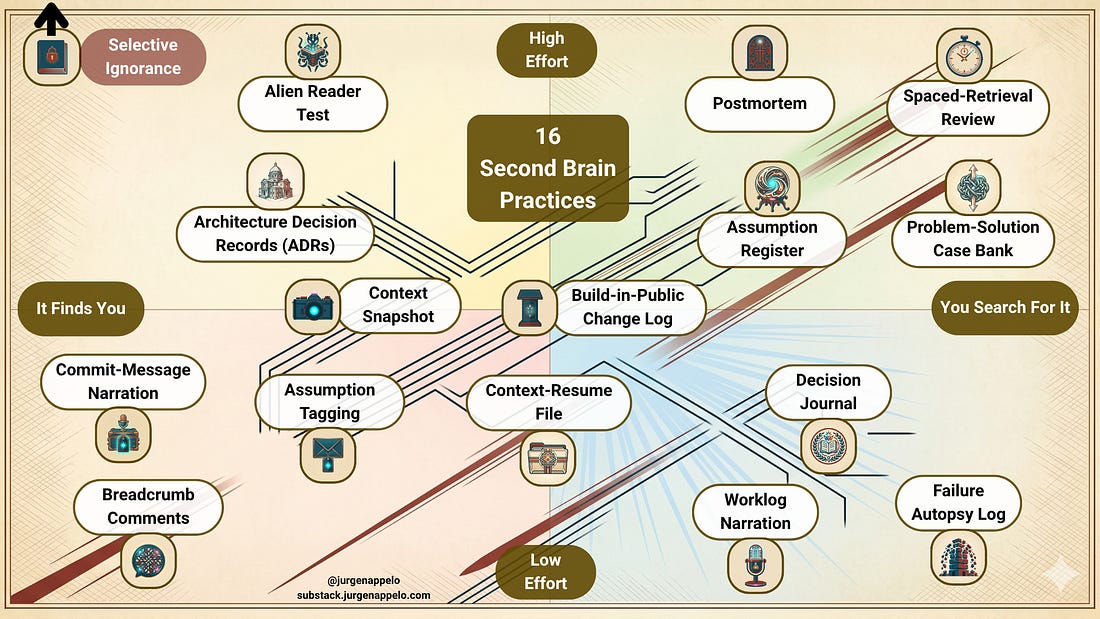 |
Vertical: Friction
How much effort does the practice ask of you? At the bottom are things you can do in five seconds while half-awake and still recovering from yesterday’s tequila party. At the top are rituals that demand time, intent, and the sort of discipline most of us only claim to have on a CV.
Horizontal: Retrieval
How do you get the information back later? On the left are practices where the explanation is waiting for you to be discovered inside the artifact itself, like fingerprints at a crime scene. On the right are practices where you go hunting through your records like an investigator browsing through police dossiers.
That gives you four zones.
The bottom-left (red-ish) is where most people should begin: low effort, the information is embedded in the work. You’re like the painter who writes the names of the rooms on his paint buckets because that’s where he looks first to remember which room he painted in which color.
The top-right (green-ish) is where people rarely go because it takes more effort and discipline. You’re like an interior designer keeping extensive dossiers on their clients, with mood boards, wallpaper designs, and official color codes. It’s more professional. It’s also more work. The choice is entirely yours.
Every practice below includes an approximate map position so you can see where each belongs.