
|
 |
5.2.26 | Let's set up a monthly habit tracker 📝
our editorial director's personal journal routine, a site to discover love songs, the best hammock for summer, and which health metrics are worth tracking
|

| |||||||||||||||


Happy Saturday!
I’m delighted to welcome Emily McGowan, our Editorial Director and one of the earliest voices behind The Good Trade, as the author behind today’s edition while I’m mid-move this weekend at 35 weeks pregnant (prayers, pls! 🙏)
Emily’s essays have helped shape our editorial voice for over a decade, and many of you have grown alongside her writing. Some of my favorites: How To Stop Overthinking Everything, How To Take Care Of Yourself When You Live Alone, A Guide To Getting Dressed When You’re Depressed, How To Get In Touch With Your Feminine Energy, and How To Take Your Own Advice.
Emily is not just a deep soul, she’s also our go-to for all things productivity, optimization, and removing office spiders.
I know you’ll enjoy her edition!
Xx,
AmyAnn
 |
 |
Blank pages used to make me unreasonably nervous.
Not because of what was unknown, but because of the pressure I put on myself to make the first mark perfect. What if I wrote the wrong date? Or used the wrong pen? What if I changed my mind halfway through the first page? I’d stay frozen in indecision and anxiety, one misplaced ink splotch away from catastrophe.
I can see it now, with compassionate eyes, for what it really was: A deep fear of failure.
I thought somehow that if my journal was ~aesthetic~ that I would somehow automatically be a good person; an organized, competent, successful woman. I’d open my notebooks carefully as to not tear the pages, grimace whenever the spine cracked, and never, ever let a drop of coffee fall on the page. There were even a couple years where I only allowed myself to write in cursive using a blue BIC Cristal ball pen for my morning pages; if I didn’t have that exact pen I wouldn’t let myself “ruin” the consistency. Instead, I’d just skip writing altogether.
The thing about all this, though, is that my journals aren’t meant to be seen by anyone other than myself. Why was I being so strict about a personal tool that’s sole function is to catalog my days and bring me joy in the process? Why was I policing my own creative expression?
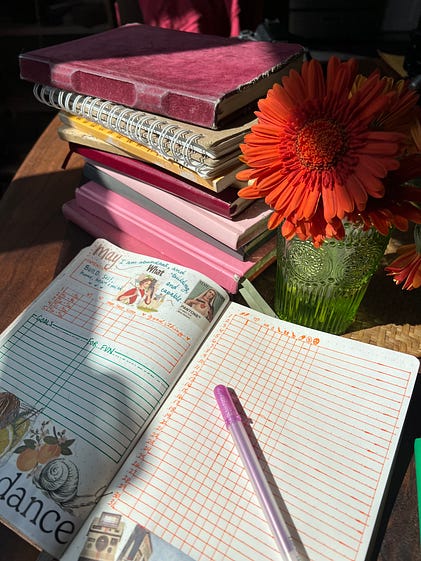
Fast forward to now, and my archival notebooks look more like fat wallets than the sad, creaseless journals of my younger years. I’ve stopped limiting myself — my journal is a catch-all for my daily reflections, writing sessions with my mentee, notes from therapy, and lists of what I need to clean before guests come over. It’s filled with magazine cutouts, pasted-in ticket stubs, stickers, and labels from bottles of wine I’ve particularly enjoyed.
The ink bleeds from page to page (much to the horror of my past self), but that’s because these days my journals are actually alive.
Sometimes that blank page syndrome does sneak back in, and I’ve found that having a monthly checkpoint and daily prompts keep me engaged, even on days I don’t have much else to say. And that’s okay — again, my journal is just for me, and no one else. Here are a few of the routines that help me sustain my journaling:...