| | In today’s edition: The White House grapples with the challenges of AI, and ballroom funding becomes͏ ͏ ͏ ͏ ͏ ͏ |
| |  | Washington, DC |  |
| |
|
 - US-China AI channel?
- Rubio’s Europe challenge
- Tense wait on Iran
- Ballroom campaign
- Collins’ $600k ad buy
- Lutnick on Epstein
- Epstein Pulitzer drama
PDB: Jet fuel worries  Trump meets Brazil’s Lula … US posts initial jobless claims … AFP: Kremlin says two-day Ukraine ceasefire to begin at midnight |
|
Trump weighs new approaches to AI |
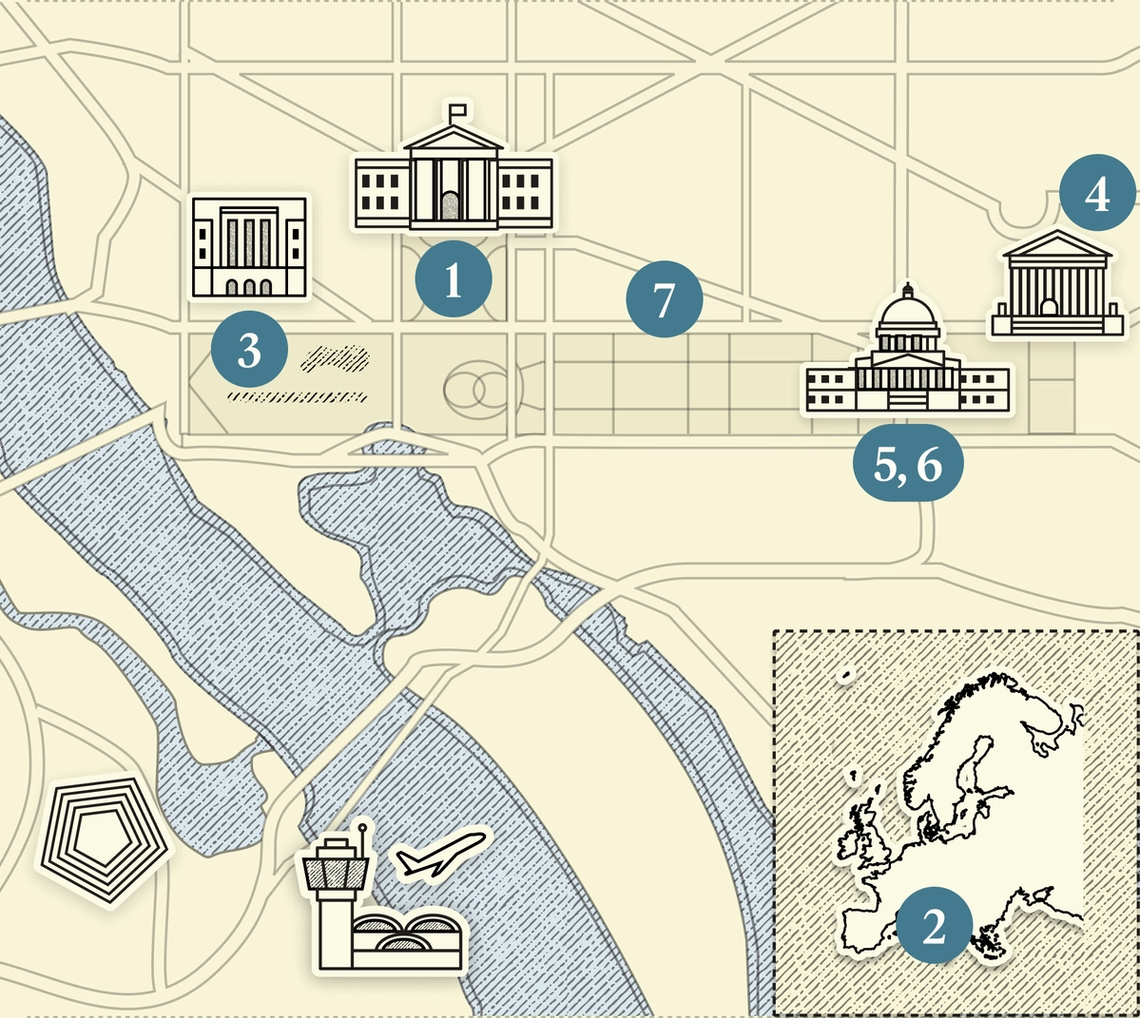
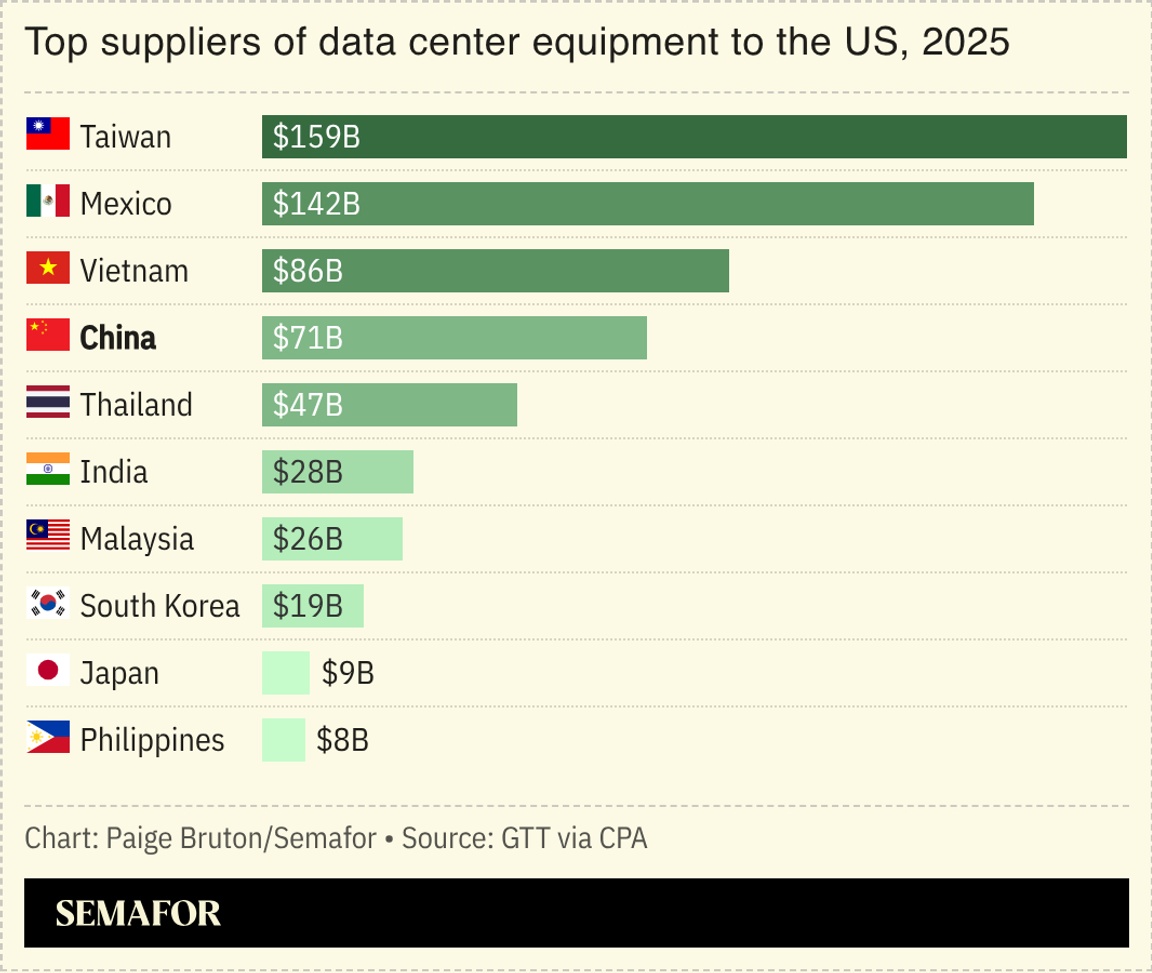 The Trump administration is rethinking how it addresses the evolving challenge of artificial intelligence. The US and China are considering launching a channel to discuss AI guardrails, The Wall Street Journal reported, and may put AI on the agenda for President Donald Trump’s meeting with Chinese leader Xi Jinping next week. Such a channel would be a revived relic from the Biden era. There will be criticism of any push by Trump to engage in talks with China about AI, given the broad skepticism in Washington toward Beijing. And The New York Times reported earlier this week that Trump is considering increasing oversight of AI models. “This administration has one goal; ensure the best and safest tech is deployed rapidly to defeat any and all threats,” White House chief of staff Susie Wiles posted on X last night. |
|
Rubio lands in Italy at difficult moment |
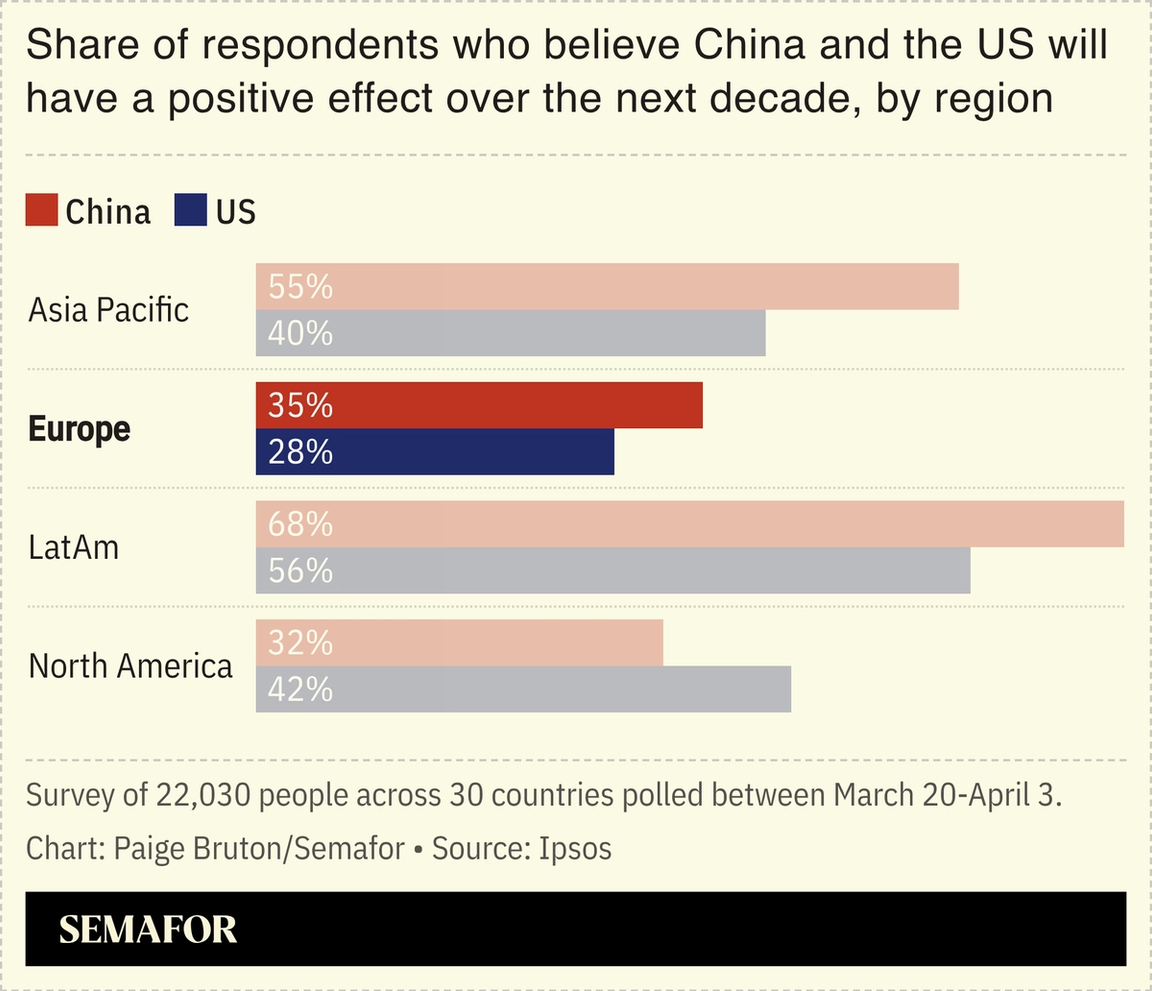 Secretary of State Marco Rubio is touching down in Europe at a tenuous moment for transatlantic relations. The US is withdrawing thousands of troops from Germany, threatening higher auto tariffs on the EU, and accusing NATO countries of not doing enough to help the US fight Iran. Trump has even criticized one of his allies in the region, Italian Prime Minister Giorgia Meloni, with whom Rubio will meet tomorrow following today’s face-to-face with Pope Leo XIV. Rubio and Meloni will cover a broad agenda, including the Middle East, Western Hemisphere, and China, according to the Italian embassy. But the Trump administration is unlikely to persuade European partners to do more to reopen the Strait of Hormuz. “I don’t think there’s much that they can do because I don’t think there’s much that the United States can do,” the Atlantic Council’s Matthew Kroenig told Semafor. — Morgan Chalfant |
|
White House faces tense wait on Iran |
 The Charles de Gaulle aircraft carrier. Stefanos Rapanis/Reuters. The Charles de Gaulle aircraft carrier. Stefanos Rapanis/Reuters.The White House remains stuck in a holding pattern on Iran, while growing hopes of a durable peace led stocks to rise and oil to fall back below $100 a barrel. Tehran is reportedly expected to respond today to a one-page American proposal to reopen the Strait of Hormuz and end the conflict, which has been in stasis for weeks, despite sporadic attacks. The ongoing standoff around the closure of the strait has left roughly 2,000 ships stranded in the Gulf and insurance premiums four to five times normal rates. France on Wednesday said it was moving its aircraft carrier group toward the Gulf, part of a plan drawn up by a coalition of more than 50 nations, including France and the UK, to help reopen the waterway and provide visible escorts for ships. |
|
Graham’s opponent hits him on ballroom |
 Kylie Cooper/Reuters Kylie Cooper/ReutersDemocrats are preparing to make Trump’s ballroom a campaign issue if Republicans follow through on plans to send $1 billion to the White House for security for the East Wing renovation — and the strategy might start with Sen. Lindsey Graham’s Democratic opponent in South Carolina, Annie Andrews, Semafor’s Burgess Everett reports. “That will go over like a lead balloon in South Carolina, and we will use that in our campaign every single day between now and the general election,” Andrews said of the proposed funding. Graham is a leading proponent of the ballroom in Congress, and Democrats’ campaign arm indicated other Republicans could get swept up in the strategy. Graham said Andrews is too liberal for the state but indicated he’ll be taking her challenge seriously if, as expected, both emerge from their primaries next month: “If you don’t in this environment, you’re crazy.” |
|
Collins launches first election ad in Maine |
 Screenshot/YouTube/Susan Collins Screenshot/YouTube/Susan CollinsSen. Susan Collins, R-Maine, is going on the air with her first ad of what’s looking like a very long reelection race against presumptive Democratic nominee Graham Platner. The ad nods to her seniority as Senate Appropriations chair and her sway in Washington, highlighting her advocacy for securing $6 million to help replace the collapsed Eastport Breakwater, according to details first shared with Semafor. The $600,000 ad buy will run for two weeks as Collins prepares for a general-election battle with Platner, who nudged Gov. Janet Mills out of the primary in a stunning victory for progressives. There’s plenty more cash where that came from: Collins had $10 million in the bank as of this spring. Outside groups are planning to pound Platner with negative ads, but Collins’ first spot is positive, narrated by the executive director of the Eastport Port Authority, who recalls Collins calling him before sunrise back in 2014 to assure him she’d advocate for the breakwater. — Burgess Everett |
|
Inside Lutnick’s Epstein testimony |
 Jonathan Ernst/Reuters Jonathan Ernst/ReutersDemocrats came away dissatisfied after the House Oversight Committee’s hourslong private interview with Commerce Secretary Howard Lutnick, but he didn’t do himself any damage among Republicans. Rep. Suhas Subramanyam, D-Va., said Lutnick was “evasive, nervous, he was dishonest” — in contrast with Oversight Chair James Comer, R-Ky., who called Lutnick “forthcoming.” One piece of yesterday’s testimony Democrats questioned was Lutnick’s closed-door comment about visiting Epstein’s home for lunch; he told them his family had been invited while on vacation, and he found it unsettling that Epstein’s assistants knew he was in the US Virgin Islands. Lutnick also told lawmakers the two had no personal or professional relationship, according to a person familiar with his testimony. A department spokesperson said Lutnick answered nearly 400 questions and “explained repeatedly that three encounters do not constitute a relationship. The committee adjourned without identifying any evidence to the contrary.” — Nicholas Wu |
|
Ex-NYT editor blocked Epstein Pulitzer |
 Aaron Schwartz/Reuters Aaron Schwartz/ReutersA Miami Herald investigative reporter who received a “special citation” from the Pulitzer Board this week for 2018 reporting about the federal government’s prosecution of Jeffrey Epstein was blocked from receiving an award when the series was first published, Semafor’s Max Tani reports. Pulitzer judge Joseph Sexton, then a ProPublica editor who had previously run the Metro and Sports sections for The New York Times, voiced strong concerns at the time that Julie Brown’s reporting didn’t include enough substantially new information to deserve the award. In an email to Semafor, Sexton called Brown’s work “commendable and consequential” but said the “most explosive elements of her reporting had been previously published, both in news articles and books.” Still, Brown’s citation was seen by some close watchers of the award as a kind of corrective; her reporting effectively reopened the investigation into what became a major scandal. |
|
 Semafor today launched Semafor Intelligence, a new AI-enabled editorial insight product that transforms the full onstage record of Semafor’s global convenings into evidence-backed analysis — capturing the views of the world’s most consequential decision-makers, the debates shaping their thinking, and forward-looking signals. The first edition draws on Semafor World Economy 2026, where more than 500 CEOs, policymakers, and G20 leaders gathered in Washington, DC to discuss the forces shaping the new world economy. To produce it, Semafor developed a proprietary AI tool that analyzes the full onstage record of each convening, identifying key claims, topics, stances, and supporting evidence, then linking each finding back to the relevant speaker, session, transcript, and video moment. Semafor’s editorial team then distilled the strongest patterns into the sharpest insights. Each published theme combines transcript-backed analysis, speaker moments, citations, and a journalist’s view on why the signal matters. Semafor Intelligence findings from Semafor World Economy 2026 tell the story of The Chokepoint Economy — the consensus among leaders that the promise of globalization has given way to concentrated power and risk, and that resilience is now the organizing principle of the new world economy. Across nine themes, the report surfaces where consensus is forming, where it is fracturing, and where the prevailing views may be dangerously wrong.
|
|
GOP prepares for domination of redistricting battle |
 The growing conventional wisdom is that the “gerrymandering wars” of 2025-2026 will end in a draw. That’s better than Democrats expected at the start, but they shouldn’t celebrate yet, Semafor’s David Weigel writes. In two elections — this week’s Indiana primaries, and last month’s Virginia referendum — both parties learned that their voters will, if given the chance, eliminate the other party’s seats. That brings up an important reminder: There will be more chances to draw maps again for 2028, thanks in part to the tit-for-tat Trump started in Texas last year. And Republican-led states which aren’t redistricting right now, because they ran out of time, are expected to jump in come 2027. |
|
 Beltway NewslettersPunchbowl News: Sen. John Kennedy, R-La., says he’ll force another vote on the SAVE America Act this month, during the second vote-a-rama for the reconciliation package currently moving through Congress. Playbook: Likely Maine Senate Democratic nominee Graham Platner’s campaign is going up today with his first TV ad in the race for GOP Sen. Susan Collins’ seat. Axios: The White House is intent on achieving a diplomatic breakthrough with Tehran by the time President Trump’s trip to China concludes next Friday, and may otherwise carry out further military action, US officials said. White House |
|
|


