| | The price of crude oil fell on signs of progress in US-Iran peace talks, but US gasoline prices cont͏ ͏ ͏ ͏ ͏ ͏ |
| |  Nairobi Nairobi |  Brasília Brasília | Brussels |
 | Energy |  |
| |
|
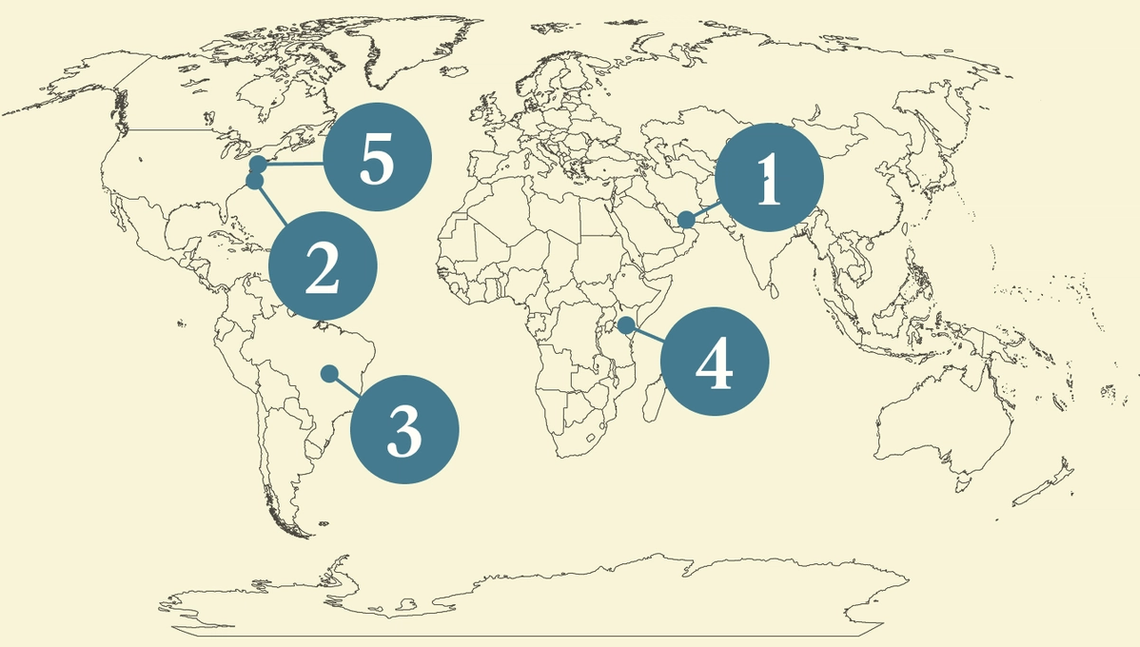 - Crude calculations
- SWE’s energy consensus
- Rare earth IPO
- Data center DOA
- Cool trees
 JPMorgan on Europe’s energy future, and Kraken’s first US customer. |
|
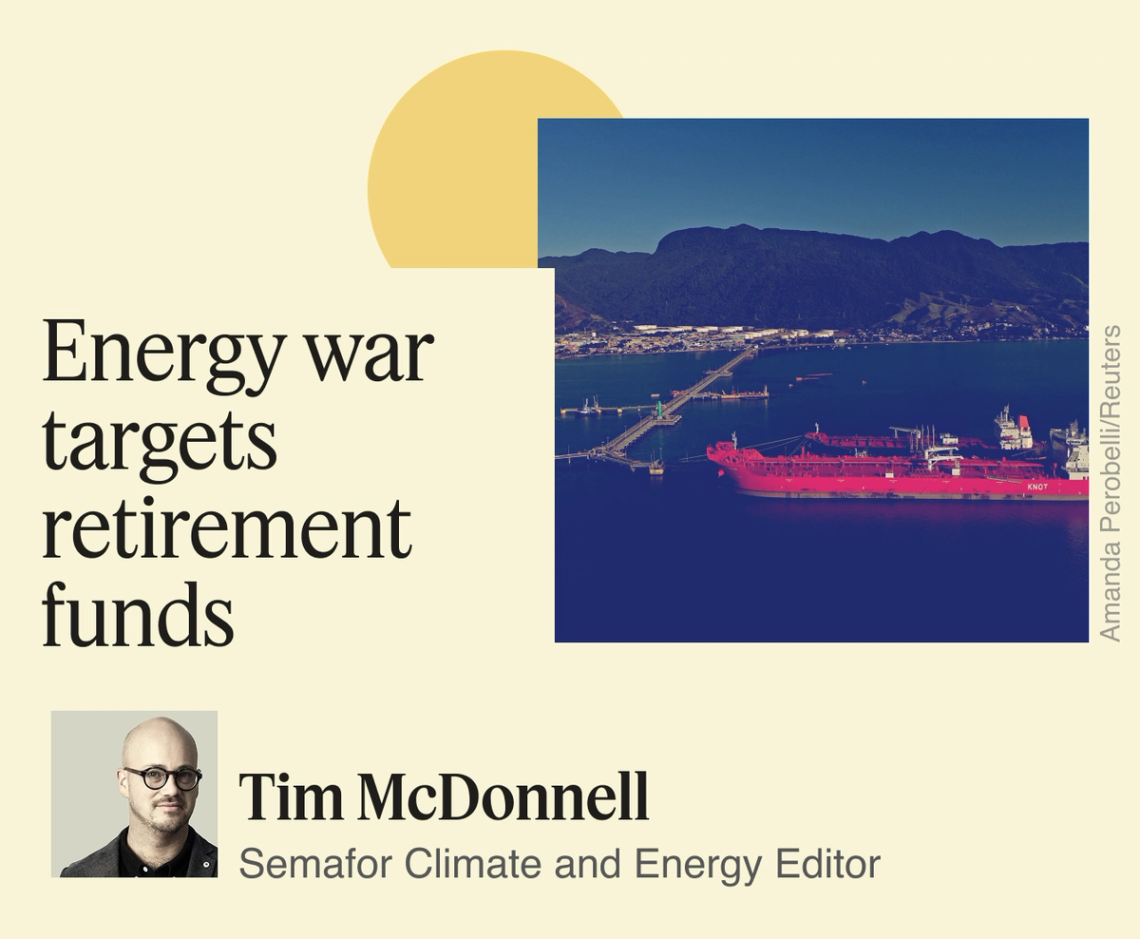 So far, the main direct threat that average Americans seem to have faced from the Iran War has been higher gasoline prices. But more could be at risk. On Monday, as US President Donald Trump launched a short-lived naval operation to escort ships through the Strait of Hormuz, Iran carried out an air attack against an oil storage terminal in Fujairah, UAE. The port — now one of only a few crucial trade lifelines for the Gulf — has been hit several times during the war, occasionally forcing a pause on oil exports. The storage facility is owned by the energy infrastructure company VTTI, which is jointly owned by the UAE’s state oil company ADNOC, the commodities trader Vitol, and IFM, a private equity firm. IFM’s global infrastructure fund counts some of the largest US public pension funds, including CalPERS and New York State Common, as investors. Many US pensions have in recent years put a larger share of their assets into the hands of private equity firms, chasing higher returns for retirees. PE, meanwhile, has poured capital into the infrastructure needed to move fossil fuel molecules around the world. Firms like Brookfield, GIP, BlackRock, and Stonepeak own networks of pipelines, terminals, tankers, and more — including many in the Middle East that are now under threat of being either bombed, or at least suspended from service. Put it together, and wars that revolve around energy infrastructure could pose a new material risk to long-term investors, Jim Baker, executive director of the Private Equity Stakeholder Project, a nonprofit watchdog group, told me. “Until a couple of months ago, most people in private equity didn’t think there was a geopolitical risk in shipping LNG in and out of the Gulf. Events have proved otherwise,” he said. “There’s a question of whether these firms have fully communicated potential risks to their investors.” (IFM didn’t return a request for comment; CalPERS declined to comment.) Arguably, despite certain physical risks, a war like this one is exactly the perfect time for gutsy investors to dive into the energy midstream, as the consequences of an overreliance on chokepoints drive renewed spending on supply chain diversification, especially in the Gulf. But as Carlyle CEO Harvey Schwartz — whose firm is pursuing its own risky venture into Middle East energy infrastructure via its acquisition of Lukoil’s global assets — said during Semafor World Economy, markets are bad at assessing geopolitical risk. Retired teachers shouldn’t pay the price. |
|
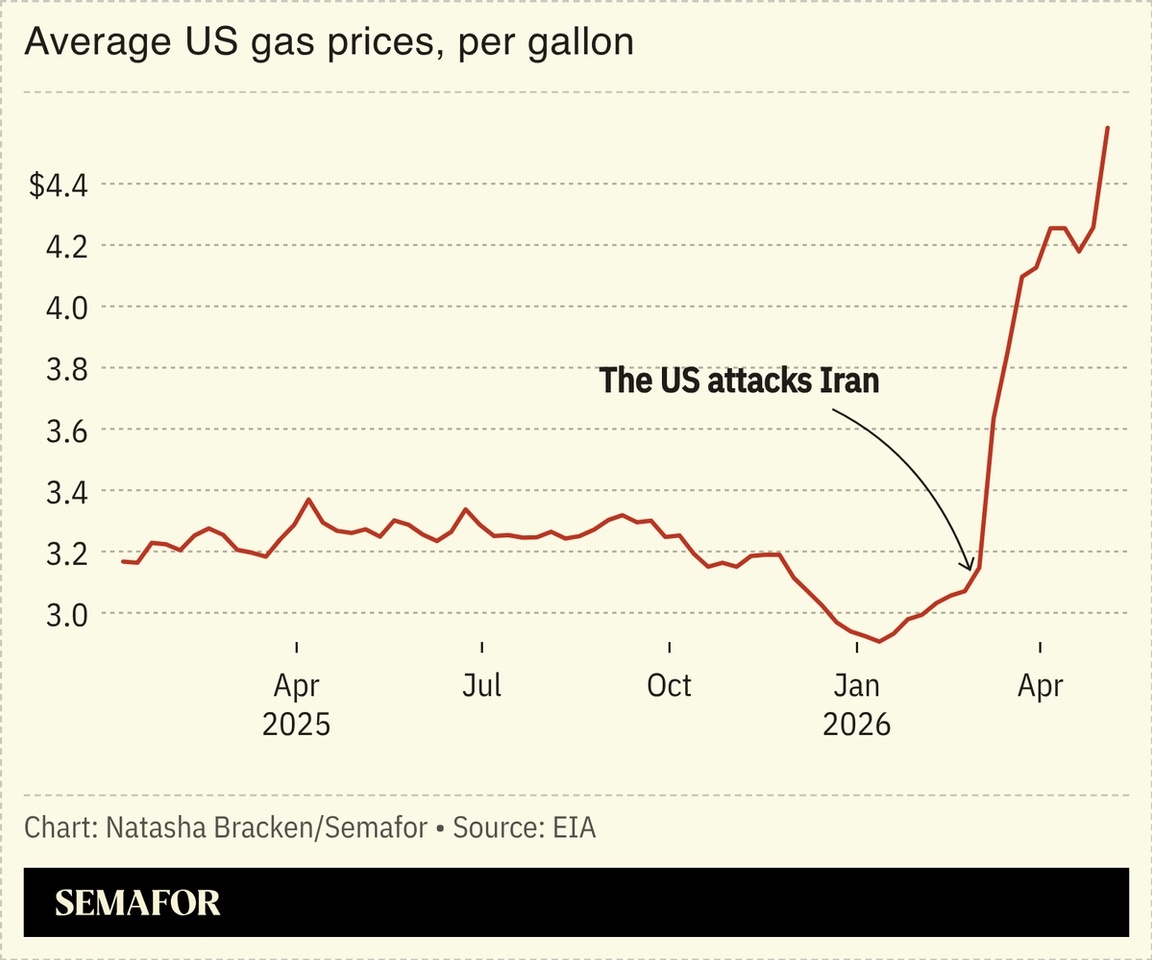 The price of crude oil fell on signs of progress in US-Iran peace talks, but US gasoline prices continued to rise, with President Donald Trump running out of moves to lower them. If negotiators do manage to agree on the one-page memo that is reportedly under discussion, it could still be at least another month before the US lifts its naval blockade and anything like normal oil tanker traffic can resume through the Strait of Hormuz. “A six-to-eight-week lag between credible access conditions and real-flow normalization is not a conservative estimate, it’s a structural feature of how shipping markets work,” Rystad Energy chief oil analyst Paola Rodriguez-Masiu said. “Global markets should not mistake a ceasefire headline for a supply headline.” In the meantime, Iran’s own oil sector is running into trouble from the US export blockade. On the home front, Congressional Democrats are beginning to clamor for a gas tax holiday, which the White House told Axios is “not currently under consideration.” A report by the Bipartisan Policy Center concluded that temporarily suspending gas taxes could add $12 billion to the federal deficit, and shave only a few cents off per-gallon prices. The Trump administration’s latest solution was to offer an additional 92 million barrels from the Strategic Petroleum Reserve on loan to oil companies. But the drawdown of domestic reserves only means a greater risk of physical shortages, like what countries in Asia already face. “You can’t keep pulling down inventories, or you’re about to start hitting tank bottoms in some spots,” Houston equities investor Dan Pickering said in his podcast. |
|
  Kris Tripplaar/Getty Images for Semafor Kris Tripplaar/Getty Images for SemaforCEOs think the Trump administration’s energy “dominance” strategy is largely working, but that the market is underpricing the true economic disruption ahead, according to Semafor Intelligence, an analysis of interviews with more than 300 people conducted over five days at Semafor World Economy. Executives at last month’s gathering mostly agreed that the US was somewhat insulated from the most extreme energy-price volatility as a result of the conflict, but diverged on where the true cost of the disruption would fall, according to the analysis, which used a proprietary AI tool to examine the full onstage record and rank nearly 5,000 claims. The tool then distilled the patterns into sharp, evidence-backed themes and tied them back to each speaker, session, transcript, and video moment (see the full report on the chokepoint economy here). Record US oil and gas production is indeed providing an effective buffer for the world’s biggest economy, with Kevin Hassett, director of the White House National Economic Council, neatly summing up the administration’s view: “Why is it that energy prices don’t have as big an economic effect as they did in the ’70s? For the US, the obvious answer is because we’re the largest oil producer on Earth.” Yet as Harvey Schwartz, CEO of private equity firm Carlyle, said, “there’s a complacency around geopolitical events.” So even if oil prices have risen relatively more slowly in the US than elsewhere, the country remains vulnerable to broader inflationary pressure and recession risk that stem from the energy disruption. A third point of consensus: The US is falling gravely behind China in the rollout of abundant, cheap electricity, which is the fundamental prerequisite for future AI dominance. “Electricity drives compute,” said Chris Lehane, chief global affairs officer at OpenAI. “We don’t have to match it gigawatt to gigawatt, but we do need to be in the ballpark.” |
|
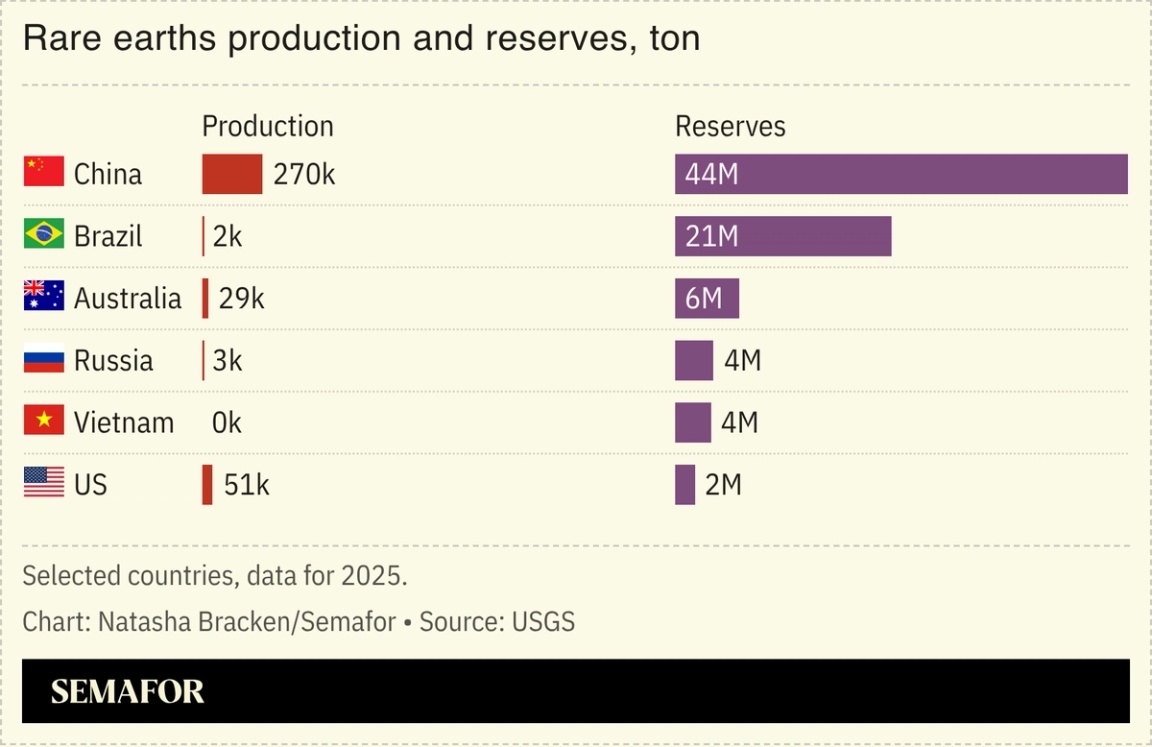 The Trump administration’s financial interventions in support of rare earths mining companies are working to drive more capital into the sector, the CEO of the latest such company to go public told Semafor. Rare Earth Americas listed on the New York Stock Exchange on Wednesday, the first rare earths mining venture to go public in the US since 2010 via a traditional listing, unlike the special-purpose acquisitions that recently brought companies like USA Rare Earth and MP Materials to the public market. REA, which aims to mine heavy rare earths like dysprosium and terbium from plots in Brazil and the US state of Georgia, also stands out from those other players in that it does not have any financing from the US government. But CEO Don Swartz said he’s open to seeking it out “in the future,” with the support of his board chair Reta Jo Lewis, who was CEO of the US Export-Import Bank under former President Joe Biden. REA is scrambling to reach meaningful production volumes from its mines within four years, Swartz said, as more magnet and battery factories get built outside of China. Federal funding — for example the package of debt, price floors, and procurement guarantees that USA Rare Earth tapped last month to enable its $2.8 billion acquisition of a mine and processing facility in Brazil — is the only way to catch up with China, Swartz said: “It’s a 20- or 30-year problem that you’re trying to solve very quickly.” |
|
| |  | Martin K.N Siele |
| |
 The proposed site for the data center in Kenya’s Great Rift Valley. Donwilson Odhiambo/Semafor. The proposed site for the data center in Kenya’s Great Rift Valley. Donwilson Odhiambo/Semafor.A $1 billion geothermal-powered data center project in Kenya by Microsoft and UAE’s G42 is unlikely to go ahead after President William Ruto blamed inadequate power capacity for its stalling. Semafor reported in September that the once-hyped project had stalled, with developers yet to break ground and questions mounting on its future. Ruto said last week that Kenya was forced to reconsider the plans after learning that it would require a third of the country’s total installed capacity of around 3,000 megawatts. “To switch on that one data center, we would need to shut off power for half the country,” he said of the project. “That’s when I knew there was a problem.” Ruto had first announced plans for the facility during a state visit to Washington in May 2024. Orchestrated by the Biden administration, Microsoft and G42 originally promised to invest in the site around 60 miles (100 kilometers) northwest of Nairobi to provide government and business cloud services on the US tech giant’s Azure cloud computing platform. They said it would run on geothermal power — which accounts for around 40% of Kenya’s energy mix — a sustainable source of baseload power that was seen as an advantage. |
|
 Volt Insight is a weekly newsletter decoding China’s battery and critical minerals industries for financial markets. Written from Chinese-language primary sources by former Financial Times correspondent and author of Volt Rush, Henry Sanderson, Volt Insight offers a clear view of China’s influence on batteries, minerals, and the energy transition. Subscribe for free. |
|
 Andrew Wong ASW/TW/Reuters Andrew Wong ASW/TW/ReutersWithout the cooling effect of trees, the urban heat island effect across the world’s cities would be twice as hot, a new study by The Nature Conservancy found. Trees in major cities worldwide mitigate nearly half of the heat effect generated by man-made surfaces such as roads, buildings, and car parks, which absorb and re-radiate solar heat, causing cities to run hotter than their surrounding rural areas. More than 900 million city dwellers, the study found, benefit from ambient air temperatures 0.25°C lower than they would experience without trees, while 200 million enjoy reductions of at least 0.50°C. But this cooling effect is concentrated precisely where it’s less needed, in high-income countries and suburban neighbourhoods. On top of that, the study projects that current and future tree cover will mitigate only around 10% of the increase in temperatures caused by climate change that is expected by 2050. Governments worldwide should in response prioritize expanding tree canopy in dense, low-income urban areas while there’s still time for those trees to reach their full, cooling potential, the report’s authors said. — Natasha Bracken |
|
 New Energy- Europe’s solar power capacity has more than doubled since 2020, but it’s now generating so much power during peak hours that it’s driving prices into negative territory and forcing European power companies to shift their focus from building new capacity to building storage capacity and complex markets, Reuters wrote.
Fossil Fuels- Norway is reopening three gas fields that it closed last century as the country seeks to make up for lost supplies from Russia and the Middle East.
- The reason the UAE quit OPEC isn’t just because of production quotas or wartime disruptions, the UAE’s ambassador to the US wrote in the Financial Times, it’s largely because Abu Dhabi joined OPEC when its economy was still oil-dependent. The cartel “offered expertise, stability and leverage that a small, newly independent country could not generate on its own,” Yousef Al Otaiba wrote, “but that country no longer exists.”
- Shell’s first-quarter profit hit its highest level in two years at $6.9 billion, boosted by the war in Iran.
Finance |
|
|


