Two Trump heirs, two stages

Get behind the headlines of Washington politics and its global impact. Subscribe to Reuters.com for $1/week. Subscribe now.


Politics U.S.

Politics U.S.


By Trevor Hunnicutt, White House reporter

Two leading Republican contenders to succeed U.S. President Donald Trump took center stage this week. The appearances by Vice President JD Vance and Secretary of State Marco Rubio offered a fresh look at how they handle the spotlight at a time when their boss’ brand may be diminishing and their party is starting to think about its political future. 


Latest U.S. politics headlines

  • US and Iran explore short-term deal to end fighting
  • Exclusive: US intelligence indicates limited new damage to Iran's nuclear program, sources say
  • Tensions over pro-Israel lobbying group highlight rifts in Democratic primaries
  • Trump vowed to fight crime in Minneapolis. Prosecutions plunged
  • Warned off vaccine actions, Kennedy seeks quick health wins ahead of midterms
  • Exclusive: US aims for Fourth of July to deploy Qatar-gifted jet as Air Force One
 

Two Trump heirs, two stages

In Washington, Rubio breezily fielded questions from the White House press corps, borrowing liberally from 1990s hip-hop to characterize Iran’s negotiating position. 

“They're insane in the brain,” Rubio said, echoing Cypress Hill. 

Meanwhile, in the country’s heartland, Vance gladhanded campaign donors and drew on folksy lessons from “Mamaw” and “Papaw” – his grandparents – in a stump speech for an Iowa congressman at risk of losing his seat in November’s midterm elections. 

These are the two men Trump believes could be his successors as president after 2028. “If they ever formed a group, it’d be unstoppable,” Trump told me last year. 

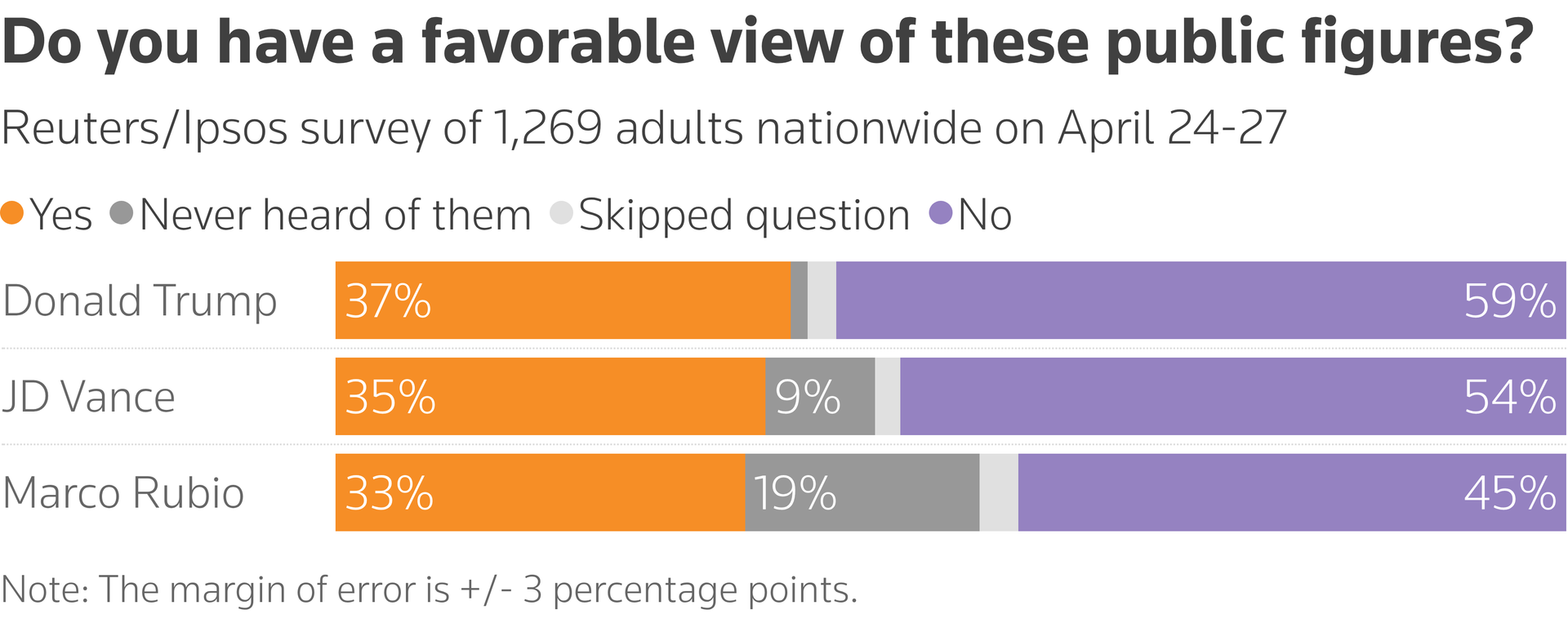
This week's split screen offered both a rare opportunity to step out from Trump’s vast shadow. Just 35% of Americans say they have a favorable view of Vance and 33% say the same of Rubio, according to a Reuters/Ipsos poll conducted April 24-27. 

On Tuesday, Rubio got the higher-profile assignment, defending the Iran war before the press. Standing in for press secretary Karoline Leavitt, who is out on maternity leave, Rubio also previewed his meeting on Thursday with Pope Leo, who has been at odds with Trump. He capably navigated the chaotic, standing-room-only White House briefing room and peppered his presentation with Italian and Spanish. 

“You can ask me two questions, I’ll give you one answer, and I’ll pick the one I like better,” he joked with a reporter. 

It wasn’t all smooth. Rubio’s statement that the Iran war was over clashed with Trump's a day later in which he said the conflict would only end if Tehran made a deal. The administration’s inconsistent messaging has been a hallmark of the two-month-old war, and Rubio is often the face of a conflict that remains unpopular with U.S. voters. 

Vance, less so. The vice president was handed a nuts-and-bolts campaign trail assignment, raising money and helping a vulnerable congressman. In Oklahoma, he headlined an event expected to raise $2 million for the Republican National Committee, according to a person familiar with the matter. He also met with the families of two servicemembers killed in the Middle East. 

But in a campaign speech for Representative Zach Nunn of Iowa, he didn’t dwell on the mounting costs of war. Instead, he talked down Democrats as out of touch and touted Republicans’ efforts to police fraud and cut taxes. Vance shuffled through notes and forgot the name of Nunn’s Democratic opponent. “Help me out with her name,” he said. “I lost my page.” 

Both men have big Florsheims to fill. Over the last decade, Trump has built an enduring political empire. If either man can construct a winning midterm message for Trump, he may be anointed as the one to take it over. 


Poll of the week

 
Survey of 1,269 adults nationwide on April 24-27 about their view of Donald Trump, JD Vance and Marco Rubio

Follow Reuters/Ipsos polling on the president's approval ratings here.


The view from Berlin

Friedrich Merz is the latest European target of Trump’s anger. The German chancellor’s comments last week that Iran is humiliating Washington was followed by the announced withdrawal of 5,000 U.S. troops from the NATO ally over the next six to 12 months. Germany is home to 35,000 active-duty U.S. military personnel, more than anywhere else in Europe.

Merz said there was no connection between the rift and the troop drawdown, but a U.S. official said the events were linked. “What is worrying is … the political signal from Washington that longstanding, absolutely reliable partnerships no ⁠longer seem to count for anything,” said Siemtje Moeller, a lawmaker from Germany’s Social Democrats, who are part of Merz’s governing coalition.


Photo of the week