Every person who joins a startup and takes equity as part of their pay package has a dream that this company will not only be successful, but also either IPO or be acquired, allowing them to cash out with a massive sum. A new report from The Wall Street Journal shows there’s a third option for early hires at OpenAI: sell shares even before going public. Around 75 such employees have walked away with about $30 million… each.
Yesterday, the S&P 500, Nasdaq 100, and Russell 2000 made modest advances, closing at new record highs. Energy was the best-performing sector, with oil rising as President Trump said that the ceasefire with Iran is “on life support.”
|
|
|
|
Landing in your inbox premarket every Monday, Wednesday, and Friday, EntryPoint explores macro themes, market trends, and technical signals, giving unique insights into what Robinhood* investors are buying and selling. |
*Robinhood Markets, Inc. is the parent company of Sherwood Media, an independently operated media company. |
|
|
|
How much Apple’s biggest contribution to the AI boom matters for its sales |
Three and a half years after ChatGPT burst onto the scene with widely available generative AI, Apple has yet to release a good AI assistant and instead appears to be positioning the iPhone as a distribution layer for competitors’ superior models. To borrow from Wedbush Securities analyst Dan Ives’ previous comments, Apple’s AI strategy remains mostly “invisible.” That said, the company has been making a roundabout contribution to AI through some of its lesser-known hardware: the Mac mini.
|
- The small, screenless desktop computer has become a relatively affordable, low-friction way for developers and hobbyists to run AI models locally, without relying on Big Tech’s cloud infrastructure.
- The device is so popular that on the company’s earnings call last week, CEO Tim Cook said it was facing shortages that would last “several months.”
- Apple shipped 298,000 Mac minis in the first quarter, up 8% from a year earlier, according to new data from IDC.
-
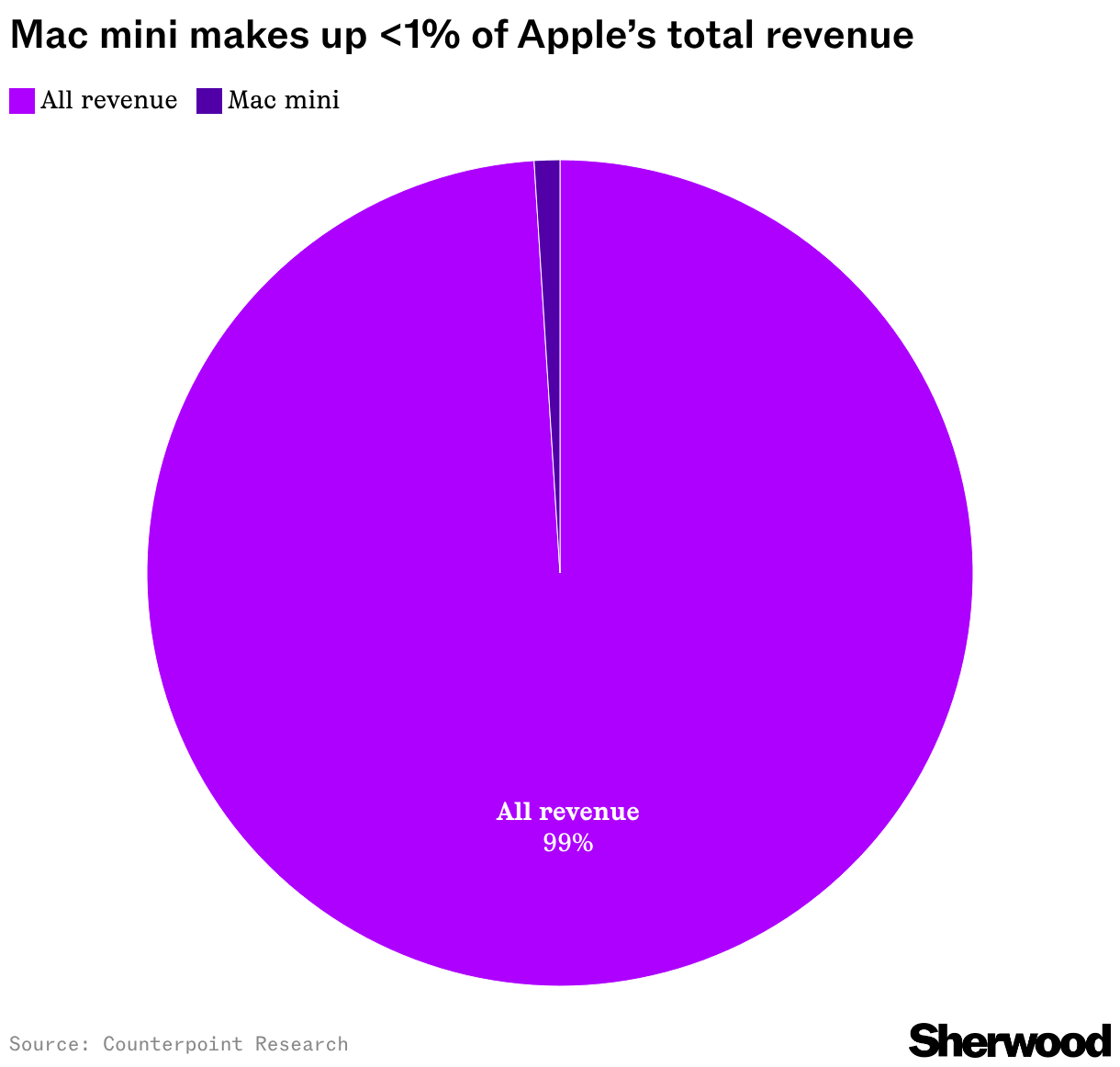
Counterpoint Research Associate Director David Naranjo told Sherwood News that even amid increased demand, the Mac mini accounts for about 3% of Mac unit sales and less than 1% of total Apple revenues. Our chart shows just what portion of Apple’s pie that is.
|
Even a small fraction of Apple’s revenue — $416 billion last year — is still a tidy sum, even if it’s a rounding error for Apple. |
|
|
|
The rise of AI agents has spurred a reevaluation of how big of a role CPUs will play in the boom by “orchestrating” workflows for their bigger-brained GPU counterparts to carry out.
That newfound interest is quickly shifting the Mac mini’s identity from a budget entry point to a premium developer tool. Consequently, Apple recently discontinued its $599 entry-level configuration, effectively raising the starting price to $799 to prioritize higher-margin models. |
|
|
|
AI Works Best When It Solves Real Problems In Real Industries. Surf Air Mobility Is Doing Exactly That In Aviation. |
One of the places AI is driving real results right now is inside specific industries, where companies with deep operational data are using it to transform how they do business. In aviation services, Surf Air Mobility (NYSE: SRFM) is positioned to lead the way.
The company is building SurfOS, an AI operating system powered by Palantir, and is deploying it inside its own airlines before selling it to anyone else. The results so far: 32% more bookings for top-performing brokers, 57% faster sales cycles, and 40% more payments processed on-platform.1
Now Surf Air Mobility is taking that same software to market this year across a broader $156 billion global aviation services industry, and Palantir’s own engineers are supporting enterprise deals. Built on real operations. Backed by real data.
See the SurfOS commercial plan. |
|
|
|
Investors really want Moderna to whip up a hantavirus vaccine |
Late last week, Moderna said that it was in the early stages of researching vaccines to protect against the hantavirus, which has killed three people and infected at least six others on a cruise ship crossing the Atlantic Ocean.
Moderna’s research for a hantavirus vaccine predates the recent outbreak and has been done alongside the US Army Medical Research Institute of Infectious Diseases and the Vaccine Innovation Center at Korea University College of Medicine, per Bloomberg. |
- Hantavirus — which is passed by rodents and has a fatality rate of up to 50%, according to the World Health Organization — has brought back memories of the early COVID-19 days in 2020, when outbreaks surged on cruise ships and eventually spread across the world.
-
Moderna, a small biotech tapped to quickly develop a vaccine for COVID-19, would go on to sell $18.4 billion worth of vaccines in 2021 and $19.2 billion in 2022.
- But as Moderna’s main revenue driver, the COVID-19 vaccine, has seen a decline in demand, Moderna needs to shift its focus.
|
| |
|
After plummeting sales for its COVID-19 vaccine, Moderna finally sees growth on the horizon this year. In addition to research into the hantavirus, Moderna said a growing share of its revenue is coming from international markets after the European Commission approved its combination vaccine for the flu and COVID-19 for adults 50 years and older.
|
|
|
|
Dunkin’ is going public again |
America’s biggest coffee-and-doughnut chain may be heading back to Wall Street after nearly six years. Last Friday, Inspire Brands, the private equity-backed restaurant conglomerate behind Dunkin’, Arby’s, Sonic, and more, announced that it has confidentially filed for an IPO.
Thanks to a store-refresh push, Dunkin’ is the crown jewel in Inspire’s empire: see its widening lead over Inspire’s other chains. |
|
|
|
|