
|
Carrying the deadly weight of fashion's excess
In Ghana, women risk their spines and their lives carrying 120-pound bales of secondhand clothing cast off by wealthy nations.
|

| |||||||||||||||


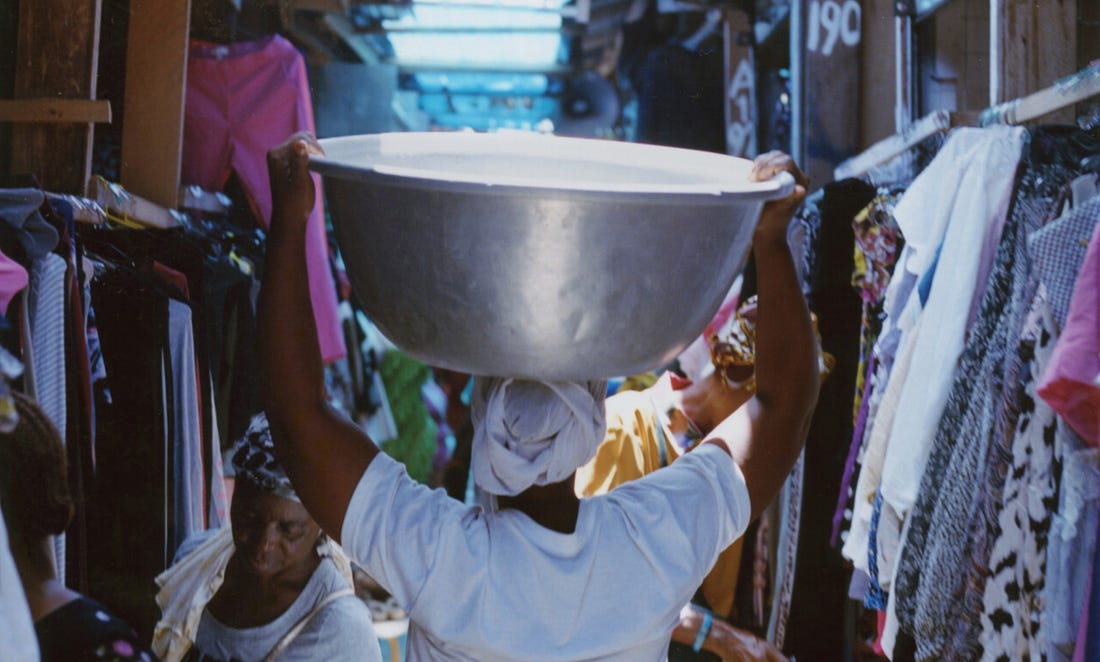 |
Najiha Yahaya has a wide smile, a creative impulse so strong that she taught herself to crochet without the help of a smartphone or YouTube, and the kind of courage that allows her to stand before powerful men and defy them to their faces. But if you had met her when she first arrived in Accra alone at 15 and began working as a head porter, or kayayo, carrying heavy bales of secondhand clothing on her head, you might not have seen any of that.
Born and raised in Kpilo, a small farming community in northern Ghana, Yahaya moved to the bustling capital of Accra to earn just enough money for books and a school uniform before returning home. Yahaya quickly began head porting to make ends meet. She found herself in Kantamanto, one of the largest secondhand clothing markets in the world. There, garments discarded by customers in Europe, China and North America arrive packed into large bales that usually weigh about 120 pounds. Small-scale retailers selling that clothing to Ghanaian customers pay kayayei like Yahaya less than $1 to carry the bales on their heads through the market’s narrow aisles to their stalls.
The first time Yahaya loaded one of those crushingly heavy bales onto her head, she cried. Yet despite the ways that customers talked down to her, and the pain that began to blossom in her chest each time she loaded up with a bale that weighed more than she did, Yahaya gritted her teeth and kept working. She used the few cedis she earned each day to pay for a place to sleep in a small room shared with more than a dozen other women, and saved whatever else she could.
Yahaya is just one of about a thousand women who end up working as kayayei in Kantamanto each year. Yahaya sees the work less as an opportunity than as a trap—the kind of job you get stuck in despite the poor pay, the lack of upward mobility, and the ever-present risk of serious harm.
“It’s something I don’t think anybody will wish to be doing,” Yahaya told me, describing head-porting as an option women take up when the only other alternatives they can see are stealing or sex work.
 |
Kayayei, these women who form “backbone of the secondhand market” for much of the globe from their place in Accra, face myriad challenges: Poor pay. Discrimination and abuse in the market and in healthcare settings (one woman told me of a hospital visit where a health worker asked, ‘Why are we wasting money on these girls?’). Overcrowded and unsanitary living conditions. Health problems due to the impact of carrying dangerously heavy weight. In the most horrifying cases, death: I heard stories of more than one kayayo who died on the job; one had a baby strapped to her back at the time.
Losing even one life this way is a horrific tragedy. But it’s made all the more senseless when you consider what this dangerous labor is in service of: a fashion system built on excess, in which companies and governments in the Global North export their waste to the Global South and pass it off as charity. This extractive dynamic echoes throughout fashion’s history. In the 18th and 19th centuries, African labor was exploited at the beginning of the supply chain on cotton farms in the Americas; in the 21st, African labor is being exploited at the end of the supply chain to handle textile waste. The names have changed, but a business model built on human rights abuses remains.
Kayayei carry the literal weight of the fashion industry’s greed and excess on their heads. Some pay for it with their lives.
This post features excerpts from a story about kayayei, the first in a series I’m reporting for Atmos focusing on the impacts the global fashion industry is having by sending fashion waste to Ghana. Walking through the market in Accra where these women work and then visiting the slum where many live, hearing their stories along the way, was sobering. But what a privilege, too, to get to meet them in person, and to meet the people who are championing solutions that would allow for the end of dangerous head-carrying and a more equitable approach to fashion waste globally.
I will be thinking about these women for a long, long time. I hope you’ll take the time to read more about them here.
And stay tuned for the next installment in the series, which will be coming this summer.
I’ll leave you with the poem “Whom Do We Thank for Women’s Conferences?” by Ama Ata Aidoo.
May we be unafraid of ideas,
Whitney
You're currently a free subscriber to The Unwrinkling Roundup. For the full experience, upgrade your subscription.
|