
|
Trump goes to China, without any cards
It's enough to make the Nixon era seem like the good old days.
|
| |||||||||||||||


 |
PN is supported by paid subscribers. Become one ⬇️
Decades after Richard Nixon went to China, America needs a president with the strategic mindset of Nixon (but not his amorality) to deal with a Chinese regime that has become a hub of authoritarianism across the globe.
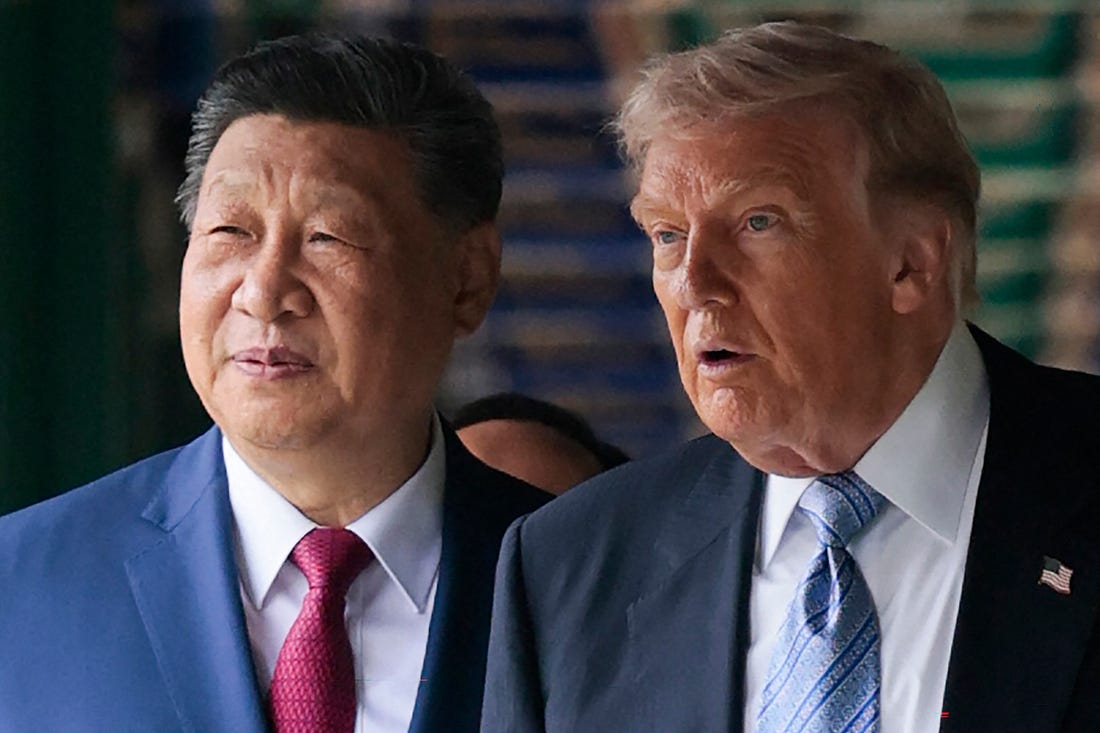
Instead, we have Donald Trump, who just went to China as a supplicant, freely offering to help China undermine America itself in return for the promise of alleviation from the consequences of his own catastrophic political and military blunders and profits for his cronies.
The unintended consequence of realpolitik
In 1972, Nixon and Henry Kissinger pulled off the greatest gambit of the Cold War when Nixon surprised the world with a visit to China, a country that had been largely closed to the West since the victory of the Chinese Communist Party in 1949.
Kissinger famously labeled Nixon’s foreign policy, and particularly the opening to China, as “realism,” reflecting a willingness to deal with the rule of the most repugnant regimes in order to serve what the two deemed to be the interests of the United States.
 |
|
The “realpolitik” opening to China yielded immediate successes, not the least of them outflanking the Soviet Union, leading to a nuclear arms control regime that lasted for decades and likely ultimately hastened the unraveling of the USSR. And China went on to embrace capitalism after the passing of the murderous dictator Mao Zedong in 1976.
But Nixon and Kissinger’s accommodation with China 54 years ago ultimately ended up facilitating two problematic developments: First, China has become an industrial colossus that is deeply integrated into the economies of the US and the rest of the West, and second, the Chinese regime — still fully controlled by the Communist Party — is a committed opponent of the West, and has become the financial and industrial engine of authoritarianism and despotism across the world.
China, the interdependent enemy of the West
Under its first post-Mao leader, Deng Xiaoping, China’s communist regime emulated the strategy of its nemeses, Japan and Taiwan, by relentlessly pursuing an industrial economy based on creating products for export to the West. That led to the country becoming deeply codependent on the US and other Western nations by funding the debt required for their purchases of the massive quantities of Chinese goods, and likewise making US farmers heavily dependent on Chinese markets.
But far from pursuing political liberalization, China, since the fall of the Soviet Union, has turned back to a leader-centered, and near totalitarian, dictatorship under Xi Jinping. Xi has pursued an increasingly audacious policy of threatening and intimidating China’s neighbors, foremost among them Taiwan, and occupying parts of the South China Sea with an increasingly massive (and menacing) military.