
|
 |
It’s Trump’s Party and He’ll Crash If He Wants To
The GOP has never been more Trump’s party. Midterm voters will surely notice.
|


| ||||||||||||


A month and a half ago, Donald Trump reached into his bag of negotiatin’ tricks and pulled out a few threats of genocide: If the “crazy bastards” of Iran wouldn’t “Open the Fuckin’ Strait,” the president warned, a “whole civilization” would die. Didn’t work then, but maybe second time’s the charm: “For Iran, the Clock is Ticking,” Trump posted on Truth Social yesterday, “and they better get moving, FAST, or there won’t be anything left of them.” Happy Monday.
 |
Live by Trump, Die by Trump
by William Kristol
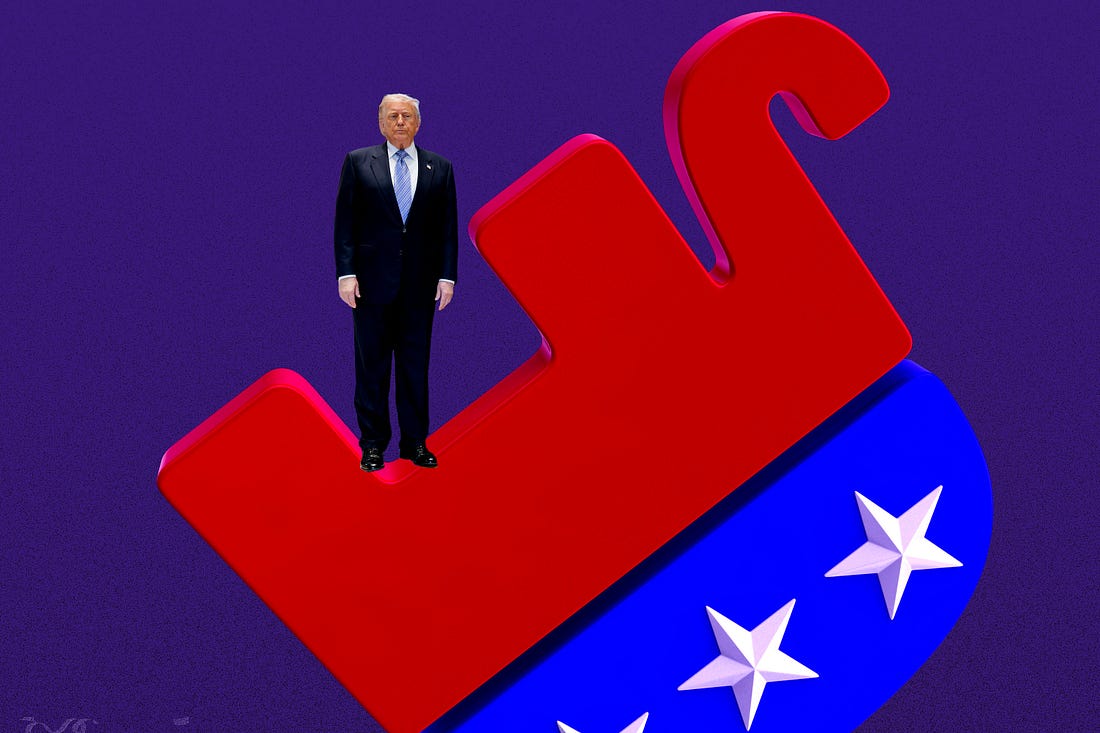
“This is the party of Donald Trump.” So Sen. Lindsey Graham proclaimed on Meet the Press yesterday, in the wake of Sen. Bill Cassidy’s defeat in the Louisiana Republican primary. Graham is right. The Republican party is unquestionably and unambiguously Trump’s party. And the GOP will be dragged down by him, burdened by his dead weight, as it sinks this fall beneath the political waves.
As Graham was confirming that the GOP is Trump’s party yesterday, CBS News released its latest survey, conducted by YouGov, of more than 2,000 adults last week.
The first question asked was, as usual, “Do you approve or disapprove of the way Donald Trump is handling his job as president?” Here are the answers from this poll so far this year:
January 2026: Approve 41 percent, disapprove 59 percent.
February 2026: Approve 40 percent, disapprove 60 percent.
March 2026: Approve 39 percent, disapprove 61 percent.
April 2026: Approve 38 percent, disapprove 62 percent.
May 2026: Approve 37 percent, disapprove 63 percent.
Yes, the movement of American public opinion away from Trump has been frustratingly slow. But unlike in the last half of 2025, when Trump’s numbers were basically stable at around 41 percent to 59 percent, the movement this year has been real. The decline to 37 percent approval (and the climb to 63 percent disapproval) has been slow but steady, gradual but inexorable. One percentage point a month adds up. (And this morning, a new New York Times/Siena poll has very similar numbers, with Trump at 37 percent approval, 59 percent disapproval.)
When you dig into the CBS poll, it gets worse for Trump. Separating those who approve or disapprove of Trump strongly from those who do so only tepidly, here’s what you get:
Strongly approve: 20 percent.
Somewhat approve: 17 percent.
Somewhat disapprove: 11 percent.
Strongly disapprove: 52 percent.
Sitting at 20 percent vs. 52 percent among the voters with the strongest opinions is not a strong position.
And when asked, “How much do you think Donald Trump cares about the needs and problems of people like you?” Americans responded:
A lot: 18 percent.
Some: 17 percent.
Not much: 14 percent.
Not at all: 51 percent.
These are very bad numbers for Donald Trump. And these are very bad numbers for the Republican party.
As Ron Brownstein points out, “Trump is consistently in a much deeper hole now than other recent presidents who had bad mid-terms.” A party’s performance in a midterm, especially when that party has controlled both the presidency and Congress for the preceding two years, tends to correlate pretty reliably with the president’s approval rating. This makes sense. After all, in November, voters have to decide whether they want the next Congress to continue to go along with that president or to check him.
And that correlation will presumably hold all the more tightly when the congressional party is visibly tied at the hip to their president. Which, as Lindsey Graham said yesterday, today’s Republican party is.
So for all the complexities of the tasks we face confronting the ongoing disaster of Trump and Trumpism, the short-term political task today is pretty simple. The pro-democracy movement has to try to continue to drive down Trump’s approval, to the degree possible. At the very least, it has to get out of the way as Trump’s own actions lead to public disapproval.
And the short-term task of the Democratic party is also pretty simple: Tie Republican incumbents and candidates as tightly as possible to their president. This means among other things making them vote over and over for Trump’s unpopular policies and for his unpopular vanity projects. The best way to make sure Trump’s enablers pay a price is to make them continue, visibly and embarrassingly, enabling their leader. (And if some of them grow sick of doing so, or decide it’s in their political interest to allow a little space between themselves and the president, all the better. Some coverage of “Republicans in disarray” would be fine too.)
The closest parallel to this year could well be 2006. Republicans went into those midterms with control of both houses. Most polls had President George W. Bush around 37 percent approval on election day. Democrats took control of both houses, gaining thirty-one seats in the House and six in the Senate. They won the national popular vote in the House by eight points.
Trump and his party will be able to do a lot of damage over the next six months. They’ll be able to do a lot of damage for the subsequent two years even if Democrats do win Congress. But perhaps the tide has turned.
I haven’t gone all Victorian poetry for a while, so if you’ll permit the indulgence, I’ll close with some lines from Arthur Hugh Clough’s “Say not the struggle nought availeth”:
For while the tired waves, vainly breaking,
Seem here no painful inch to gain,
Far back through creeks and inlets making,
Comes silent, flooding in, the main,

And not by eastern windows only,
When daylight comes, comes in the light,
In front the sun climbs slow, how slowly,
But westward, look, the land is bright.