
|
 |



When everything is bad, nothing is bad. People get desensitized. They can no longer keep track of it all. It’s all so awful that none of it gets processed anymore.
So I need you to hear me when I say tonight: This is bad. Really, really bad. MS Now’s Ari Melber called it “worse than Watergate”. He was right.
Here’s the bottom line. Donald Trump wants to take $1.8 billion dollars of money that taxpayers like you and me have paid to the government, and he wants to give it to his most hardcore followers, the people who stormed the Capitol on January 6. Trump calls them victims of Joe Biden’s weaponization of the Justice Department. It’s corruption. Corruption in plain sight. Trump is going to give his supporters taxpayers’ money.
One of the most troubling things about Trump’s second presidency is that fraud and corruption have been completely normalized. There’s no call for accountability. And it’s a long list. Trump crypto. Trump pumping up Palantir stock after buying a sizable amount for himself. The Campaign Legal Center has a 38-page report, last updated in February, called “Trump’s Corrupt Transactions.” But it all pales in comparison to what began to unfold last week.
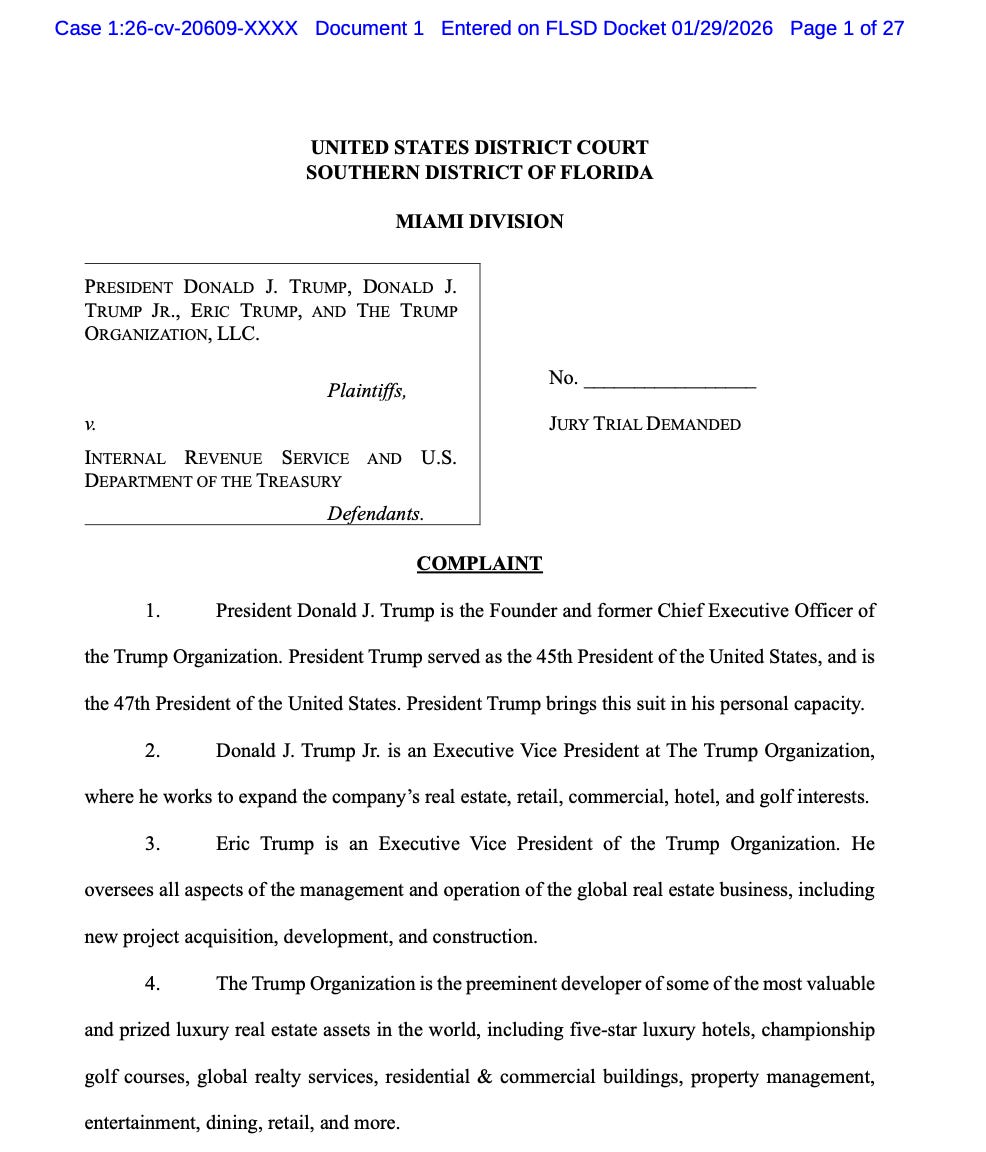
You may recall that back in January, Trump, his two oldest sons, and the Trump Organization filed a lawsuit against the Internal Revenue Service, asking for $10 billion. In it, they alleged that a former IRS employee illegally gave Trump’s tax returns to the New York Times, ProPublica, and “other leftist media outlets.” They fault the IRS for failing to take precautions to prevent it from happening.
The claim for $10 billion stems from an allegation that the disclosure “caused reputational and financial harm, public embarrassment, unfairly tarnished their business reputations, portrayed them in a false light, and negatively affected President Trump and the other Plaintiffs’ public standing.” There is no documentation that the release of tax records caused any of that, and no proof that it resulted in $10 billion in damages. Arguably, given Trump’s reelection and reports that he’s now worth more money than ever, he suffered no damages at all. And even if he did, it would be difficult to isolate them to the IRS leak as opposed to his 34 felony counts of criminal conviction, the January 6 insurrection, or his connection to Jeffrey Epstein.
 |
The lawsuit was filed in the Southern District of Florida, possibly in hopes of landing in front of Judge Aileen Cannon. But this time, Trump pulled Judge Kathleen M. Williams, an Obama appointee. Judge Williams served as both a federal prosecutor and as the chief assistant federal public defender prior to her appointment, and also has experience as a litigator in private practice. She saw a potential problem with the lawsuit and its request to line the president’s pockets with taxpayers’ hard-earned cash.
The problem is that Trump essentially sued himself. Trump sued an executive branch agency he controls. Trump claims that he, the unitary executive president, can dictate all things in the executive branch. So when Trump sued the IRS, he was on both sides of “the v.” It was really Trump v. Trump, and the president could decide what the agency would pay him. Judge Williams saw a problem.
So she appointed three distinguished lawyers to file an amicus brief exploring the issues in the case. That was appropriate since the IRS wasn’t exactly trying to defend the case. The amici lawyers the court appointed filed their brief on May 14, concluding, among other things, that:
“The Court may consider further inquiring into the circumstances surrounding Defendants’ litigation conduct to determine whether the atypical treatment of this case can be attributed to some factor other than the President’s ability to control Defendants. The Court might ask why DOJ’s approach to litigating this case appears to depart from its approach in similar cases, as well as what steps Defendants are taking to ensure that settlement discussions are conducted at arm’s length and without risk of collusion. The Court may also find it appropriate to inquire whether, if the parties settle this suit, DOJ intends to comply with applicable regulatory requirements and to account for limitations on the relief available under the causes of action asserted.”
The handwriting was on the wall. The amici wrote, “With respect to these Defendants specifically, the President’s capacity for control is extraordinary.” Because a lawsuit must involve two parties on opposing sides, and this one increasingly gave every appearance of being a pretext to pay Trump damages, it became clear to everyone, including Trump’s lawyers, that it was very likely that his pitch for $10 billion in taxpayer money was going to get dismissed.
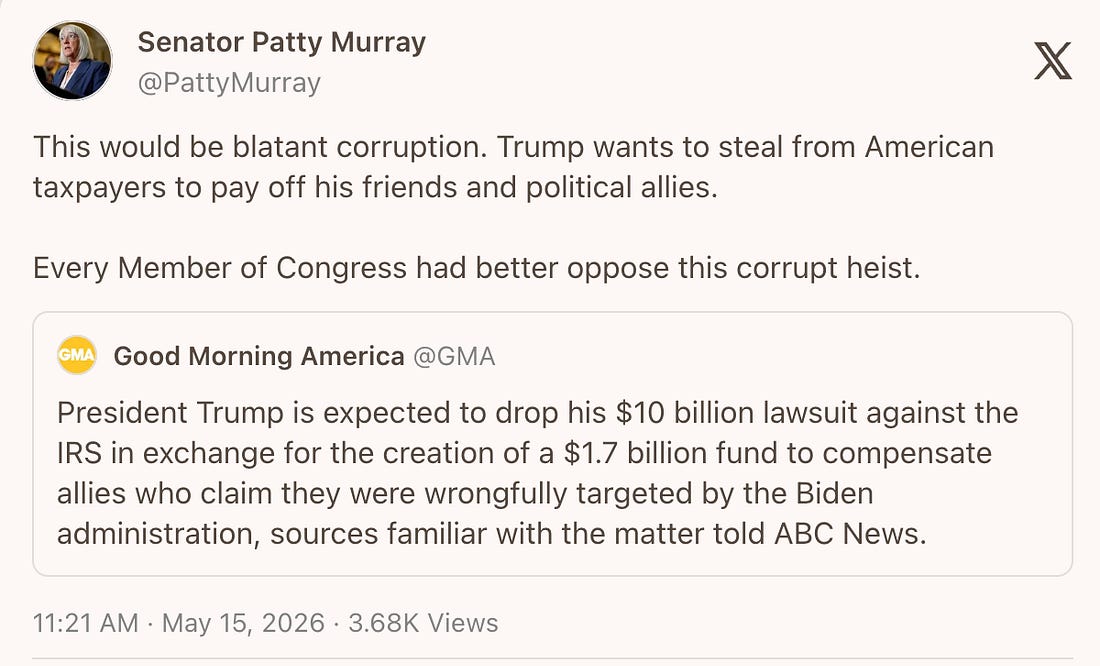
Rumors emerged over the weekend of a “settlement,” a $1.8 billion “judgment fund” that people harmed by the weaponization of the Biden Justice Department could apply to for compensation. A settlement would allow Trump to still benefit from the deficient lawsuit. Trump wouldn’t receive the money himself, but he could use it to pay off his social debts. Senator Patty Murray put it like this:
 |
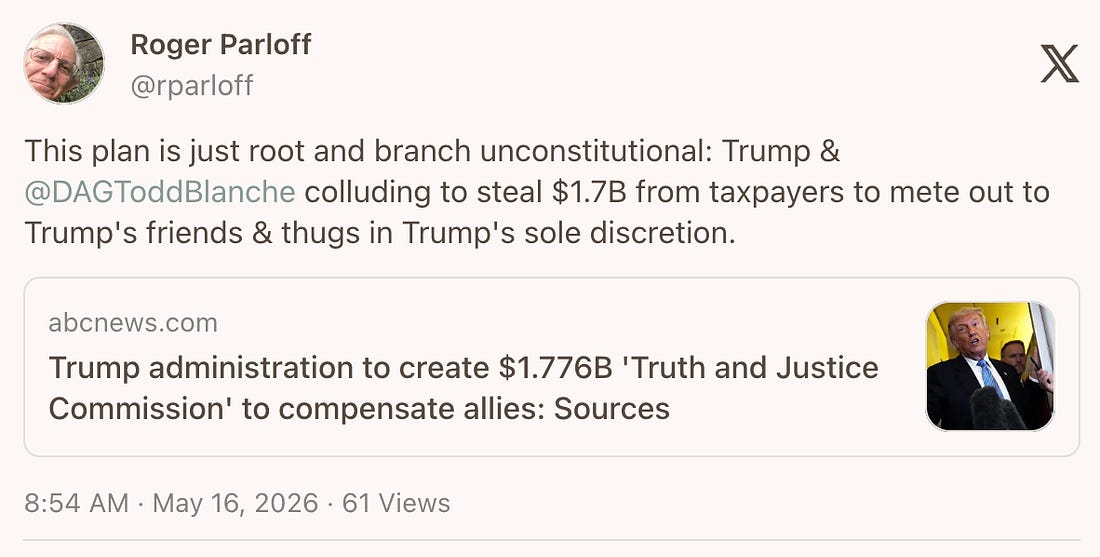
Roger Parloff at Lawfare called it “root and branch unconstitutional.”
 |
After a weekend of rumors, the settlement materialized on Monday. First, Trump’s attorneys filed a motion to dismiss the case, saying that their request was “self-executing” and didn’t require the judge’s approval.