
|
 |



There is corruption. And then there is the second Trump administration.
Monday night I wrote to you about kleptocracy. This evening, we pick up the same thread. It has to do with the $1.776 billion slush fund we discussed last night (get it? so cute that number, 1776; such an homage to the Founding Fathers). That fund, the money that Trump is trying to “give” to his most vociferous, even violent, supporters, was created to settle the lawsuit he brought against the IRS. Today, there is more news about the terms of that settlement. Kleptocracy. Corruption.
Todd Blanche, the acting Attorney General, testified before the Senate today. In one remarkable exchange, Delaware Senator Chris Coons asked Blanche:
“Has it ever happened that a sitting president sued his own government for $10 billion dollars and then directed the settlement of the case and the establishment of a payout fund?”
Blanche responded: “No, but there’s a lot of things that President Trump is the first of.”
Another one of those firsts happened today. Not a good one. Without fanfare, DOJ posted a settlement document on its website in the case. It was unexpected, because we’d already seen a settlement agreement in this case, the one we looked at last night. There was no reason to expect anything additional would be forthcoming. When it showed up, the addendum came without any title, just a date at the top.
A development like this is public. But there were none of the tweets announcing settlements in major cases that we’ve come to expect from this DOJ; no “truths” from the president himself. Just a remarkable one-page document bearing the acting Attorney General’s signature.
It’s a pardon on steroids for Trump, Trump’s family, and Trump businesses. The government agrees in this document, signed by Blanche, that it will never prosecute or pursue any civil claims against any of the Trumps, “whether presently known or unknown” that could have been brought as of the date of the settlement agreement. That date is yesterday. The IRS is “forever barred and precluded” from pursuing “examinations” of Trump, “related or affiliated individuals,” and related trusts and businesses. Any proceeding over “tax returns filed before the effective date” of the settlement is now off limits. Any crimes committed before Monday, whether prosecutors were aware of them or not, are off the table. It’s a virtual get-out-of-jail-free card, and also a get-out-of-debt one.
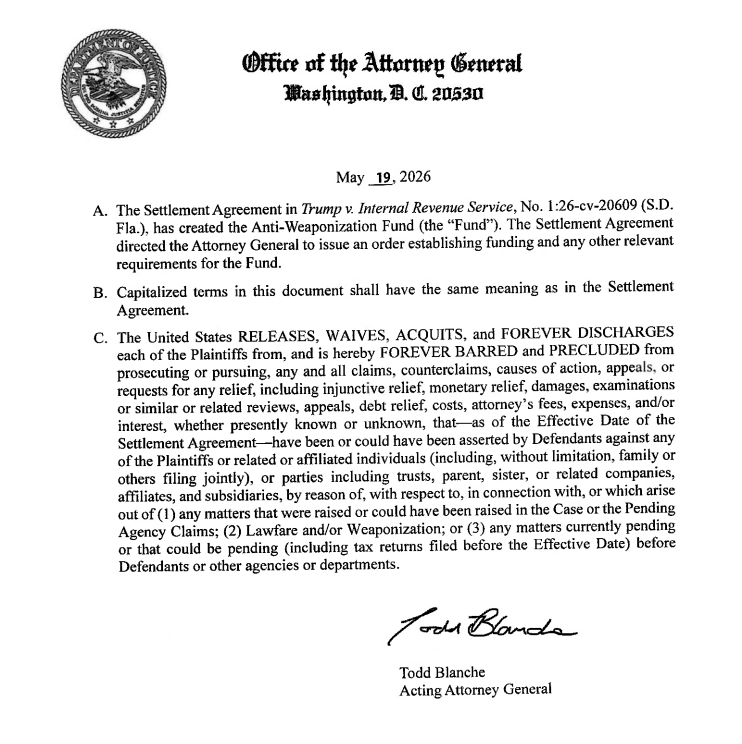 |
I’ve seen a lot of settlement agreements, but never one like this where the government is giving the store away and getting nothing in return. As we discussed last night, the underlying lawsuit was on life support, most likely about to be dismissed because of legal flaws. Now, it’s become a vehicle for protecting Trump from all problems, criminal and civil, and not just tax matters—the subject of the lawsuit—but all matters. Any sins he may have committed or debts he owed but didn’t pay before now are forgiven.
The optics of this are so bad that it’s hard to believe Trump would expose himself to their consequences unless he really needed this deal. The protection it offers must be essential in some way we are as of yet unaware of. The Supreme Court has already given Trump immunity from criminal prosecution for official acts, but paying taxes, personal business transactions, and a whole host of other activities fall outside of the scope of that protection. And the unusual waiver of the government’s ability to pursue civil claims could cover a whole host of possibilities, anything from recovering unpaid taxes to suing for unpaid White House meals that a president pays on his own. Beyond that, there is the protection for virtually everyone connected to him—”any of the plaintiffs or related or affiliated individuals,” an incredibly broad provision.
A senior veteran FBI agent put it like this when we discussed the agreement: “Fraud by Don Jr at Kalshi? Out. Fraud at Trump Media & Technology Group? Out. Fraud at whatever crypto/drone/AI/investment endeavor? Out - no DOJ, no SEC, no IRS, no CFTC - no federal entity.”
There is no hint in the document of what consequence Trump may be trying to avoid. But many legal commentators believe that while a president’s pardon power is broad, it’s not so broad that he can pardon himself. Here, Trump seems to have found a way around that limitation, obtaining a pardon equivalent and then some for himself and for his family.
There will be challenges to the settlement in court. Unlike a pardon, which can’t be set aside, a judge could rule that Trump isn’t entitled to the benefit of this bargain, which, as we discussed last night, isn’t much of a bargain since Trump is both the beneficiary of the settlement and the authority who decides what it should be. If a judge finds that the lawsuit Trump brought was merely a pretext to reach a settlement and extract a huge benefit from the government, the agreement could be disapproved. But it’s unlikely a court will decide whether DOJ’s concession that it won’t prosecute or bring any civil actions against Trump is legal, absent an actual “case or controversy,” which could mean it’s only ripe for judicial action if some future Justice Department brings a case against Trump or a member of his family and they are forced to assert the settlement in an effort to get it dismissed.
Todd Blanche got it right this morning: “There’s a lot of things that President Trump is the first of.” Yet another first for Trump, the first president to be impeached more than once, indicted in connection with an insurrection, and convicted on multiple felony charges. Never forget what kinds of “firsts” this president acquires.
Thanks for your support for Civil Discourse. Your paid subscriptions make it possible for me to stay caught up on these rapid-fire developments, so I can make sure you’re up to date too.
We’re in this together,
Joyce
You're currently a free subscriber to Civil Discourse with Joyce Vance . For the full experience, upgrade your subscription.