
|


Friends,
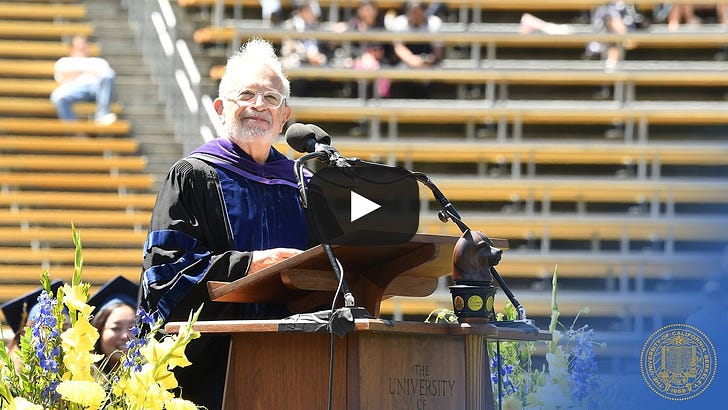
I was honored to be selected to give the commencement address at Berkeley. For any of you who’d like to see and hear what I said, I’m posting the address above (and the written version below). I’d be very interested in your reactions, so please don’t hesitate to comment.
**
Faculty, staff, administrators, alumni, parents, significant others and insignificant others, and finally and most importantly, members of the great class of 2026.
It is a profound honor to be here with you today. Now, I know every commencement speaker probably says this. The graduates down on that little farm in Palo Alto will probably find someone to say how honored they are to speak there.
But as we all know, those other places are not Berkeley, the best university in the world. I may be accused of some bias. I had the privilege of teaching here for 17 wonderful years. Yet as someone who attended and taught in other places, I can honestly say that nowhere is quite like Berkeley.
Yes, it’s beautiful. Yes, the weather is superb. Yes, its faculty are world renowned. But more than anything, this place is the best because of you, the best students I have ever had the honor of teaching. You are exceptionally curious, remarkably kind, amazingly smart, and you care extraordinarily about each other.
Three years ago, I taught my last big undergraduate course, in Wheeler Hall. Some people call what happened next “retirement.” I hate that word. I didn’t retire. I just graduated into the next phase of life.
But the truth is I’ve missed you. So, like many Berkeley graduates, I found excuses to never leave here. Maybe one of the reasons you selected me as your speaker is that you took pity on this old guy roaming the campus telling anyone who would listen how much he missed you.
There’s a reason why both professors and students have such affection for this place. While your time here is relatively brief -- in the span of what will hopefully be a long and happy lifetime -- the bonds formed here, the people you met, the way you learned to think, the passage from childhood to adulthood, will never leave you.
Do you remember beginning your formal education? Maybe the first day of kindergarten? My memory is a bit fuzzy because it was back when Abraham Lincoln was president. But if you think that you’re now leaving your student days behind, I want to let you in on a little secret. You may have had your last final exam and your last term paper, but the most important thing we’ve taught you is to be a student as long as you’re alive. Life is about learning.
While our job as professors has been to teach you, what makes being a professor so rewarding, especially in a place like this, is that we are also learning from you. To be a teacher is also to be a student. To be a student is to be a teacher. Two parts of the same impulse – to engage with a world continuously replenished by curiosity and community. I see in teaching and learning an embrace of life itself. Think about how much of who you are now, you’ve learned from the people now sitting next to you in their caps and gowns. And think of what you’ve been able to teach them.
A question that often haunts me is who the teachers of tomorrow will be. Not only in the formal classroom sense, although classroom teachers are desperately needed. But also in the larger sense of helping make sense of the world and showing the way forward. That is, leading.
You don’t need to be cloaked in formal authority to be a leader. You don’t need a fancy title or a big office. You certainly don’t need to be a Cabinet secretary to be a leader. Many of our most important leaders through history had no formal title. Martin Luther King, Jr., Dolores Huerta, Rosa Parks, W.E.B. DuBois, Susan B. Anthony. To be a leader you need to understand where we should be heading and why, what we need do to get there, and how to summon the intelligence and energies of many people to help accomplish it. Leadership is a moral vocation.
We live in a world obsessed with doing things. We’ve invented incredible tools -- machines, robots, now AI. But a much more important and interesting problem than what we are doing is why we’re doing it.
Engineers are already designing headphones that can simultaneously translate other languages. It’s remarkable. But the purpose of learning a foreign language is not just to order a beer in Belgium. It’s to teach ourselves how to see the world from different perspectives and connect with people who have other ways of living and knowing. As I used to tell my students, the best way of learning anything is to talk with people who disagree with you.
The purpose of so much of what you have learned, and will learn, is not just to master complicated concepts or solve difficult problems but to understand why you have mastered these concepts and problems, what you might do with your mastery, and how they might help you connect with others in mastering or at lease improving your community, your society, the world.
I didn’t discover much of this until I was in my 50s. That’s when I came to teach here, the best university in the world.
I was running for governor of Massachusetts and came to the Bay Area to raise money for my campaign (the part of campaigning I hated most). I stopped for a cup of coffee at Cafe Strada, and it suddenly hit me: I didn’t want to be governor of Massachusetts. I wanted to be a professor at Berkeley, a public university that prizes education as a public good, where I could teach a diverse group of brilliant students who would help heal the world.
Thankfully, the good people of Massachusetts saw the light and decided they didn’t want me to be their governor. And luckily, the Berkeley faculty decided they did want me to be a professor, here.
So, I left Massachusetts and came to Berkeley. Amazing. It was like that moment in the movie the Wizard of Oz when Dorothy opens the window of her house that’s fallen into Oz, and everything’s in technicolor.
That’s really what it’s about. Sometimes getting caught up in a tornado, occasionally coming down with a crash, and, if you’re fortunate, opening your window and seeing the beauty of the world you’ve landed in.
One lesson you have taught me is that you are part of an incredible wave of youthful energy, empathy, and intelligence. Whenever I despair – which, these days, is more often than I’d like to admit -- I just take a stroll through campus, past the Campanile, through Sproul Plaza, under the towering redwoods, and I see the flyers on the bulletin boards, the intricate group dances being rehearsed, I see you going to or coming from classes. And I have a feeling that the nation and world are not just going to be okay, you will also make them better. Much, much better.
But I’d be remiss if I didn’t tell you, if you hadn’t noticed, that we’re in trouble right now. With each passing day, the systems that have been in place in this nation for nearly 250 years to advance democracy and prevent authoritarianism are under ever-greater strain.
Why is democracy so important and authoritarianism so dangerous? Because the moral purpose of a civilized society is to prevent the stronger from attacking or exploiting the weaker. Otherwise, we’d be permanently immersed in a brutish war in which only the fittest and most powerful could survive.
This moral imperative lies at the center of America’s founding documents. It’s also at the core of the postwar international order championed by the United States – emphasizing multilateralism, human rights, and the rule of law.
It’s an aspiration we have not always lived up to. Maintaining it has required that the powerful possess sufficient integrity and civic virtue that they not abuse their power -- and if they do, they are held accountable.
Yet we now inhabit a society and world grown vastly more unequal. This itself invites the powerful to exploit the weaker, because in an extremely unequal society and world, some of the powerful come to feel omnipotent.
But unfettered might does not make right. It makes for instability, upheaval, depravity, and war.
History shows that laws and norms designed to constrain the powerful also protect them. Without such constraints, their insatiable demands for more power and wealth eventually bring them down – along with their empires, dynasties, or nations. And threaten the entire world.
It is the responsibility of every one of us – and of this great university -- to do whatever we can to preserve democracy, fight authoritarianism, protect freedom of speech and expression, and treat all workers well.
It is the responsibility of all of us to seek the truth and speak truth to power, regardless of any pressures and threats the powerful may place on us. And it is our responsibility to work toward a society based on inclusion rather than exclusion.
Mind you, these ideals do not belong to one political party or one part of America. They are fundamental. They underpin the education you have received. They form the basis of our lives together. They are central to the meaning of a good society.
I’m not going to minimize the challenges you face – from authoritarianism to climate change, to the job market, and a world in turmoil. But I know that you will take what you have learned at this wonderful place, and teach others what is worth doing, how to do it better, how to protect the powerless and how to hold accountable the powerful.
This is the great unending chain of inspiration and responsibility. All of you are products of it and all of you have the capacity to keep it going.
No pressure at all, but we’re counting on you. We believe in you.
We also love you. The people who have gathered here today to see you get your degrees – your families, friends, and significant and insignificant others -- love you. We the faculty who have poured our hearts into teaching you and have learned so much from you, we love you.
And those of you embarking on the adult part of your life today – the part where you’re on your own, when your life is really yours – well, treat it as you would someone you love, too. Not in order to boast or gloat. Not to look down on anyone else. Not to be rich or famous. But to learn to be you, authentically you. To know yourself. To be patient and kind to yourself. And to be the best version of yourself you can possibly be. You are the teachers and the leaders the world needs.
Thank you.