
|
 |
Welcome to Popular Information, a newsletter dedicated to accountability journalism.


President Trump’s “anti-weaponization fund” has faced bipartisan opposition. Multiple Republicans have argued that the $1.776 billion fund, which is part of a settlement agreement in Trump’s lawsuit against the Internal Revenue Service (IRS), is a “slush fund” to reward Trump’s political allies, including rioters who participated in the January 6, 2021, Capitol insurrection.
Republican opposition to the fund delayed voting for a reconciliation bill to fund immigration enforcement agencies, including Immigration and Customs Enforcement (ICE) and Border Patrol. To advance that legislation, the Trump administration wants Republican Senators and the public to believe that the fund is not moving forward.
This effort started Monday, when the Department of Justice (DOJ) posted a statement to X in response to a federal judge’s temporary order preventing the activation of the fund. In the statement, the DOJ wrote that it disagrees with the decision, but “will abide by the Court’s ruling.”
This was paired with a report from Axios citing “two senior administration officials” that said that the Trump administration would “drop its controversial $1.8 billion ‘weaponization’ fund.”
This proved insufficient for Senate Republicans. Majority Leader John Thune (R-SD) said that Republicans would not be satisfied until the administration “shuts it down“ and makes it “very very clear.”
On Tuesday, acting Attorney General Todd Blanche told a House committee that the DOJ was “not moving forward” with the fund. Many major media outlets, citing Blanche’s comments, quickly published headlines claiming that the fund was “dead” or had been “scrapped.”
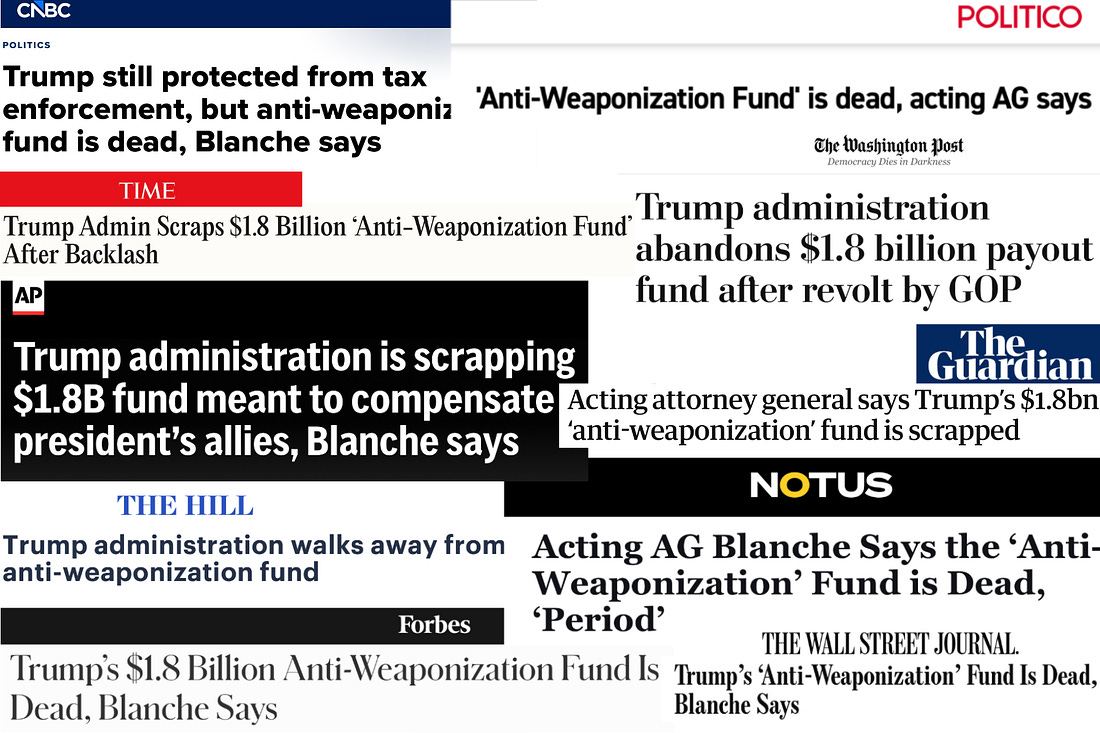 |
Politico, for example, published an article with the headline, “‘Anti-Weaponization Fund’ is dead, acting AG says.” The Washington Post published an article entitled, “Trump administration abandons $1.8 billion payout fund after revolt by GOP.” The Wall Street Journal wrote that the Trump administration was “abandoning” the fund. The Associated Press, TIME, and the Guardian all published articles with headlines claiming the fund was scrapped, while Forbes, CNBC, and NOTUS all wrote headlines stating that Blanche said that the fund was “dead.”
This is not, however, what Blanche said.
The settlement agreement between Trump and the DOJ, which created the weaponization fund, states, “This Settlement Agreement may be modified only with the written agreement of the Parties.” During his testimony, Blanche repeatedly declined to reverse the settlement in writing.
Congresswoman Grace Meng (D-NY): You and Associate Attorney General Woodward signed earlier documents regarding the settlement and this fund. Would both of you now sign and release documents reversing the DOJ’s position on the fund?
Blanche: We’re not moving forward with the fund. I’m not sure what that means to sign documents reversing. There’s nothing to reverse. We’re not moving forward with the fund.
Later, Meng said, “You established it in writing. So it just makes sense to rescind it in writing.” Blanche responded, “I’m not committing to doing anything in writing.”
During his testimony, Blanche indicated the Trump administration would continue to defend the fund against legal challenges, saying the administration would be “defending our rights and making sure our rights are protected.”
Further, the future of the fund depends on the position of Trump, not Blanche. Trump can replace Blanche, who is only serving in an acting capacity, at any time. Without a written reversal, Blanche could also simply say that the DOJ’s position has changed and the fund will move forward.
In a podcast interview that was taped on Tuesday, Trump was asked by host Miranda Devine if the fund was dropped. “No, a court ruled against it,” Trump said. Trump defended the fund, arguing that “these are people that have been decimated” and “they should be reimbursed for a crooked government.”
When asked Wednesday by CNN’s Kaitlan Collins if the fund was dead or on hold, Trump said, “I don’t know” and said he would have to ask “the lawyers.” When Collins pressed for further clarification, Trump told her to “be quiet.”
“I love it,” Trump said of the anti-weaponization fund. “I think it’s so important.”
$100 million immunity
Another important part of Trump’s settlement with the IRS remains fully intact. Trump, his family members, and their businesses are shielded from any audits or punishments by the IRS related to tax returns that were filed before the settlement became effective last month.
Blanche confirmed that this part of the settlement is still in effect during his appearance in the House on Tuesday. He defended the provision, saying, “It’s nothing that gives any sort of immunity in the future to the president or his family or his organizations.”
The release from all audits of past tax returns, however, could generate massive savings for him and his family — potentially more than $100 million. (Further, like many wealthy people, Trump typically carries deductions forward multiple years. So preventing audits of prior tax returns would likely make auditing future tax returns extremely difficult, if not impossible.)
According to the New York Times, Trump has faced an ongoing audit by the IRS since 2010, when he received a $72.9 million tax refund. The IRS suspected that Trump had written off the same losses on a Chicago hotel tower twice. If the IRS had ruled against him, Trump could have owed more than $100 million.
It is unclear whether the audit was still ongoing when the settlement was reached this year. It is also unknown whether Trump or his family were facing any other audits.