
|


 |
About a month ago, I weighed in on an interesting debate over American vs. European living standards.
On one side, you have people who argue that Europe is much poorer than America, and is falling even further behind. Most of the people making this argument are Europeans themselves — especially economists like Mario Draghi, Philippe Aghion, Luis Garicano, and Antonin Bergeaud. They look with envy on the U.S. tech sector, which Europe has no real equivalent to, and they yearn for liberalizing reforms that would allow Europe to catch up.
On the other side, you have American liberals like Paul Krugman and Brad DeLong. They argue that Europe is not falling behind — that most of the gap in material living standards is due to Americans working more, and that America’s apparently faster productivity growth is an artifact of the way relative growth rates are measured.
This is an interesting debate, and in the end it comes down to some surprisingly technical measurement issues and data mysteries. I’ll have more to say on it in the future. But it’s really just the most recent exchange in a long-running debate over the “varieties of capitalism” — whether Europe’s stronger welfare and regulatory states deliver better outcomes for regular people, or whether America’s more free-market system is superior. I don’t think that debate is close to being settled — and may never be settled, since liberalizing reforms in Europe and expansions of welfare and regulation in America may shrink the differences between the two systems.
But there’s a second debate going on regarding Europe’s economy, with potentially far more devastating consequences. It’s the question of whether Europeans should be rich at all.
Instead of crowing about the superior performance of the European social model, leftist economists are increasingly arguing that Europeans are too rich, and ought to be poorer than they are. This was the upshot of a manifesto by Thomas Piketty and his World Inequality Lab, which I covered in my last roundup post. Piketty argued that “labour hour reductions, growth caps in rich countries, less material consumption, and changes in food habits” will be needed in order to beat climate change:

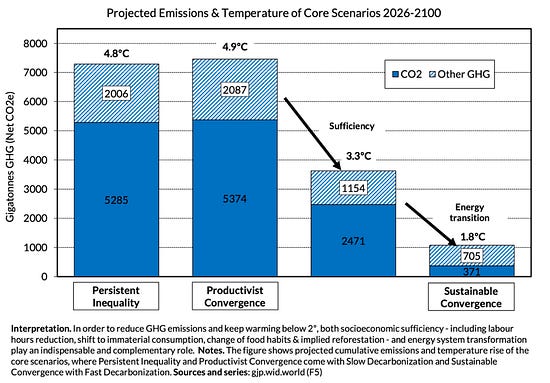
This is also the argument in a recent Guardian editorial by Piketty, Olivier De Schutter, Joseph Stiglitz, Jayati Ghosh, Kate Raworth, and Jason Hickel:
We live in an age of manufactured scarcity. In a world richer than ever before, roughly one 10th of the world’s population still lives in extreme destitution…
For decades, the recipe was simple: grow the economy, and poverty would gradually disappear. But the promise that economic growth would “lift all boats” has not been kept. While national incomes expanded, wages stagnated, work became more precarious and public services were cut. At the top, fortunes ballooned; at the bottom, families turned to food banks. Growth has become decoupled from shared prosperity…It has also become ecologically unsustainable…That is why we have come together to develop and support the “roadmap for eradicating poverty beyond growth”.
The essay — which was immediately identified by Pangram as being 100% AI-generated — was extremely vague on its plans for transforming the global economy. It often reads like a mishmash of buzzwords and slogans. Here’s a taste:
The real question today is not whether growth continues, but what kind of economies we are building, who they serve and whether they allow everyone to live in dignity within planetary boundaries…[W]e are united in the conviction that our economies must be redesigned around the fulfilment of rights and collective wellbeing within planetary boundaries, rather than maximising output at any cost. Human rights here are not an afterthought; they are the organising principle for how we measure progress, set priorities and resolve trade‑offs…All too often, policies affecting people in poverty are designed without them – and sometimes against them. When welfare systems are built around suspicion, sanctions and humiliating conditions, they deepen stigma and deter people from clai