|
|
 
|
Some 66% of office workers misuse AI tools at work, while 72% believe they understand AI better than IT teams, a report from PagerDuty reveals. This "shadow AI" poses major challenges, especially when employees input sensitive or proprietary information into unauthorized tools. Education -- not punitive measures -- is key to addressing the issue, PagerDuty CIO Eric Johnson says, emphasizing the need for IT to understand and adapt to employee practices.
|
|
|
|
|
Is your Salesforce data storage eating up your budget? Shift those funds towards AI projects without compromising on data integrity. Discover Veeam's innovative strategies to cut costs and enhance resilience. Register for the webinar! |
|
|
|
|
|

|
Agentic AI is challenging traditional revenue models of software-as-a-service providers, with up to $234 billion in application spending at risk by 2030, Gartner says. The research firm says agentic AI offers direct outcomes, bypassing user-heavy applications and potentially making some software services obsolete.
|
|
| |
 |
| (Tadamichi/Getty Images) |
Cloud outages are happening more frequently -- major incidents have affected Google Cloud, AWS and Microsoft Azure in the last year alone, David Linthicum writes, adding that these failures are no longer rare exceptions but a regular risk for organizations relying on cloud infrastructure. Understanding that all cloud platforms can fail, enterprises should audit dependencies, implement hybrid architectures and establish robust disaster recovery to boost resilience -- providing an edge over competitors struggling amid outages, Linthicum advises.
|
|
|
|
|
AI agents don't request permission; they analyze data and recommend solutions. On July 23, learn how leading brands leverage scalable data enrichment to optimize catalog health, secure AI surface visibility, and protect market share. Register for the webinar » |
|
|
|
| ADVERTISEMENT |  |
|

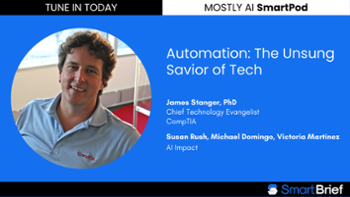
In this episode of The Mostly AI SmartPod, James Stanger, CompTIA's chief technology evangelist, discusses why the future of IT lies in automation and infrastructure as code, not just in popular tools like Claude and ChatGPT. Stanger says automation can help organizations manage technical debt and improve operational stability by creating a single source of truth, and can enable IT professionals to engage in strategic discussions and better align technology with business needs. |
|
| Got a tip or technique to share? Email us and we'll share it in a future issue of CompTIA SmartBrief. |
|
|
The joint operations of Vect and TeamPCP announced earlier this year represent a maturing, industrialized model of ransomware deployment. By merging credential theft, data extortion and scalable ransomware-as-a-service offerings, the groups are streamlining attack processes and enabling mass mobilization of cybercriminals via underground forums. Sophos warns that as AI becomes more accessible, this industrialization will only accelerate, allowing more attackers to automate and scale their operations more efficiently.
|
|
|
Some 55% of cybersecurity professionals report being instructed to keep a data breach confidential -- a figure that surged from 42% to 58% between 2024 and 2025 before stabilizing this year, security firm Bitfender reports. Despite the introduction of new disclosure regulations, a cultural lag persists, making concealment common, the report indicates, suggesting that true change will require shifting organizational attitudes so that secrecy becomes untenable.
|
|
|
|
As AI tools become more prevalent in professional settings, concerns are rising about their impact on skill retention. A survey indicates that a significant percentage of healthcare workers fear losing their skills due to reliance on AI. Studies, such as one involving Polish endoscopists, show that AI can lead to decreased performance when the technology is unavailable. Similarly, research by Anthropic highlights that software engineers using AI assistants may not fully grasp coding concepts.
|
|
|
Medical scribe, coder and insurance verification specialist are among the healthcare jobs most likely to be taken over by AI, writes physician Jesse Pines, chief of clinical innovation at US Acute Care Solutions. Jobs requiring a human connection and adaptability, such as nurse and mental health therapist, are largely safe from automation. New opportunities are emerging in AI implementation, ethics, data science, and other areas for healthcare professionals with AI literacy and adaptability.
|
|
|
Trinity Health, a 90-hospital health system based in Livonia, Mich., will outsource its IT service desk and applications support to an unnamed technology company by the end of 2026. The change affects internal tech support roles but not clinical positions. Trinity Health cited the increasing pace and complexity of healthcare technology as a key reason for the change. Employees will be given the opportunity to apply for other positions at Trinity Health or with the vendor.
|
|
|
| Last Week's Top Headlines |
|
| | | |


.png)