| | In this edition, it isn’t just big companies fretting about high and unexpected bills for AI tokens,͏ ͏ ͏ ͏ ͏ ͏ |
| |  | Technology |  |
| |
|
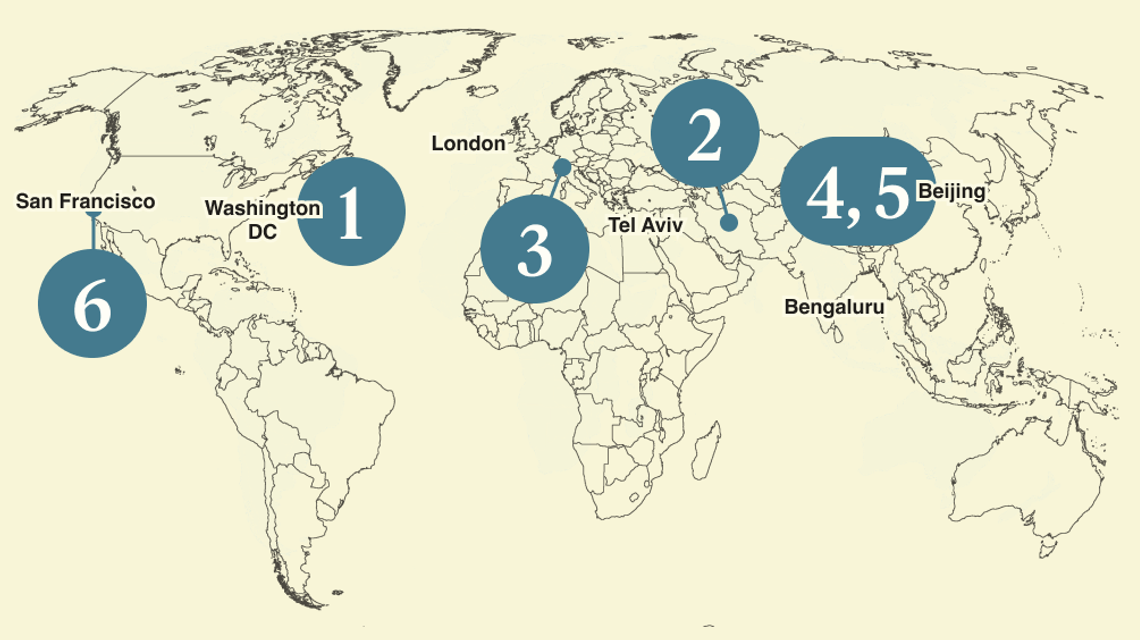 - Trump admin’s quantum push
- Iran automation debate
- China pitches open source
- AI anxiety in China
- DeepSeek designs own chips
- Charging the AI bot army
 A cautionary tale about letting your agent roam free, China’s talent grab, and AI is creating an internet of near-identical websites. |
|
 It isn’t just big companies fretting about high and unexpected bills for AI tokens. It is also … me. On Sunday morning, I woke up jet-lagged after two weeks in Europe to find that OpenAI was repeatedly charging me $5, more than 20 times a day in some cases. I had no idea why. I’ve been using OpenAI’s Codex desktop app for months, which has helped me personally and professionally and even led to the launch of a new product called Semafor Intelligence. Before I left, my AI spend was pretty low. I’m not a tokenmaxxer or a pretend software developer, and I had never bothered to set limits on how often Codex could “top up” with $5 credit recharges. As my blood pressure rose, I turned to Codex, where the problem started about a month ago. A software glitch had erased all of my Codex chats. After deleting and reinstalling it, I asked Codex to revive a particularly ambitious project, which somehow sent my agent into a loop where it kept reviewing a bunch of data over and over again, racking up tokens. This was happening on a Mac Mini that I access remotely. And, because of consistently spotty data connection overseas, I wasn’t checking it. Codex explained that the agent had taken the prompt for my ambitious project “too literally.” (Codex had written it, mind you.) In the end, I was billed just shy of $500. It could have been worse. I asked Codex to help again — this time to contact OpenAI’s customer service department and explain what happened, hoping they might refund me. Soon, I was a messenger, shuttling responses back and forth between Codex and OpenAI’s customer support AI chatbot. In the end, there was no refund, and I never spoke to a real person at OpenAI until I contacted their PR department. I am the only human in this story. My bill was entirely avoidable. I made lots of mistakes, including putting too much faith in an unproven technology and giving it too much control and access to my wallet. I’m as much a software developer as a celebrity sitting courtside at a Knicks game is a professional basketball player. Today, this technology is the software equivalent of a fantasy camp. Whether you’re a big company or a lowly journalist, the price of playing with this technology now is a lot of token waste and overspending. But there’s no other way to get a glimpse into the future, and this is the trade-off that everyone is grappling with. Just do yourself a favor: Put a limit on those auto-credit top-ups. |
|
Trump’s ‘sober’ approach to quantum |
 Trump showing a signed executive order regarding quantum computing in June. Jonathan Ernst/Reuters. Trump showing a signed executive order regarding quantum computing in June. Jonathan Ernst/Reuters.In closed-door discussions with quantum industry leaders at a White House event on Tuesday, government officials pushed the importance of domestic supply chain security, according to a person in attendance. The tone of the Trump administration was “sober” and “serious,” they said. While officials highlighted actions taken by the White House to support the quantum industry, there was no sense of partisan performance, the person said. Officials also emphasized the transition to more advanced cryptographic algorithms that quantum computers can’t break — a threat Google recently warned could arrive as soon as 2029. The event follows the White House’s publication of two executive orders which addressed similar issues. At the time, academics questioned whether the Trump administration’s stated objective to expand the quantum workforce translated to more funding for universities and basic research. Tuesday’s keynote by Office of Science and Technology Policy Director Michael Kratsios echoed the need for workforce development but stopped short of making any funding commitments. — Rachyl Jones |
|
Iran school bombing still fuels automation debate |
 Mehr News/Handout via Reuters Mehr News/Handout via ReutersThe tragic bombing of an Iranian girls’ school by US forces in the early days of the conflict was not the result of automation, CNN confirms. The revelation is a reversal from initial reports that tied the attack to tools like Anthropic’s Claude language model. Semafor reported in March that it was human error. Specifically, Semafor reported that human targeters failed to check a database that had updated intelligence indicating that the target, located within an Iranian military base, had actually been converted to a school. It’s easy to say in hindsight, but the Iranian school bombing could have been avoided with automation that scanned more sources of data, and CNN’s reporting affirms that. Humans can only process so much information, and the ability to process more, and quicker, is a good thing amid the chaos of war. But that assumes humans employ automation tools to decrease risk. It’s possible that some military powers could use automation to simply deploy more weapons, more quickly, without regard for civilian casualties. Rather than treat all automation on the battlefield as a boogeyman, we’ll need to draw clear human rights lines around the nuances of this new technology. |
|
China pitches open-source AI |
 J.D. Capelouto/Semafor J.D. Capelouto/SemaforGENEVA — Chinese government officials are using the United Nations’ AI for Good summit in Switzerland this week to, in part, reframe the open-source models that have proliferated in China. The implicit pitch: In contrast to the most advanced US models, which can be restrictive and expensive, open-source AI tools can be a development tool for lower-income countries. “Open source is good for all countries and all groups and all people, and I believe that is the right direction,” Yu Xiaohui, the president of a Chinese government think tank, said Tuesday at a panel hosted by the Chinese government. Beijing is leaning on its geopolitical allies to advance that vision, as it looks to shape how the technology is governed worldwide and pitch itself as the developing world’s AI partner of choice. Other speakers at Tuesday’s session included top officials from Russia and Pakistan, as well as Global South nations where Beijing is making inroads, like Zambia and the Maldives. A recurring theme: The benefits from AI shouldn’t be concentrated in a few rich nations. — J.D. Capelouto |
|
China looks to lock in tech talent |
 Tsinghua University. Thomas Peter/Reuters. Tsinghua University. Thomas Peter/Reuters.Two prominent US scientists — including last year’s winner of the Nobel Prize for Chemistry — will move to Chinese universities this year, as the global competition for top academic talent heats up. Nobel recipient Omar Yaghi is moving from Berkeley to Tsinghua University to lead a new AI research center, the South China Morning Post reported. In addition to luring top scientists, Beijing is exploring ways of disincentivizing Chinese researchers from publishing in foreign journals over fears about leaks of technological innovations, the Financial Times said. China, which has long been a nation of techno-optimists, is facing a collective bout of anxiety over AI. “In a country of strivers, AI is feeding a morbid obsession with being left behind,” Semafor’s Andy Browne wrote. The desperate attempt to keep up with the latest advances manifests in kids burying themselves in books and tech workers routinely putting in 72-hour workweeks. As in the US, Chinese workers fret about AI-induced layoffs. Meanwhile, the technology is key to realizing Xi Jinping’s vision of remaking China into a “rich and powerful” nation. The question now is what compromises the country is prepared to make. |
|
DeepSeek takes control of its hardware |
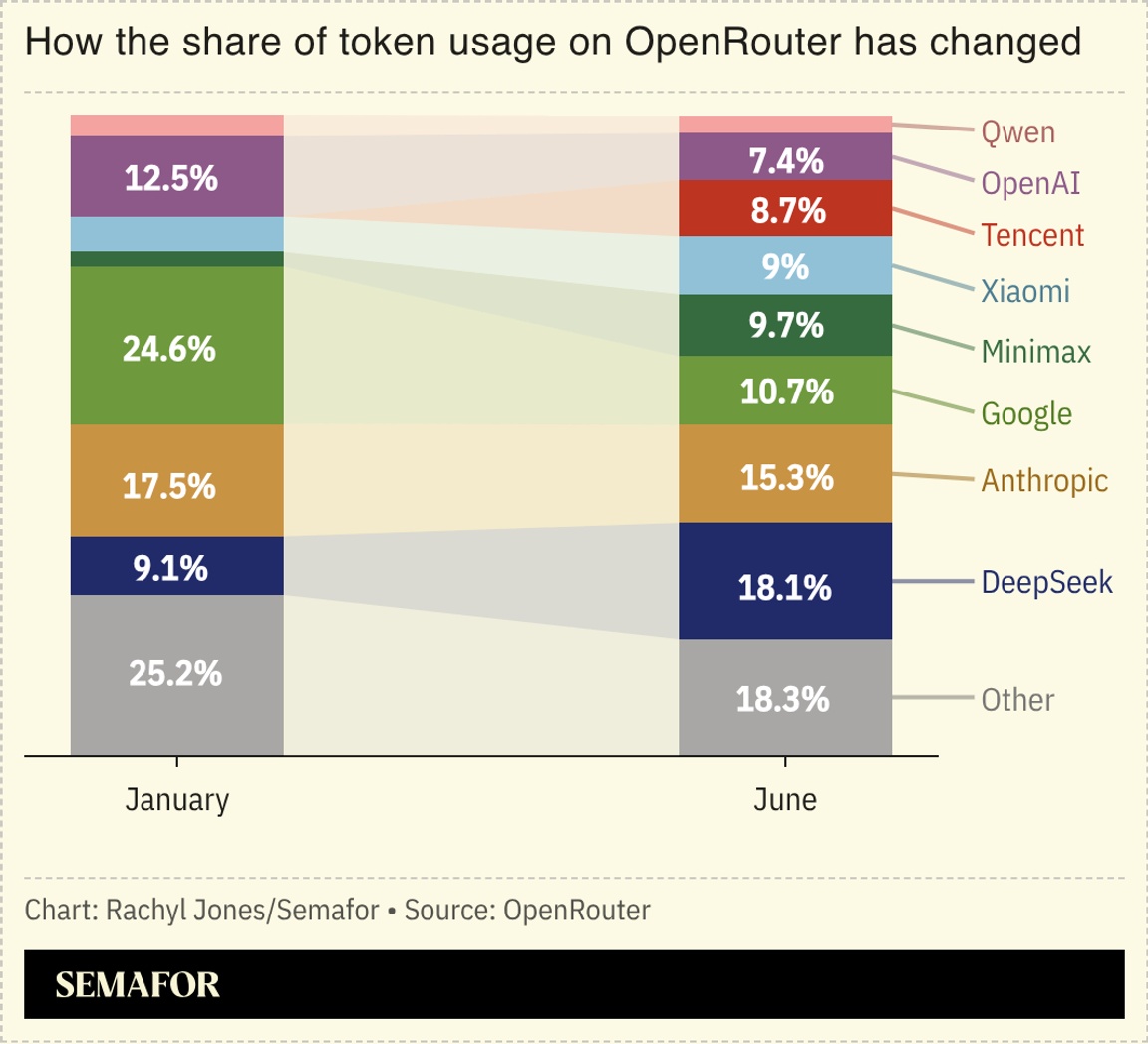 China’s DeepSeek is taking a page out of OpenAI’s playbook by developing its own AI chip for inference. The move would reduce the country’s reliance on semiconductors made by American Nvidia, which has struggled to reestablish a sales pipeline in China after US President Donald Trump began allowing chip exports last year. Like with OpenAI, bringing chip design in-house would also give DeepSeek more control over its technology stack. The Chinese government has been pushing domestic companies to address a shortage of access to powerful chips, which has been a barrier to the country’s development of advanced models. The news, reported by Reuters, comes as DeepSeek’s pricing is making it more attractive to consumers and businesses. The share of tokens used by DeepSeek models on OpenRouter, which provides access to a series of AI models through one platform, has doubled in the last six months, according to its data — a surge that followed DeepSeek’s release of its newest V4 model in April. Nearly all Chinese model providers gained market share on the platform since January, while all US companies lost it. — Rachyl Jones |
|
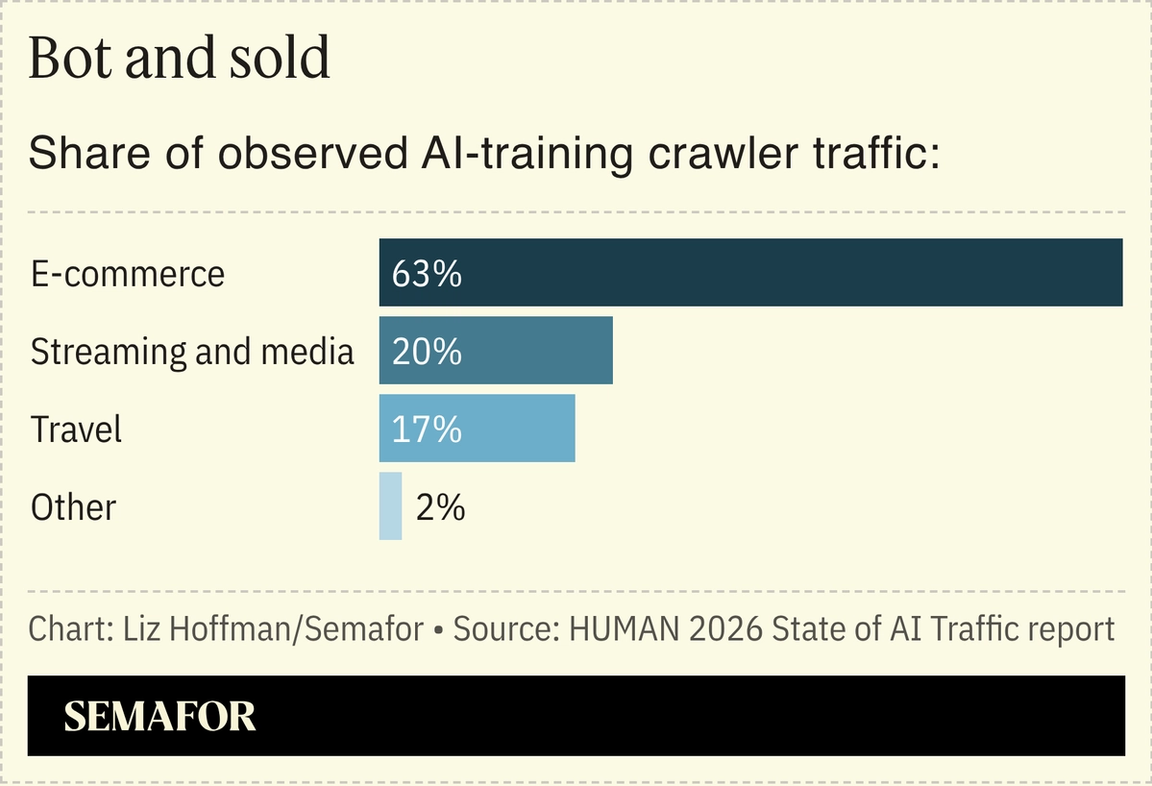 As AI bots take over the internet and displace human eyeballs, one of the biggest web-infrastructure companies has an idea about how to charge them. Cloudflare recently rolled out what is essentially a bot paywall that would allow its customers to charge AI models for scraping its customers’ content. Online retailers, travel companies, and publishers, which spent decades wrangling with Google over how to get paid for their websites, now face the same challenge as LLMs scrape their content. The internet is moving toward a point where “every interaction, every transaction, is a chance for commerce,” Cloudflare’s chief strategy officer, Stephanie Cohen, told Semafor, adding that more than half of its web requests now come from agents. Cloudflare’s new architecture allows content owners to set a minimum price and AI crawlers to set a maximum bid, and lets the magic of a two-sided marketplace take it from there. That doesn’t mean the subscription businesses that media companies labored to build will collapse, Cohen said. “I don’t think everyone wants to read the average,” she said, which is good news for scoopy and voicey publications (hi.) — Rohan Goswami |
|
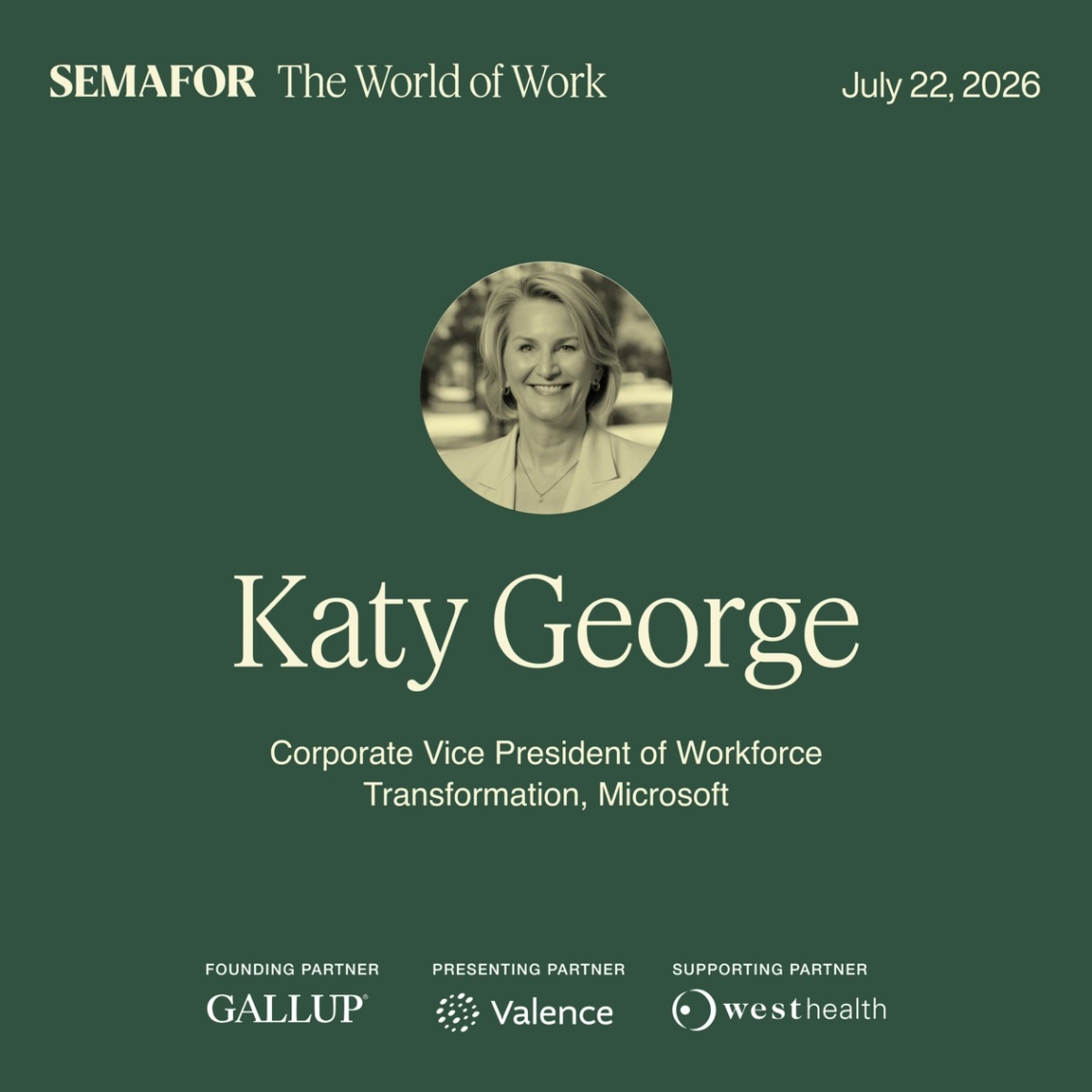 On Wednesday, July 22, Katy George, Corporate Vice President of Workforce Transformation at Microsoft, will join Semafor’s The World of Work in Washington, DC to unpack how institutions are adapting and thriving in an increasingly fragmented economy. As companies face rapid technological change, economic uncertainty, and shifting workforce expectations, leaders are rethinking performance, trust, and long-term success. To explore how AI adoption, workforce transformation, and evolving leadership demands are reshaping the future of work, Semafor editors will sit down with policymakers, business executives, and workplace innovators including Sen. Roger Marshall, R-Kan., Senate Committee on Health, Education, Labor, and Pensions (HELP); Claire MacIntyre, Chief People Officer, Sam’s Club; Mary Moreland, Executive Vice President, Human Resources, Abbott; Allison Peek Bebo, Chief Human Resources Officer, Pearson; and more. July 22 | Washington, DC | Request Invite |
|
|


