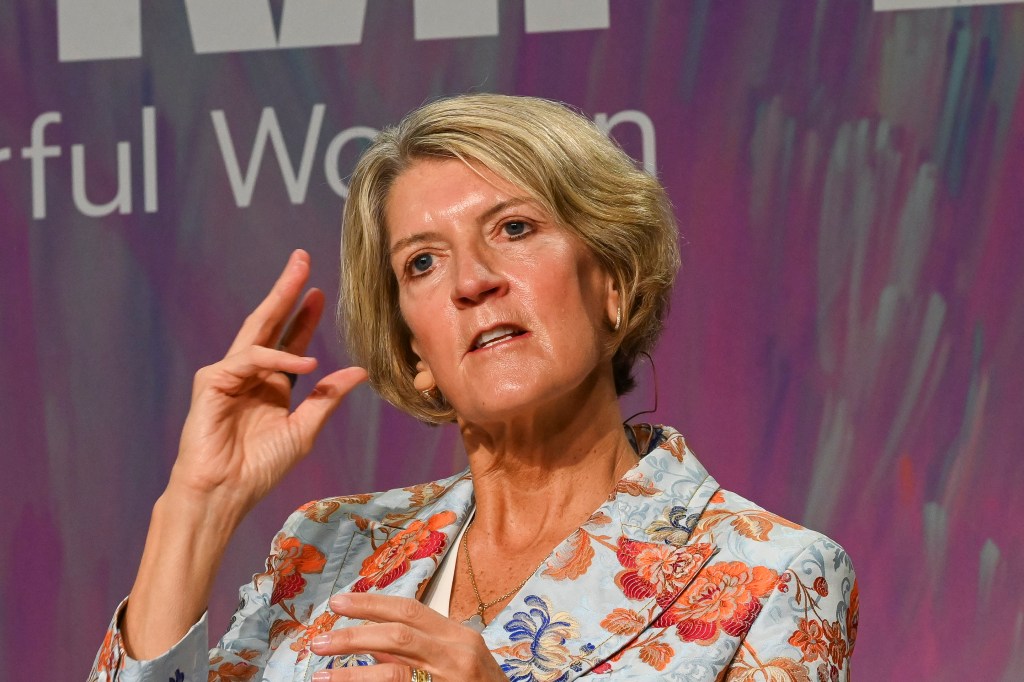
As CEO of Land O’Lakes, Beth Ford has become
a top spokesperson for rural America. Every chance she gets, the Fortune 500 CEO directs attention toward the intersecting crises affecting farmers and the American food system, from rising farm bankruptcies and trade wars to labor shortages and price instability. Land O’Lakes mostly does this work through what Ford calls “policy, not politics,” but her executive team has now found another arena to fight this battle: culture, and especially Hollywood.
Over the past several months, Land O’Lakes has started addressing what it sees as stereotypes of rural America in popular culture. This effort started with a partnership
with Getty Images, meant to introduce more realistic portrayals of people in rural America to stock photography used across the internet every day. Earlier this year, it expanded to film and television through a partnership with Ron Howard’s Imagine Entertainment. Land O’Lakes worked with Imagine to develop a writers’ toolkit to help film and TV writers in L.A. and New York better understand rural America when they write about it; the company is also planning to host workshops for screenwriters. Land O’Lakes CMO Heather Malenshek went to the Sundance Film Festival in January to share this mission and learn more about the industry.
Why is Land O’Lakes taking on this cause? It’s a $16 billion business ranked No. 273 on the Fortune 500, and it already has many of the world’s most pressing challenges on its plate, from the effects of data center construction on the nation’s farmland to the impact of geopolitics on the global food supply. But as I’ve seen in my conversations with Ford over the years (ICYMI, I wrote
an award-winning feature about her last fall), Land O’Lakes views all of these challenges as connected. The same is true here.
Farmers are member-owners of Land O’Lakes, which is a cooperative. “The future of vibrant rural communities really is the success of the company,” Malenshek says. And that applies to the next generation too; the
average age of a farmer in the U.S. is 58. “How do we attract people coming into the industry?” Malenshek says. More realistic portrayals of rural America on TV can help people understand that farming is “hard work” but “it’s actually a great way of life,” she says.
When undertaking this mission, Malenshek learned about something called the “rural purge.” In the 1970s, advertisers became less interested in shows set in rural America, and networks (namely, CBS) canceled several of them—
Lassie,
Green Acres. Since then, portrayals of rural America have been up and down. There’s the ridiculous, like
Farmer Wants a Wife. Overall, 20% of U.S. residents live in communities considered part of rural America, but only 5% of popular U.S. visuals are set in those places. And often, those visuals are not accurate. “In rural America, there’s no technology,” Malenshek says, rattling off stereotypes. “They don’t tend to be with friends. They’re not doing things young people would do. Women apparently don’t work in rural America.”
Malenshek has experience rubbing up against stereotypes. She’s the former CMO of Harley-Davidson and is a “rider” herself. “It was stereotyped as a very one-dimensional community, the guy with the bandana and the big bike,” she says. “That’s not the way it is. And it’s the same thing with rural America.”
Already, shows set in the rural U.S. are gaining popularity again.
Somebody Somewhere, set in Kansas, earned a surprise best actor win for Jeff Hiller, beating out Harrison Ford at the Emmys last year. Of course, Taylor Sheridan has turned
Yellowstone into a mega-hit with multiple spinoffs. (“It’s a bit romanticized, I would say, but it’s still good to have people think about that way of life,” Malenshek says.) Land O’Lakes and Imagine hold up
Friday Night Lights, which aired from 2006 to 2011, as an example of the best of the best, showing the depth of a small-town community.
Beyond training L.A. writers in the reality of today’s rural America, Land O’Lakes hopes to connect rural film and TV talent with opportunities in the industry. It points out that rural America includes Native Americans who live on reservations, Black Americans in the South, and that Hispanic people are 77% of U.S. farmworkers—all ripe areas for storytelling.
“The idea here isn’t to romanticize rural America or idealize it,” Malenshek says. “It’s to build the real, human stories of things that are actually happening and the richness in rural America.”
Emma Hinchliffeemma.hinchliffe@fortune.comThe Most Powerful Women Daily newsletter is Fortune’
s daily briefing for and about the women leading the business world. Subscribe here.