| | In this edition: Taking stock of the Bernie wing’s influence, a look at the Democrats jockeying to r͏ ͏ ͏ ͏ ͏ ͏ |
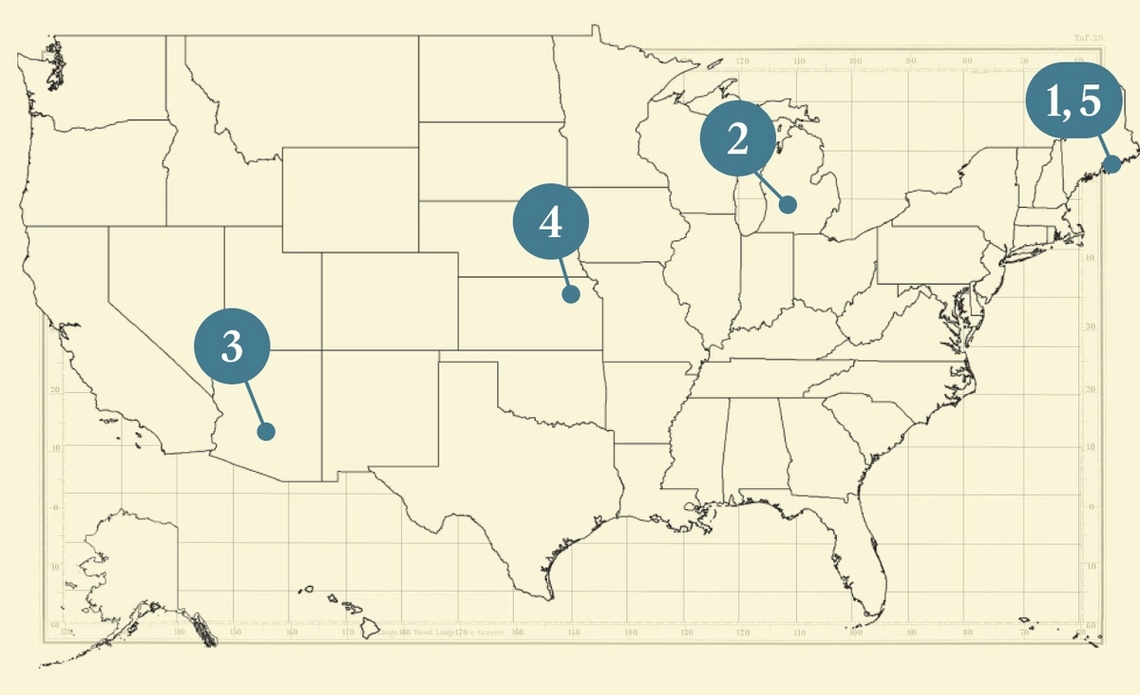
| |  LAWRENCE, KS LAWRENCE, KS | GRAND RAPIDS, MI | SULLIVAN, ME |
 | Americana |  |
| |
|
 - Maine succession latest
- Stevens hits back
- Meet the centrists
- Promoting new state-level limits
- Platnergate’s preview
|
|
 For 21 hours, while Bernie Sanders said nothing about the sexual assault allegation destroying Graham Platner’s campaign, speculation grew that the Vermont senator might be trying to talk his ally out of Maine’s Senate race. Sanders helped write the Platner story, after all, so he could close the book. It sounded good, but this story — and Sanders’ entire movement — doesn’t work that way. The founding myth of the Sanders camp, now entering its second decade at the arguable peak of its power as a left-wing electoral force, is that it sits outside the Democratic Party. Sanders can style himself that way because he never won the presidential primary. But the reality is that he, and his faithful, are inside the party — competing in its primaries, voting for most Democratic candidates, and communicating in all the forums where Democrats get news and opinions. It’s a very successful case of entryism, in which left-wing activists join a larger organization to move it in their direction. So as much as mainstream Democrats are frustrated by what the left’s rise has given them, particularly the collapse of Platner, they’re unlikely to see the Maine mess discredit Sanders and his wing of the party. There are two main reasons for that. First, establishment Democrats don’t have leaders who can command the grassroots crowds and fundraising of Sanders, as displayed at last year’s “Fight Oligarchy” rallies. They don’t have a figure who excites people and grabs attention like New York Mayor Zohran Mamdani does; in New York, some of them unnecessarily resisted him and tried to breathe life into Andrew Cuomo. Second, their party has been more welcoming to the entryists than most Democrats want to admit. In 2016, Sanders refused to release his delegates until the weakened Clinton campaign and the rest of the party gave Sanders a big role in drafting their platform. In 2018, the DNC reformed its primaries on Sanders’s preferred terms, curtailing the role of superdelegates. And in 2020, when Joe Biden quickly beat Sanders (including in Maine), the failed challenger walked out of the race with a “unity task force” that gave his wing a coequal role in shaping Biden’s platform. Why would Sanders’ movement look at those facts, then give ground in Maine? Why would it not try to extract concessions, and argue that Platner’s primary victory over the sitting governor amounted to a mandate that the party needed to respect? The Sanders faction has plenty of evidence that the party wants its grassroots energy, and its votes, so there’s little reason for them to offer all that without a role in whatever happens next. |
|
Platner’s aspiring replacements gear up for nomination clash |
 Brian Snyder/Reuters Brian Snyder/ReutersMaine Democrats prepared for the potential end of Platner’s Senate campaign by throwing their names into the mix and accusing each other of trying to skew the replacement discussion. At issue: The state party’s rules provide for flexibility about how to replace a nominee who quits, and the candidates who want the job have lobbied for the most open process possible. Nirav Shah, who narrowly lost last month’s gubernatorial primary, called for a televised debate and urged any candidate to hold public town halls — something the party may embrace, after it ruled out letting the state committee membership simply hold a meeting to pick a nominee. “This is ‘Game of Thrones’ now, and everyone’s going to be jockeying,” Shah told Semafor. “Elections are like job interviews, and voters should have the opportunity to put their candidates through the paces of what the job would entail.” |
|
Michigan’s Democratic Senate primary becomes a one-on-one brawl |
 Nathan Howard/Reuters/Andrew Roth/Sipa USA via Reuters Connect Nathan Howard/Reuters/Andrew Roth/Sipa USA via Reuters ConnectMichigan’s Democratic candidates for Senate met on Tuesday for their first debate since state Sen. Mallory McMorrow exited the race, and the dynamic shifted somewhat. Rep. Haley Stevens’ stumbles at the last three-candidate debate had emboldened Abdul El-Sayed, who told Semafor that the congresswoman couldn’t “string together two coherent sentences.” Stevens was more directed in a one-on-one contest, attacking El-Sayed as a glory hog with an overhyped resume. “Unlike my opponent, I’m not running at the first mic or camera I see,” she said. El-Sayed repeatedly accused Stevens of doing what “corporate” donors and AIPAC wanted. When Stevens said she’d oppose more wars in the Middle East, El-Sayed argued that she wouldn’t cross Israel. “AIPAC is perfectly fine with either Congresswoman Stevens or Mike Rogers,” he said, referring to the GOP nominee. “If either of them win, Israel wins.” El-Sayed, who’ll campaign with Sanders and Rep. Alexandria Ocasio-Cortez, D-N.Y., next week, has held more public events than Stevens and done more interviews. Stevens’ strategy was to turn that into a weakness: El-Sayed had never actually won an election, she noted, while she would “run through” any obstacle to deliver as “Michigan’s manufacturing geek.” |
|
New Democrats dive into primary season |
 TeamMarlene/YouTube TeamMarlene/YouTubeThe Democrats’ center-left wing, frustrated with the left’s knack for getting media attention, is stepping up its House endorsement game. The New Democrat Coalition announced this week that it’s getting involved in a slate of upcoming House primaries, some of them in competitive districts. Arizona’s Marlene Galán-Woods and Michigan’s Jeremy Moss are among the newly endorsed candidates; in Arizona, Galán-Woods faces Dr. Amish Shah, a more progressive candidate who lost the race for the Phoenix-area seat in 2024. |
|
Republicans have an ad challenge in Kansas and Missouri |
 kansaspolitics/YouTube kansaspolitics/YouTubeIn some red states, where Democrats can’t get majorities in statewide or legislative elections, they’ve pocketed wins with successful litigation or ballot measures. Kansas and Missouri Republicans are trying to clip those wings on Aug. 4. A Kansas constitutional amendment, if passed, would allow voters to elect state supreme court judges, taking that power away from a commission that’s occasionally rebuffed conservatives. TV ads from Kansas Information Network Action, the “yes” campaign group, contrast the majesty of democracy (voters in line to vote) with the threat posed by “insiders” (two people whispering to each other in a fancy restaurant). Protect Election Integrity, the campaign for Missouri’s effort to restrict statewide ballot measures, has a different challenge. How do you convince people that they will benefit if it becomes much harder to put amendments on the ballot? The state’s Amendment 4 would set a signature requirement from each of the state’s congressional districts — newly redrawn so that only one is winnable for Democrats. Proponents’ social media advertising highlight their support from Republicans and business groups, warning that private interests could manipulate the process. “What’s stopping Big Tech from enshrining protections for data centers in Missouri’s Constitution?” the ads ask. Other ads from the Liberty Alliance highlight the amendment’s transparency requirement without discussing the signature limits — the least popular part of what they’re pushing. |
|
An early look at Platner’s vulnerability |
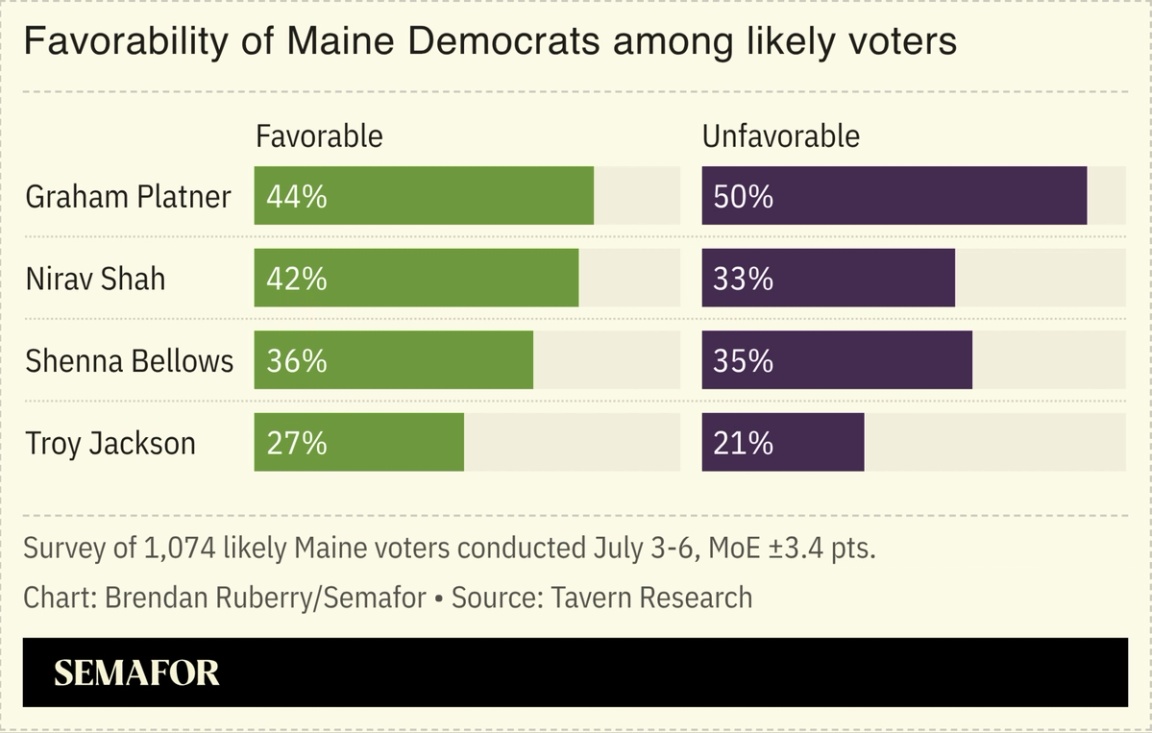 This is a snapshot of what might have been — Mainers’ views of their politicians before Platner’s endorsers fled. A month after the primaries, the three failed gubernatorial candidates had decent favorability ratings. All looked competitive against Collins, whose approval rating was net negative, as it has been all year. Platner, meanwhile, was underwater. These numbers didn’t cause Democrats to start seeking a quick replacement — the former girlfriend alleging Platner assaulted her did that. But polling was already out there showing Platner losing badly among white working-class voters while Hannah Pingree, the new gubernatorial nominee, did far better. Combined with these decent numbers for potential alternative candidates, that created the appearance that Platner was all downside. This poll got Democrats thinking about how an untainted candidate might fare against Collins, and they liked the thought. |
|
 Jovanny Hernandez/Milwaukee Journal Sentinel/USA TODAY NETWORK via Imagn Images/Reuters Connect Jovanny Hernandez/Milwaukee Journal Sentinel/USA TODAY NETWORK via Imagn Images/Reuters ConnectBack in March, a small TikTok account uploaded 911 calls made by Francesca Hong, a Madison, Wis., state legislator who saw a blood-covered Israeli flag near her restaurant. I was tipped off to the calls, but the Milwaukee Journal-Sentinel chased them, finding the most interesting context: How did she go from calling for the “defunding” of police, to making that police report — then right back to siding with Gaza protesters as a candidate for governor? The answer, from Hong, was that she only saw a photo of the flag and now regrets her decision: “The image was cropped and incomplete to misrepresent anti-Zionism as antisemitism.” |
|
 “Bernie for Burlington” is the best new political biography I’ve read this year, and an argument — I say this not to damn my trade — for more poets taking on the work of reporters. Dan Chiasson, who grew up when Sanders was the mayor of Vermont’s largest city, positions him as a historic figure for his state and for the left. The last part’s not really disputable anymore. The first part’s more interesting, and less-told. Vermont’s transformation from a solidly Republican, white, rural state to a solidly Democratic, white, rural state has not repeated itself in many other places. Nor has Sanders in-state strategy of running outside the Democratic Party, thereby getting some votes from Republicans and other people who dislike the party. All of it makes more sense after reading the book, which is stuffed with details about post-war Brooklyn, Vietnam-era Vermont, and the Reagan-era mass media that Sanders has outlived. |
|
|


