
|
A New Way to Think About Women’s Roles
Books on womanhood in the church, the Old Testament, and the pursuit of pleasure.
| |||||||||||||||


 |
The debate over women in ministry has continued to generate headlines this year, with the Southern Baptist Convention moving closer to banning churches that let women preach. But if headlines about complementarians more often focus on what they believe women should not do, one of today’s books—Christ and His Bride by Julia Higgins—takes a different approach. Theologian Andrew Wilson reviews that book—plus a deep dive into Numbers and a classic sermon—in today’s newsletter.
Happy Reading,
Taylor Berglund
Senior Features Editor, Christianity Today
A portion of this newsletter appeared as a column at Christianity Today. Join CT for full access to all our journalism.
This email may contain affiliate links that help support CT at no additional cost to you.

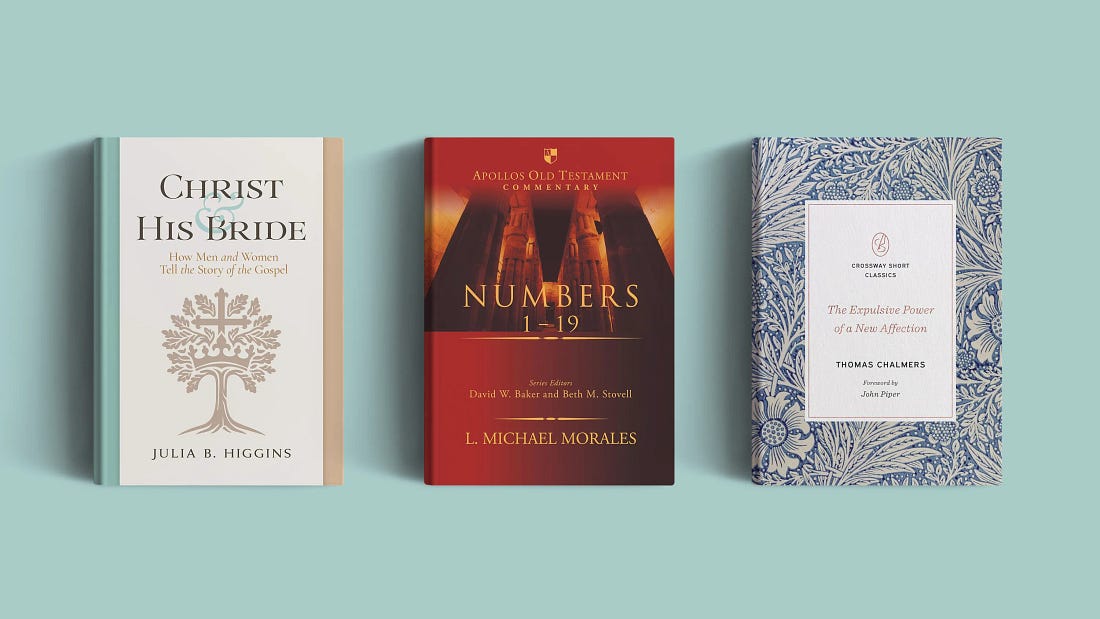 |
Three Books on Theology
Julia Higgins, Christ and His Bride: How Men and Women Tell the Story of the Gospel (B&H Books, 2026)
“In the past thirty years or so, conversations about womanhood in the church have been low-key obsessed with what women shouldn’t be doing,” writes Julia Higgins toward the end of this book. She holds a complementarian view of the relationship between men and women (as do I), which gives this observation a particular punch. “Let’s flip that question. … What should brothers and sisters in Christ be doing together to extend Christ’s self-sacrificial rule for the good of the church and flourishing of society and the world?”
In other words, how can men and women build marriages, train leaders, use our gifts, and collaborate in mission as partners together?
Higgins’s approach to that question centers on the concept of co-regency. Men and women govern the world together as regents, exercising authority on God’s behalf until his kingdom comes in all its fullness, and we govern in ways that echo and reflect the relationship of Christ and his bride, the church. Much of the book develops this theme in the form of a popular-level biblical theology, moving from Creation and Fall (chapters 1–2) to the Law, the Prophets, and the Writings (chapters 3–6), then the ministry of Christ (chapters 7–9) and the church (chapters 10–11), and finally the new creation (chapter 12). It concludes, as we have seen, with some application for today.
At times Higgins’s chatty style (“Are you a beach or mountain person?”) clashes with her use of theological jargon (“regnal formula,” “synchronistic”). In some sections, the main thread of the argument about men and women gets lost for several pages; in others, questions are asked but not quite answered. But Christ and His Bride offers plenty of insights too—some theological, some pastoral, and some practical. Which of these predominates may depend upon the reader.