
|
 |
ICE’s New Permanent Family Separation: Killing Latino Fathers
Another week, another ICE killing, another family torn apart.
|

| ||||||||||||


 |
THE MOST NOTABLE PART of the most recent statement from the Department of Homeland Security’s most recent deadly shooting of an immigrant by ICE was what that statement did not say.
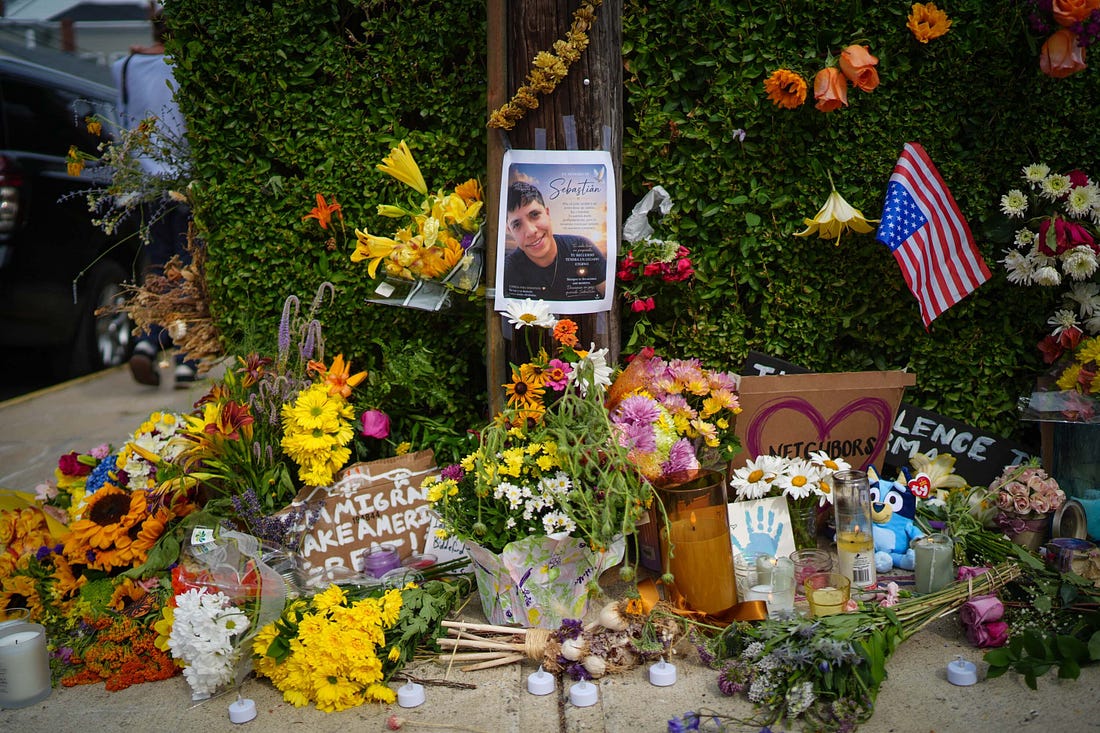
Responding to the death of 26-year-old Johan Sebastián Durán Guerrero on Monday on the streets of Biddeford, Maine, DHS did not deploy its now-standard narrative about ICE agents feeling threatened by an immigrant or protester weaponizing a car. Instead, the anodyne press release mentioned that “ICE law enforcement attempted to conduct a vehicle stop. The vehicle attempted to flee the scene and, fearing for public safety, an officer discharged his weapon.” Not officer safety. Public safety.
So ICE officers believed they would better serve the interest of public safety by shooting Guerrero than by letting him drive away in the coastal Maine city of 22,000 people.
The other details of yet another inglorious chapter in the Trump administration’s ramped-up immigration enforcement had to be gleaned from elsewhere.
As with the deadly shooting of Lorenzo Salgado Araujo last week in Houston, DHS has admitted to Sen. Angus King (I-Maine) that Guerrero was not the target of the operation that led to his death.
As with the shooting of Araujo, ICE agents were not wearing body cameras, despite Congress allocating DHS $20 million in funding for that express purpose. The Atlantic reports that the ICE officer who fired the fatal shots was a new recruit.
And as with the shooting of Araujo, Guerrero was a father. Witnesses report that his 3-year-old daughter was at the scene wearing Bluey pajamas and carrying a pink backpack. They report hearing a woman yelling repeatedly “You took her dad!” while a little girl looked on, being comforted by another child.
“I heard agony,” a witness told the New York Times. “I heard a howl that came from your soul, that your whole life had just changed and it was never going to be the same.”
What the daughter reportedly witnessed was gruesome. Doorbell cameras captured what appeared to be five gunshots. Bystander video shows a white car listlessly turning in circles as agents run alongside it—the driver, Guerrero, so incapacitated by bullets he was unable to bring the car to a stop. A separate video showed agents subsequently removing Guerrero’s dying body from the car and handcuffing him on the ground.
There was no reason to expect it would end like this. He had a Social Security number and was authorized to work in the United States, according to immigration advocacy organization Presente! in Maine. He had posted a picture of his daughter just three days ago, according to CBS News journalist Lilia Luciano. “I love you my beautiful princess,” he wrote in Spanish.¹
IN THE DAYS AND HOURS before Guerrero’s shooting, I spoke to several Hispanic members of Congress about the killing of Araujo and, more generally, about the ways in which the Trump administration has terrorized Latino fathers. It wasn’t just the fear of death that now permeates this community. It’s the sense that legal boundaries no longer apply.
It is possible to do immigration enforcement without resorting to shooting. Whether someone is in the country illegally or not does not give ICE license to murder. And when the end result is a tragic killing, the fallout goes far beyond a solitary individual.
“These are many times the providers for the family. They’re not just taking out the dad; they’re taking out the Latino family, and it’s really struck a nerve,” Rep. Joaquin Castro (D-Texas) told me. “The Latino community especially. We have fathers or grandfathers who worked in the field, worked construction, worked with their hands, weren’t making a lot of money, but fought to give us a better chance than they had.”
In the first Trump administration, opposition to the president’s immigration agenda was galvanized by the horrors of family separation. As Adam Serwer memorably noted back in 2018, “The cruelty is the point.”
Today, the opposition is different, and the stakes seem far higher. It’s not separation that drives the fear; it’s disruption and death. There is deep mourning, but there is also a growing fury at these ICE killings all over Latino social media. It’s become clear that mass deportation comes with this type of violence—and maybe that’s by design.
Under images of Araujo and Guerrero as departed angels, the page Latino and Muslim Unity wrote, “Our fathers deserve to come home to their families. We demand accountability.”
Carlos Espina, a social media influencer with 23 million followers across TikTok, Instagram and Facebook, posted videos at turns angry and heartbroken.
“The Colombian immigrant that was assassinated in a hail of bullets by ICE in Maine was in the car with his three-year-old baby,” Espina said in one. “It shows this agency has no type of respect for human life, much less the lives of our people. They see us as dogs, animals or worse.”
JC Frias, a Mexican-American activist with nearly 250,000 Instagram followers, shared the final words of both men: “Me estan matando” and “I tried to stop.”
“They were fathers. They were providers. They were loved. And they were HUNTED because of the color of their skin,” he wrote. In another post, Frias echoed a sentiment I’ve seen repeated often, including in private messages to me from Latinos and Mexican-Americans who saw their own father in Lorenzo Araujo.
“Lorenzo’s memorial says more than words ever could,” Frias wrote, describing the candles, Mexican flags, soccer jerseys, and families stopping to pray. “One message echoed over and over,” he said. “Lorenzo could have been any of our dads.”
Cynthia Santiago-Borbon, a psychotherapist specializing in trauma recovery and systemic oppression, told me what this killing means for Hispanic Americans—what this inhumanity does to those who are coming to realize our government views them as disposable, inconvenient, and fundamentally un-American.
“What it does is teach a whole community that their grief has no shelf life—you don’t get to finish mourning one father before you’re handed another,” she told me. “That’s not incidental; that’s the message. Devalue, discard, then insist the killing was procedural, and you’re the one being unreasonable. It’s narcissistic abuse at the scale of a state, and the deepest wound isn’t the violence. It’s being told the violence didn’t mean what you know it meant.”
Support our coverage of these important stories
by becoming a Bulwark+ member today: