|
Dear all,
Please find below your weekly update from the UK Health Security Agency (UKHSA).
If you have any questions please get in touch by emailing externalaffairs@ukhsa.gov.uk
As always, you can also follow UKHSA on X, on Instagram, on BlueSky, and on LinkedIn for all the latest updates. You can also find the latest news from UKHSA on our news page on GOV.UK.
Best wishes,
UKHSA External Affairs Team
New stories
- Young people urged to book lifesaving MenB vaccine
- Next phase of Government childhood immunisations campaign launched
- Measles continues to circulate
- New NHS catch-up vaccination push to protect young children against measles
- New toolkit to help partners understand and address immunisation inequities
- Travellers reminded to take precautions to avoid infections abroad this summer
- Staying well during the 2026 festival season
- New study estimates impact of recent heatwaves
- Current heat-health alerts and resources on staying safe in hot weather
- How to cope with the health risks of wildfires
- People experiencing homelessness eligible for pneumococcal vaccination
Ongoing issues
- Secure your place at the UKHSA Conference 2026
- 'Be tick aware' this summer
UKHSA communications toolkits
- Information on how to access UKHSA communications toolkits
UKHSA data, analytics and surveillance
- Statistics at UKHSA
- UKHSA data dashboard
- Notification of Infectious Diseases report
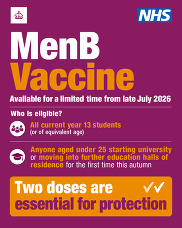
Last month Department of Health and Social Care (DHSC) and devolved nations announced that thousands of young people will get protection against meningococcal B disease (MenB) through a one-off vaccination programme launching ahead of the 2026 academic year.
The one-off vaccination programme will be offered to:
- Everyone in England and Wales born between 01/09/2007 and 31/08/2008 (current school year 13) or equivalent final year of school age (Year 14 or S6) in Scotland and Northern Ireland.
- Everyone turning 25 after 31/12/2026 who will be starting higher education for the first time, or who will be living in further education accommodation or halls of residence for the first time, in autumn 2026. This includes international students and students in the UK Devolved Administrations and Crown Dependencies.
- International students under 25 entering their first year of university should receive their first dose in their home country where possible.
Two doses of the vaccine are needed for protection at least 28 days apart.
17 and 18-year-olds can book via the NHS National Booking Service for appointments at community pharmacies.
Other eligible people can contact a participating pharmacy to book an appointment, which start from next Monday.
International students are encouraged to get their first MenB dose before coming to the UK.
We have recently published a Q&A style blog post to help answer some questions people might have about this vaccination offer.
|
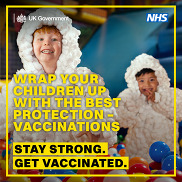
Another phase of Department of Health & Social Care, UKHSA & NHS England's ‘Stay Strong. Get Vaccinated’ childhood immunisations campaign launched on Monday. This phase will run until the end of August.
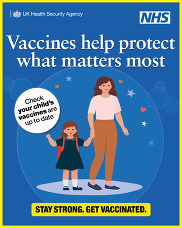
The campaign aims to encourage parents to check that their child has received their routine childhood vaccinations.
|
Our latest measles data shows that measles continues to circulate in many parts of the country.
Between 1 January 2026 and 6 July 2026 there have been 883 laboratory confirmed measles cases reported in England, an increase of 82 cases since the last report on 22 June 2026.
The majority (61%) of these cases were in children aged 10 years and under, and 33% were in young people and adults aged 15 years and over. 52% of these cases have been in London, 17% in the West Midlands, and 10% in the North West. However, all regions have reported at least one confirmed case with symptom onset since January 2026.
This data includes the confirmation that, sadly, to date in 2026, there have been three measles deaths in England (two children and one adult). Our thoughts and condolences are with their loved ones.
We continue to work with partners to urge parents to check their children are up top date with their MMR or MMRV vaccines to give them the best and safest protection against measles.
Further resources
- We have a measles communications toolkit which brings together a range of resources which partners can use to raise awareness of measles, its signs and symptoms, and the MMR/MMRV vaccination offer. This is available on our Google Drive.
- We also have a measles communications toolkit which brings together a range of resources which partners can use to raise awareness of measles, its signs and symptoms, and the MMR/MMRV vaccination offer. This is available on our Google Drive.
|
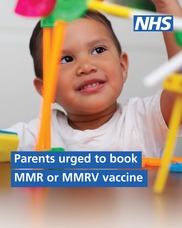
NHS England has launched a 2026/27 national vaccines and immunisations catch-up campaign focussing on on the measles, mumps, rubella (and varicella) (MMR/V) vaccination. The focus is due to recent measles outbreaks and the removal of England’s elimination status earlier this year.
The campaign will run from July 2026 to March 2027. GPs will be required to undertake local call and recall for eligible individuals aged 12 months to less than 6 years who are missing 1 or 2 doses of MMR/V. Families with children aged between 6 and 11 will be invited to book any missed MMR vaccines at their GP surgery by the NHS App, SMS, email or letter.
There is separately a selective catch-up of varicella vaccination that was agreed as part of the MMRV roll out in January 2026. The selective catch-up will be for those eligible individuals who have not yet had a chickenpox infection or 2 doses of varicella vaccination. The catch-up will run from Sunday 1 November 2026 to Friday 31 March 2028.
|
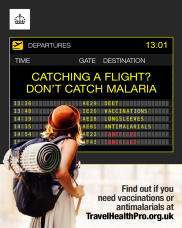
As the summer holiday season begins, UKHSA has published provisional data for England, Wales and Northern Ireland on specific selected travel associated infections including mosquito-borne infections (dengue, Zika, chikungunya and malaria) and enteric fever (typhoid and paratyphoid fever).
We are reminding travellers there are some simple steps you can take whilst away to ensure a fun and healthy trip:
- Prevent mosquito bites using 50% DEET repellent, sleep under treated nets and wear long-sleeved clothing to protect against malaria, dengue, Zika and other infections.
- Food and water safety. Choose piping hot food, follow "boil it, cook it, peel it or leave it," and wash your hands regularly.
- If visiting a malaria-risk area, take medication exactly as prescribed. Avoid buying antimalarials abroad, as they may be fake, substandard or intended for treatment rather than prevention.
- If you feel unwell abroad, seek medical attention immediately. Don't wait until you're back in the UK.
To support your travel health communications, UKHSA has a travel health communications toolkit which contains messaging and assets for both those visiting friends and relatives and those holidaying abroad. You can also encourage your audience to visit the TravelHealthPro website for country-specific health information.
|
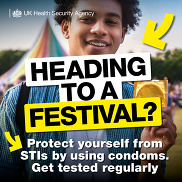
We are working with partners to remind festival-goers of
ongoing health risks so they can enjoy the festival and other events safely and responsibly this summer.
Our Festivals Toolkit 2026 and accompanying assets are now available to download.
This resource pack provides information on staying well during the 2026 festival season. It aims to support stakeholders to explain and promote key health messages for festival goers, including guidance on vaccinations, STIs, hot weather and general hygiene. It contains background information, statistics, key messages, suggested social media copy, social media assets, and links to useful information.
|
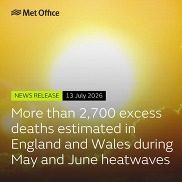
A new study has estimated that more than 2,700 people are thought to have died from heat-related causes during the May and June heatwaves in England and Wales. Of those, it’s estimated that 42% died as a result of the extra heat caused by human-induced warming.
Researchers from Imperial College London, the Met Office and the London School of Hygiene & Tropical Medicine used historical mortality records and established peer-reviewed methods to model fatalities during both heat spikes. As Scotland and Northern Ireland were not impacted by such extreme temperatures, they focused on England and Wales.
Professor Lea Berrang Ford, Head of the UK Health Security Agency (UKHSA) Centre for Climate and Health Security (CCHS), said:
"These modelled estimates are based on past trends in temperature effects on mortality and provide an important indication of the potential health impacts of sustained hot weather, particularly for the most vulnerable among us. While they are not a measure of observed mortality, they help illustrate the scale of risk associated with extreme heat and the growing threat climate change poses to our wellbeing."
|
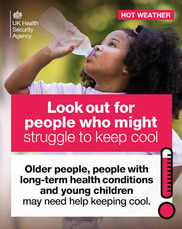
A yellow heat-health alert is in place for seven regions of England: the North West, the South West, the South East, the East Midlands, the West Midlands, the East of England, and London. The alerts will be in place from 9am on Tuesday 14 July until 9pm on Friday 17 July. There is no alert in place for the North East and Yorkshire and the Humber regions.
Individuals and organisations that wish to receive the heat-health alerts must register to receive the alerts where users will be able to specify which regions they wish to receive alerts for. The alert status is also publicly available on the UKHSA Data Dashboard.
To support stakeholders with their communications during periods of hot weather, we have a communications toolkit available. The material in this toolkit is intended to provide basic health information that can be communicated during hot spells so that the right messages reach the right people at the right time.
There are also a series of blog posts which your audiences may find useful:
If you are unable to access the toolkit, please email externalaffairs@ukhsa.gov.uk and we can send across a hard copy. Please do not publish the toolkit anywhere online to prevent old, outdated versions of the toolkit circulating.
|
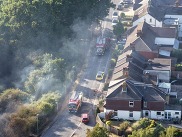
Wildfires are more common in the UK than many people realise, although most are typically small and last a short time. Hot, dry weather can dry out vegetation providing fuel for fires and increase the risk of wildfires. Climate change projections suggest we will see conditions more favourable for larger, more severe wildfires.
Our latest blog post explores why severe wildfires are becoming more frequent in the UKhy severe wildfires are becoming more frequent in the UK and how to cope with the health risks.
|
|