
|
 |
Anthropic's Claude Opus 5 Tops Fable and GPT-5.6 Sol at Half the Cost
Plus: Google expands Gemini, Kimi K3 narrows the frontier gap, Microsoft launches AI for cybersecurity, and more.
|

| |||||||||||||||


Hello Engineering Leaders and AI Enthusiasts!
This newsletter brings you the latest AI updates in just 4 minutes! Dive in for a quick summary of everything important that happened in AI over the last week.
And a huge shoutout to our amazing readers. We appreciate you😊
In today’s edition:
🧠 Anthropic takes on frontier AI with Opus 5
✨ ️Google expands Gemini with three new AI models
⚡ Moonshot AI's Kimi K3 narrows the frontier gap
🛡️ Microsoft unveils a powerful AI cybersecurity model
💡 Knowledge Nugget: Is AI Progress REAL? A SkepticCTO Analysis by SkepticCTO
Let’s go!
Anthropic takes on frontier AI with Opus 5
Anthropic has launched Claude Opus 5 across the Claude app, Claude Code, and its API, positioning it as a model that delivers near-frontier intelligence at half the cost of Fable 5. The model sets new state-of-the-art results in agentic coding, knowledge work, search, and computer use, outperforming both Fable 5 and GPT-5.6 Sol across several benchmarks.
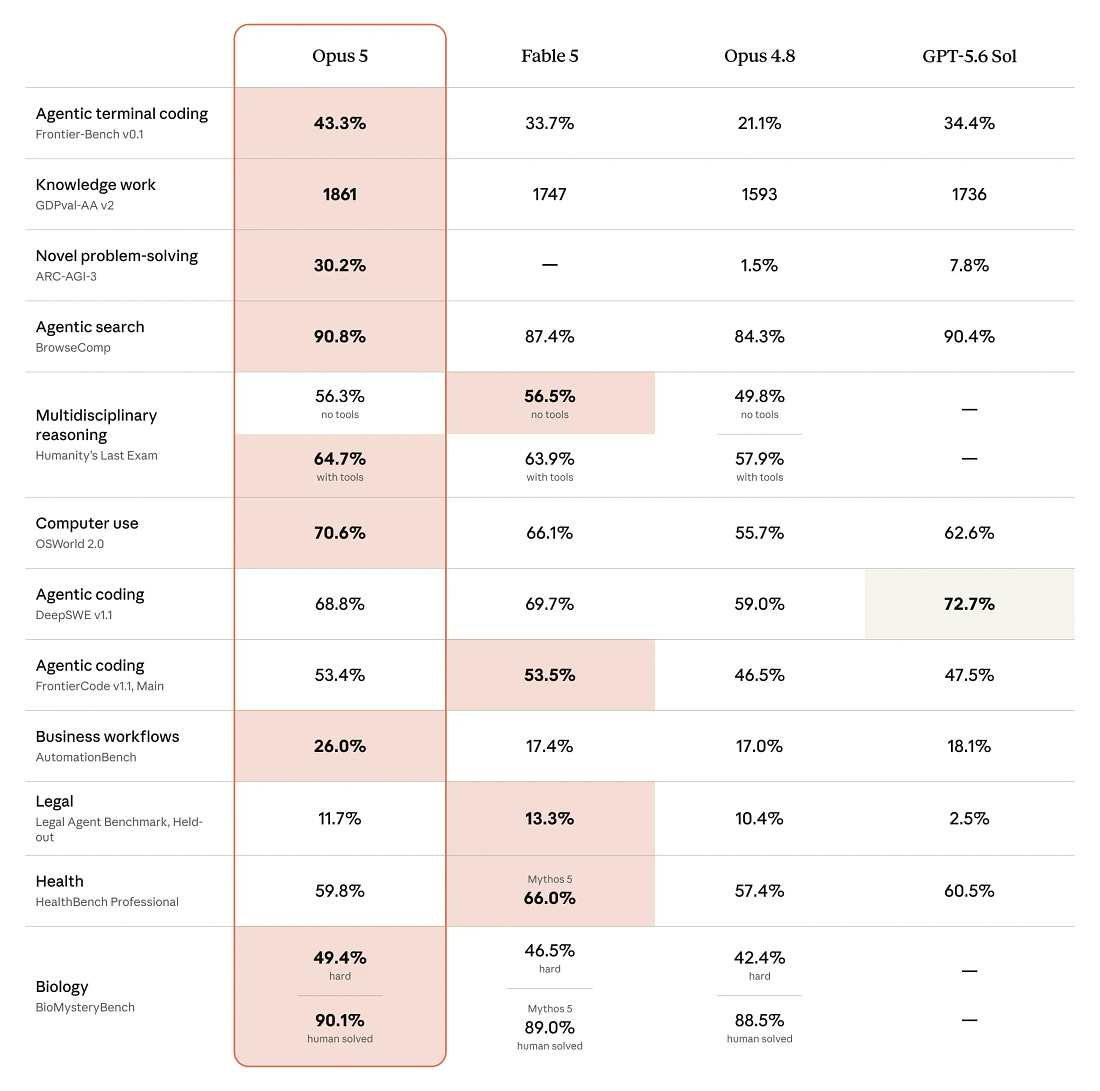 |
Opus 5 also takes the top spot on Artificial Analysis' Intelligence Index and scores 30.2% on ARC-AGI-3, roughly three times higher than the next-best model. Anthropic also highlighted a perfect score on the 2026 International Mathematical Olympiad benchmark and says the model improves AI safety by matching top systems at finding software bugs while remaining less effective at generating exploits.
Why does it matter?
Anthropic is doing what it has consistently done best: bringing frontier-level intelligence to a lower price tier. Just as Sonnet once narrowed the gap with Opus, Opus 5 now delivers near-Fable performance at half the cost, making top-tier AI far more accessible.
Google expands Gemini with three new AI models
Google has introduced three new Gemini models led by Gemini 3.6 Flash, alongside 3.5 Flash-Lite for faster, lower-cost workloads and 3.5 Flash Cyber, a version fine-tuned for security applications. Rather than chasing higher intelligence, the latest releases focus on improving efficiency, latency, and specialized use cases.
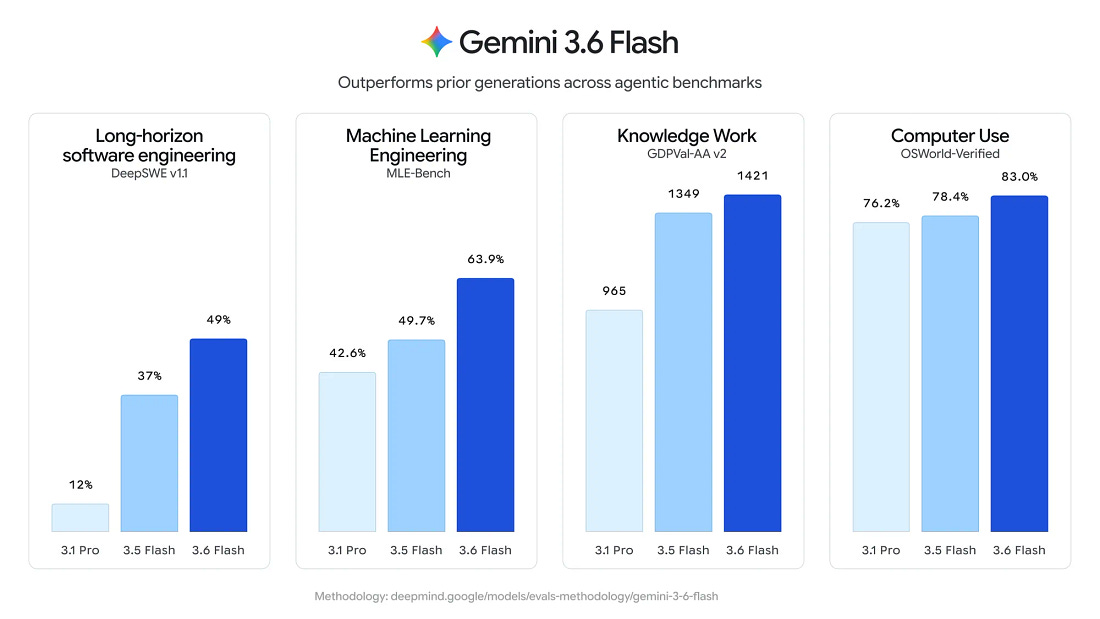 |
Despite those gains, Gemini 3.6 Flash delivers little improvement on Artificial Analysis' Intelligence Index and continues to trail similarly priced rivals like Grok 4.5 and GPT-5.6 Luna on several benchmarks. Google also confirmed that Gemini 3.5 Pro is still in partner testing, while teasing Gemini 4 as its most ambitious pre-training effort yet.
Why does it matter?
Efficiency upgrades are valuable for developers running AI at scale, but they won't change the perception that Google's frontier models are losing momentum. With Gemini 3.5 Pro still delayed and Gemini 4 now in training, the company's next flagship release has far more to prove.
Moonshot AI's Kimi K3 narrows the frontier gap
Chinese AI startup Moonshot AI has unveiled Kimi K3, a new open-weights model that rivals leading proprietary systems like Claude Fable 5 and GPT-5.6 Sol while remaining far more accessible. The model supports a 1 million-token context window and outperforms several frontier models on tasks including web research, spreadsheet analysis, frontend development, and long-form coding.
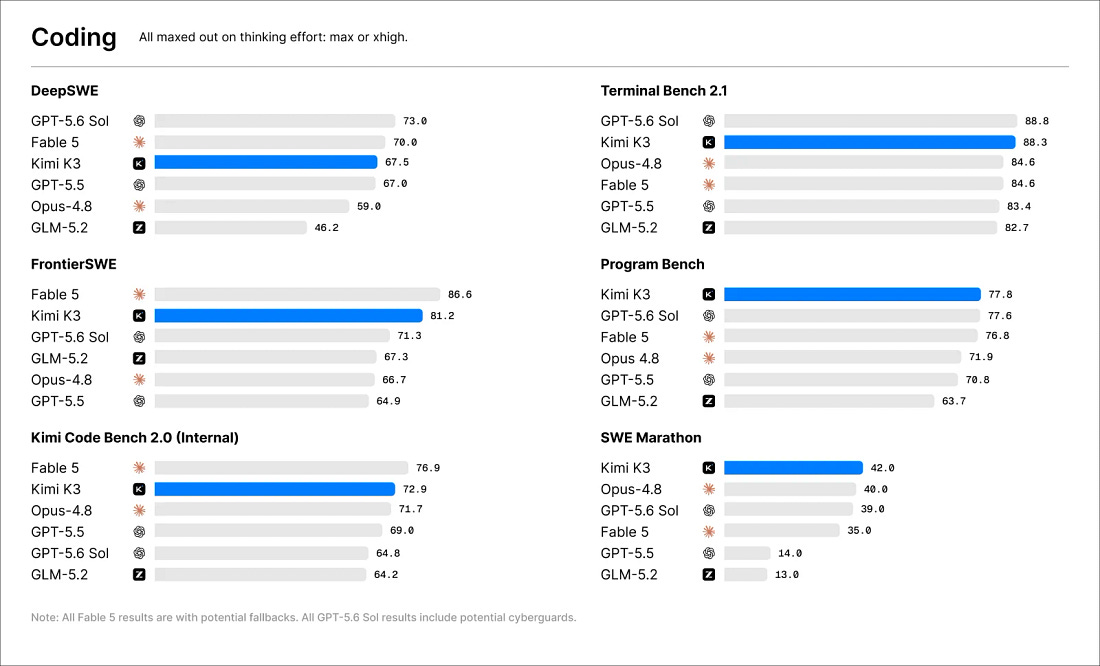 |
K3 also climbed to 57 on Artificial Analysis' Intelligence Index, placing just behind the latest flagship models. In one demonstration, it autonomously spent 48 hours designing and verifying a chip capable of running a smaller version of itself. Despite these gains, Moonshot has priced K3 competitively at $3/$15 per million tokens, matching Claude 5 Sonnet.
Why does it matter?
Is Kimi K3 the next DeepSeek moment for open AI? Closing the gap with frontier models like Claude and GPT is impressive enough but doing it with open weights makes it far more consequential. The line between proprietary and open AI is shrinking faster than many expected.
Microsoft unveils a powerful AI cybersecurity model
Microsoft has unveiled MAI-Cyber-1-Flash, its first AI model built specifically for cybersecurity and integrated directly into its MDASH security agent system. The company says the model delivers frontier-grade protection at half the cost, scoring 96% on the CyberGym benchmark while outperforming Anthropic’s Mythos by 12 percentage points.
Microsoft also introduced Project Perception, where teams of AI agents simulate cyberattacks, investigate threats, and repair vulnerabilities autonomously. According to Microsoft AI CEO Mustafa Suleyman, the biggest challenge for enterprise security is no longer intelligence, but the cost of running AI continuously making efficiency a key design priority.
Why does it matter?
Microsoft's launch signal